
How to Compare Unit Prices at NZ Supermarkets
How NZ unit pricing rules set per 100 g, per kg, per item and per 100 sheets, with Club prices, multi-buys and egg trays compared in NZ dollars, worked through.
By Redbison Dev · · 8 min read
New Zealand edition. Written for New Zealand shoppers: the 2023 unit pricing regulations the Commerce Commission enforces, their units by category, the 40-item rule, rounding, loyalty and multi-buy prices, and the shops left out, in NZ$. US edition
Large New Zealand supermarkets now print a unit price beside the purchase price, because the Consumer Information Standards (Unit Pricing for Grocery Products) Regulations 2023 require it. Compare those unit prices, not the shelf prices, and you will usually find the cheaper option in seconds. The regulations still use different bases for different products, and a few deals and shops fall outside them, so it helps to know the rules and to have the NZ Unit Price Calculator for the cases the label does not settle.
What the regulations require
The regulations apply to a retailer that sells in all ten listed categories: bread, dairy products, eggs or egg products, fruit, vegetables, meat, fish, rice, sugar and manufacturer-packaged food. Online sellers that meet that test are covered; physical stores also need at least 1,000 square metres of floor space. Stores had to comply from 31 August 2024 and online sellers from 31 August 2025. A dairy, a butcher or a specialty store is usually outside them.
The Commerce Commission's guide for retailers sets out the display rules. The unit price is the purchase price including GST per unit of measurement, rounded to the nearest cent with half a cent rounded up, so NZ$0.515 per 100 g shows as NZ$0.52. It must be clear, legible, prominent and close to the purchase price, in a font at least 25% of the size of the purchase price.
The unit of measurement is fixed by product:
| Product | Unit |
|---|---|
| Meat or seafood, fruit or vegetables sold by weight | per kg |
| Herbs, spices, powdered sauces and stocks | per 10 g |
| Flavouring essences and food colouring | per 10 ml |
| Beverages | per litre |
| Nappies | per nappy |
| Toilet paper and paper towels with perforated sheets | per 100 sheets |
| Anything else sold by weight or volume | per 100 g or per 100 ml |
| Sold by number, 40 items or fewer in the price | per item |
| Sold by number, more than 40 items | per 100 items |
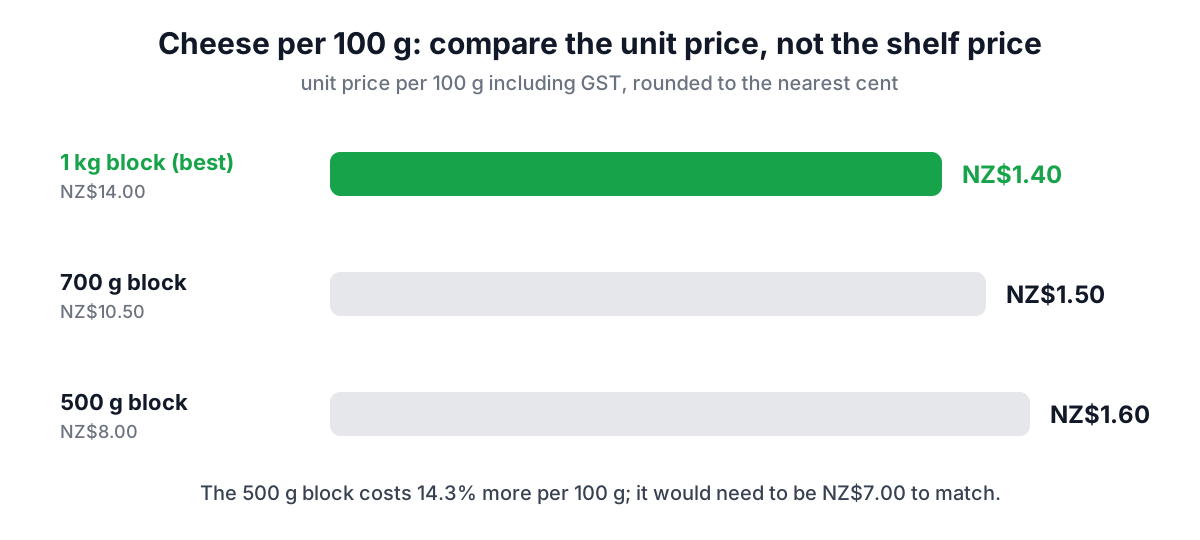
Cheese per 100 g
Cheese is not in any of the special categories, so it is priced per 100 g. Example shelf prices:
| Block | Price | Per 100 g |
|---|---|---|
| 1 kg | NZ$14.00 | NZ$1.40 |
| 700 g | NZ$10.50 | NZ$1.50 |
| 500 g | NZ$8.00 | NZ$1.60 |
The 500 g block costs 14.3% more per 100 g than the 1 kg block and would need to be NZ$7.00 to match. The 700 g block is 7.1% dearer and would need NZ$9.80. Usually the order is like this; when the 500 g block is on special, the unit price on the label tells you at once whether the special beats the big block.
Eggs per egg, tea bags per 100
The 40-item rule changes how count-based products are labelled. A dozen eggs and a tray of 30 are both 40 items or fewer, so both are priced per egg:
| Pack | Price | Per egg |
|---|---|---|
| Tray of 30 | NZ$19.99 | NZ$0.67 |
| Dozen | NZ$9.49 | NZ$0.79 |
The dozen costs 18.7% more per egg. To match the tray it would need to cost NZ$7.99 (the exact break-even is NZ$7.996). The tray only pays off if you will use 30 eggs before their best-before date.
A box of 100 tea bags is over 40 items, so it is priced per 100 items. A 100-bag box at NZ$5.50 is NZ$5.50 per 100; a 60-bag box at NZ$3.80 is NZ$6.33 per 100, 15.2% more. Tea is sold by count here rather than weight, because the regulations use the measure the product is most commonly sold by. In the calculator choose "per item" or "per 100 items" to match the label.
Club prices and multi-buys
Where a product has a loyalty price and a non-loyalty price, the guide says each needs its own unit price, unless the member price is partly in points. For multi-buys, the Commission's view is that a unit price should be shown for both the single price and the multi-buy price, because that is most helpful to shoppers.
A 1.5 L bottle of soft drink at NZ$3.99, or 2 for NZ$7.00:
| Option | Price | Litres | Per litre |
|---|---|---|---|
| 2 for NZ$7.00 | NZ$7.00 | 3.0 | NZ$2.33 |
| Single bottle | NZ$3.99 | 1.5 | NZ$2.66 |
Buying one costs 14% more per litre; the single bottle would need to be NZ$3.50 to match the deal. Enter the multi-buy as one row with 2 in the pack field. Beverages are one of the per-litre categories, so the labels should agree with this table.
Some deals have no unit price by design. Different products sold together for one price ("everything on this shelf NZ$3"), bundles of different items, vending machines and items marked down because they are damaged, discontinued or close to their use-by date are all exempt. The guide notes that a "3 for NZ$5" offer on same-size bottles of different flavours can still be usefully unit priced, and encourages sellers to do so.
A routine in the aisle
- Read the unit price and its basis on each label. Multiply per 100 g by 10 to compare with per kg.
- Check count-based products for the 40-item switch: per item below it, per 100 items above it.
- Compare the Club or member price with the best non-member price, not only with the same product.
- Enter multi-buys as one row.
- In a dairy or a store under 1,000 square metres, work out the unit price yourself.
A qualifying supermarket that leaves out unit prices can receive an infringement notice of up to NZ$1,000 per offence, and serious cases can be prosecuted under the Fair Trading Act, according to the Commission's guide. Report problems through the Commerce Commission. For a related job, the NZ GST invoice generator handles 15% GST on a sale, and the guide to sales tax, VAT and discounts explains how discounts and GST interact. To use up a big pack, see how to scale a recipe.
Frequently asked questions
Which NZ shops have to show unit prices?
Retailers that sell goods in all ten listed grocery categories: online sellers from 31 August 2025, and physical stores of 1,000 square metres or more from 31 August 2024. Dairies, butchers and other shops that do not sell all ten categories are outside the regulations.
Why are eggs priced per egg but tea bags per 100?
Products sold by number are priced per item when the displayed purchase price is for 40 items or fewer, and per 100 items when it is for more than 40. A dozen or a tray of 30 eggs is per egg; a box of 100 tea bags is per 100 items.
Does the unit price include GST?
Yes. The unit price is the purchase price, including GST, per unit of measurement, so it compares directly with the price on the shelf.
Why do two products show the same unit price but cost different amounts?
Unit prices are rounded to the nearest cent, with half a cent rounded up, so two products can share a label figure and still differ by a fraction of a cent. The calculator shows the unrounded figure if the choice is that close.
Sources and further reading
- Consumer Information Standards (Unit Pricing for Grocery Products) Regulations 2023, New Zealand Legislation. The regulations themselves.
- Unit pricing regulations: a guide for grocery retailers (March 2024), Commerce Commission. Qualifying criteria, units by category, the 40-item rule, rounding, the 25% font rule, loyalty and multi-buy prices, exemptions and penalties.
- Information for retailers: unit pricing, Commerce Commission. Compliance dates for stores and online sellers.
- Information for consumers: grocery, Commerce Commission. Where shoppers can raise grocery concerns.
- Unit Pricing Guide: A Best Practice Approach to Unit Pricing, National Institute of Standards and Technology. Why a single basis per category matters.
Open the Unit Price Calculator
More Everyday Calculators
Every tool in the Everyday Calculators section, free and in your browser.
- Age Calculator
- Time Card Calculator
- Time Calculator
- GPA Calculator
- Final Grade Calculator
- Fuel Cost Calculator
- Tire Size Calculator
- Ring Size Converter
- Shoe Size Converter
- Cooking Measurement Converter
- Heat Index Calculator
- Wind Chill Calculator
- Week Number Calculator
- Day of the Week Calculator
- Recipe Scaler
- Unit Price Calculator