
NPF Rule vs 500 Rule for Milky Way Photos in Australia
Shutter speeds that keep stars sharp under southern skies: the core overhead in winter, Carina, Omega Centauri and the Magellanic Clouds, by the NPF and 500 rules.
By Redbison Dev · · 10 min read

Australia edition. Written for Australian skies: the galactic core passing nearly overhead in winter, far-southern targets that allow longer exposures, star trails around an empty south celestial pole, and Warrumbungle, Australia's first Dark Sky Park. US edition
On a winter night in Australia, a 24-megapixel full-frame camera with a 14 mm lens at f/2.8 can hold the galactic core sharp for about 22.7 seconds by the NPF rule. The 500 rule allows 35.7 seconds, which stretches every star into a dash 5.3 pixels long. Turn the same lens towards the Magellanic Clouds and the NPF limit passes 57 seconds, longer than the 500 rule, because stars near the south celestial pole barely move. This edition applies both rules to the targets Australians photograph, with the Australian NPF rule calculator, which starts with declination set to the core's −29°.
Why southern targets allow more time
Stars do not all cross the sensor at the same speed. A star on the celestial equator, where Orion and the zodiac sit, moves fastest; a star at declination δ moves slower by the factor cos δ. The 500 rule ignores that and always assumes the worst case. The NPF rule, from Frédéric Michaud of the Société Astronomique du Havre, is t = (35 × N + 30 × p) ÷ f (N the f-number, p the pixel pitch in µm, f the real focal length), and the calculator divides it by cos δ for the declination you enter.
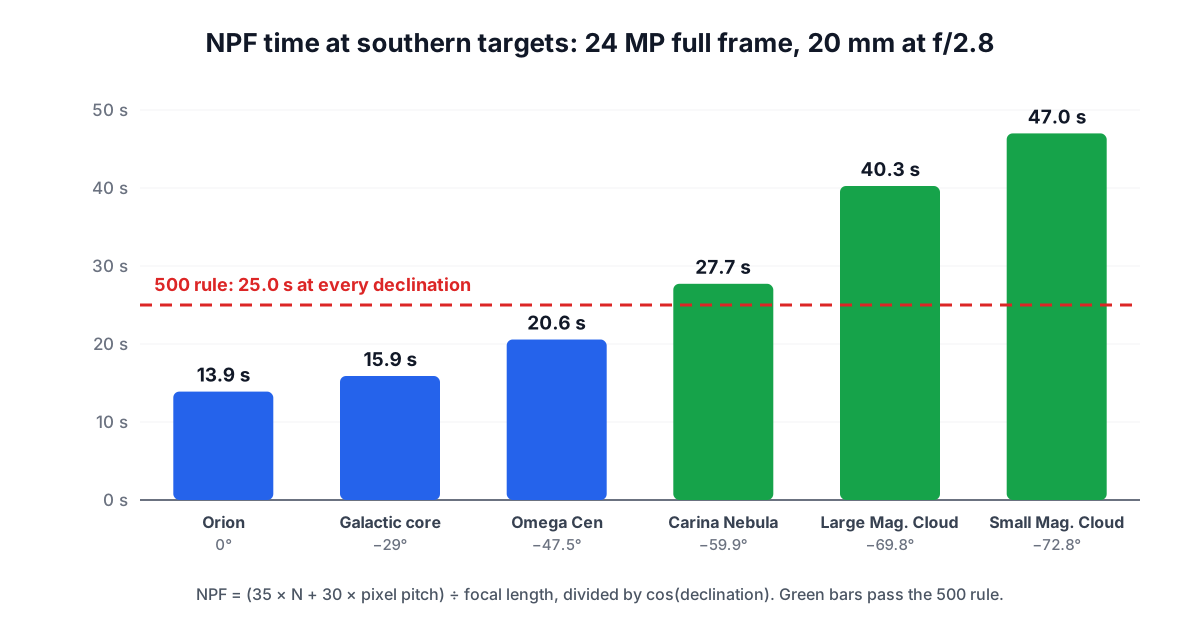
Australian skies are full of targets well south of the equator. The NASA/IPAC Extragalactic Database gives these declinations:
| Target | Declination | NPF, 24 MP | NPF, 45 MP | 500 rule |
|---|---|---|---|---|
| Orion, for comparison | 0° | 13.9 s | 11.5 s | 25 s |
| Galactic centre (Sgr A*) | −29.0° | 15.9 s | 13.1 s | 25 s |
| Omega Centauri (NGC 5139) | −47.5° | 20.6 s | 17.0 s | 25 s |
| Carina Nebula (NGC 3372) | −59.9° | 27.7 s | 22.9 s | 25 s |
| Large Magellanic Cloud | −69.8° | 40.3 s | 33.2 s | 25 s |
| Small Magellanic Cloud | −72.8° | 47.0 s | 38.8 s | 25 s |
Full-frame camera, 20 mm lens at f/2.8.
From about −60° on the 24 MP camera, and from the Magellanic Clouds on the 45 MP one, the NPF limit overtakes the 500 rule. The 500 rule is not "generous" everywhere; aimed at the far south, it is the stricter of the two.
The core overhead
From most of Australia the centre of the Milky Way climbs nearly straight up: it culminates at about 85° altitude from Sydney, 87° from Perth and 76° from Hobart. Its right ascension, 17h 46m (266.4° in NED), puts it opposite the Sun in mid-June, so it is highest around midnight in winter and well up in the evening through July and August. By late spring it sets soon after dark.
That changes the framing as well as the time. With the core overhead, a vertical panorama from the horizon to the zenith runs from northern stars near the equator up to the core and beyond, and the stars nearest the equator trail first. Set the shutter for the lowest declination you want sharp.
Worked examples
Core with a 45 MP camera. Full frame, 45 MP, 14 mm, f/1.8, −29°. Pixel pitch is 4.38 µm and NPF gives 15.9 s. The 500 rule's 35.7 s drags each star 7.3 pixels. The same lens on a 24 MP body at f/2.8 gets 22.7 s.
Carina Nebula with a fast 20 mm. Full frame, 24 MP, 20 mm, f/1.8, −59.9°: NPF 24.2 s, against 12.2 s for the same lens aimed at Orion. On a 45 MP body it falls to 19.4 s.
Large Magellanic Cloud at 24 mm f/1.4. Full frame, 24 MP, −69.8°: NPF 27.6 s, while the 500 rule gives 20.8 s. Near the pole, the 500 rule leaves time on the table.
APS-C kit lens at 11 mm. 24 MP APS-C (3.91 µm pixels, crop factor 1.53), f/2.8, aimed at the core: NPF 22.4 s; the 500 rule's 29.6 s gives a 5.3-pixel trail.
Micro Four Thirds at 12 mm, f/1.4. 20 MP (3.35 µm pixels), core: NPF 14.3 s against 20.8 s by the 500 rule.
Star trails around an empty pole
The NPF rule gives the longest single exposure without trailing. For deliberate star trails you take many frames in a row and stack them. In the south the trails circle an empty patch of sky near Sigma Octantis, because there is no bright pole star; with the Magellanic Clouds and the Southern Cross region rising and setting around it, the composition still has anchors. Each single frame can be long when you face the pole, since stars there move slowly.
Dark sites and the season
Warrumbungle National Park in New South Wales received international recognition as a Dark Sky Park in 2016, and Siding Spring Observatory, beside the park, is included in the Dark Sky Park area. NSW National Parks runs ranger-led Dark Sky Discovery Tours there, and encourages visitors to book early for winter. Plan around a new moon between June and August for the core, and check park alerts and fire danger before driving out.
Inland winter nights are clear and cold, and dew forms fast. A lens heater strip keeps the front element clear through a long sequence. If you stack ten frames at the NPF limit, random noise falls by about √10, roughly 3.2 times, close to what one long exposure would collect without its trails.
For exposure settings, the exposure value and exposure triangle guide explains the ISO and aperture trade, and the field of view and crop factor guide shows how much of the sky each lens covers.
Tools for this job
- Australian NPF rule calculator: NPF, 500 rule and trail length, starting at the core's declination.
- Exposure calculator: how far a sharp-star exposure falls short of a full exposure.
- Field of view calculator: whether the core and a foreground fit one frame.
- Depth of field calculator: a sharp foreground in the same shot.
Frequently asked questions
What shutter speed should I use for the Milky Way in Australia?
For the core with a 24 MP full-frame camera at 14 mm and f/2.8, about 22.7 s keeps stars round. With a 45 MP camera at 14 mm and f/1.8 it is 15.9 s. Higher resolution always shortens the limit.
Does the southern hemisphere allow longer exposures?
Not because of the hemisphere; because of the targets. The core, Omega Centauri, the Carina Nebula and the Magellanic Clouds are far south of the celestial equator, and stars there move across the sensor more slowly, by the factor cos δ.
Is the 500 rule ever too strict?
Yes, near the south celestial pole. At 20 mm on a 24 MP full-frame camera, the NPF limit for the Large Magellanic Cloud is 40.3 s against the 500 rule's 25 s.
When is Milky Way season in Australia?
The core is opposite the Sun in mid-June, so it is highest around midnight in winter and well placed in the evening through July and August. By late spring it sets soon after dark, and around December it is lost near the Sun.
Where is a good dark sky site in Australia?
Warrumbungle National Park in New South Wales was recognised as Australia's first Dark Sky Park in 2016, with Siding Spring Observatory beside it. NSW National Parks runs ranger-led Dark Sky Discovery Tours.
Sources and further reading
- Warrumbungle National Park celebrates 10 years as Australia's first Dark Sky Park, NSW Department of Climate Change, Energy, the Environment and Water. Recognition in 2016, Siding Spring and the Dark Sky Discovery Tours.
- Object lookup: Sgr A*, NASA/IPAC Extragalactic Database. RA 266.42°, declination −29.01°.
- Object lookup: NGC 3372, NASA/IPAC Extragalactic Database. Carina Nebula, declination −59.87°.
- Object lookup: Large Magellanic Cloud, NASA/IPAC Extragalactic Database. Declination −69.76°.
- Object lookup: Small Magellanic Cloud, NASA/IPAC Extragalactic Database. Declination −72.83°.
- Object lookup: NGC 5139, NASA/IPAC Extragalactic Database. Omega Centauri, declination −47.48°.
- La Règle NPF, Société Astronomique du Havre. Frédéric Michaud's NPF rule, in French.
Open the Star Trail Calculator: NPF and 500 Rule
More Photography
Every tool in the Photography section, free and in your browser.