
NPF Rule vs 500 Rule for Night Sky Photos in NZ
Shutter speeds that keep stars sharp under New Zealand skies: the winter galactic core, the Magellanic Clouds and aurora australis frames, by the NPF and 500 rules.
By Redbison Dev · · 10 min read

New Zealand edition. Written for New Zealand skies: the winter galactic core, far-southern targets such as the Magellanic Clouds and the Carina Nebula, south-facing aurora australis frames where the star limit runs long, and night shooting in Aoraki/Mount Cook National Park. US edition
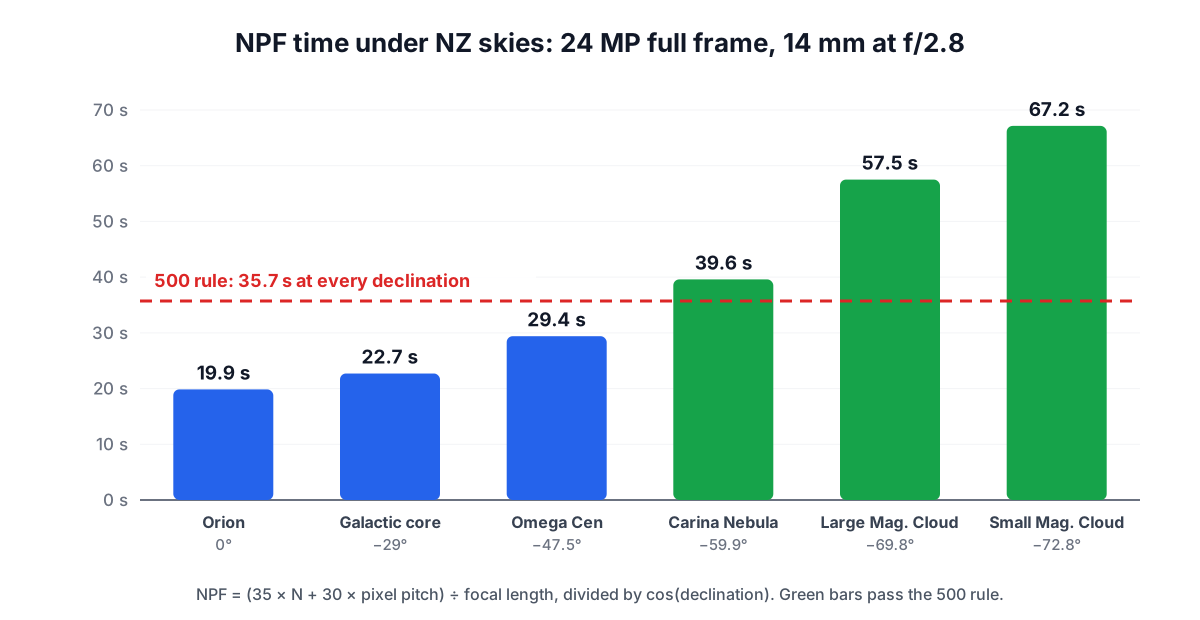
Facing south for an aurora australis with a 24-megapixel full-frame camera, a 14 mm lens at f/2.8 can hold the stars around declination −70° sharp for about 58 seconds, nearly three times the 19.9 seconds it allows on the celestial equator. A frame that includes the southern horizon also holds stars near −45° from the South Island, which allow about 28 seconds, so use that if the horizon stars must stay sharp. Swing round to the galactic core and the same lens gets 22.7 seconds, while the 500 rule would allow 35.7 seconds and stretch each star 5.3 pixels. New Zealand photographers spend most nights pointing at far-southern sky, so the declination term in the NPF rule matters more here than in most places. The NZ NPF rule calculator starts with declination set to the core's −29°.
How declination changes the limit
A star's image crosses the sensor at a speed proportional to cos δ, where δ is its declination. Stars on the celestial equator move fastest; the closer a target is to the south celestial pole, the slower it drifts. The NPF rule, published by Frédéric Michaud of the Société Astronomique du Havre, is t = (35 × N + 30 × p) ÷ f, with N the f-number, p the pixel pitch in µm and f the real focal length. The calculator divides that by cos δ, and the 500 rule (500 ÷ the full-frame equivalent focal length) ignores declination altogether.
With a 14 mm lens at f/2.8 on full frame, at declinations from the NASA/IPAC Extragalactic Database:
| Target | Declination | NPF, 24 MP | Trail at the 500 rule's 35.7 s |
|---|---|---|---|
| Orion, for comparison | 0° | 19.9 s | 6.1 px |
| Galactic centre (Sgr A*) | −29.0° | 22.7 s | 5.3 px |
| Omega Centauri | −47.5° | 29.4 s | 4.1 px |
| Carina Nebula | −59.9° | 39.6 s | 3.0 px |
| Large Magellanic Cloud | −69.8° | 57.5 s | 2.1 px |
| Small Magellanic Cloud | −72.8° | 67.2 s | 1.8 px |
From the Carina Nebula southward the NPF limit is longer than the 500 rule. The usual advice that "the 500 rule is too long" is only true for the northern half of a New Zealand frame.
Worked examples under New Zealand skies
Winter core over the Southern Alps on a 45 MP body. Full frame, 45 MP, 14 mm, f/1.8, −29°. Pixels of 4.38 µm bring NPF down to 15.9 s; the 500 rule's 35.7 s drags each star over 7.3 pixels. Choose 15 s and raise the ISO, or stack.
Aurora australis, facing south. Full frame, 24 MP, 14 mm, f/2.8, stars around −70°: NPF 58.1 s. On a 45 MP body it is 47.9 s. Stars on the southern horizon sit at 90° minus your latitude, near −45° from the South Island, and allow only 28.1 s (23.2 s at 45 MP), so set the shutter for them if the horizon is in the frame and must stay sharp. The aurora is what limits the shutter: active curtains lose structure long before a minute, so a few seconds at a higher ISO is a common choice. The NPF figure is the ceiling for the stars.
Small Magellanic Cloud with a 20 mm f/1.8. Full frame, 24 MP, −72.8°: NPF 41.1 s, while the 500 rule gives 25 s. A long single frame works here, as long as no stars from further north are in the shot.
Carina Nebula with a short telephoto. Full frame, 24 MP, 35 mm, f/1.8, −59.9°: NPF 13.8 s instead of 6.9 s on the equator. The 500 rule's 14.3 s happens to agree.
Micro Four Thirds at 12 mm, f/1.4. 20 MP (3.35 µm pixels), aimed at the core: NPF 14.3 s against 20.8 s by the 500 rule.
One frame, two limits
A wide New Zealand nightscape often spans from the Magellanic Clouds low in the south to the zodiac high in the north. The stars nearest the celestial equator trail first, so set the declination of that edge, not the centre. If the frame takes in both the core (−29°) and the Small Magellanic Cloud (−72.8°), the 14 mm limit is 22.7 s, not 67.2 s. Polaris is never above the horizon in New Zealand; star trails around the south celestial pole curve round an empty patch of sky.
The season and the place
The core's right ascension, 266.4° (17h 46m), puts it opposite the Sun in June, so it is highest around midnight in winter and well up in the evening in July and August. By early summer it sets soon after dark. Plan around a new moon in the winter months.
The Department of Conservation describes Aoraki/Mount Cook National Park as one of the best places in New Zealand to view the night sky: there are no cities or even small towns close by, and the village uses downcast lighting. It also warns that access may be limited in winter, June to September, because of snow, which is exactly the core season, so check highway conditions before you go. The nearest towns with supermarkets and services are Twizel, about an hour away, and Tekapo, about an hour and a half.
Clear winter nights bring frost and dew. A lens heater keeps the front element clear, and spare batteries kept warm last longer. Stacking ten frames at the NPF limit cuts random noise by about √10, roughly 3.2 times, without lengthening the trails.
For exposure settings, the exposure value and exposure triangle guide explains the ISO and aperture trade, and the field of view and crop factor guide shows how much sky a lens covers.
Tools for this job
- NZ NPF rule calculator: NPF, 500 rule and trail length, starting at the core's declination.
- Exposure calculator: how far a sharp-star exposure falls short of a full exposure.
- Field of view calculator: whether the core and the mountains fit one frame.
- Depth of field calculator: a sharp foreground in the same shot.
Frequently asked questions
What shutter speed should I use for the aurora australis?
For the stars, a long one: about 58 s at 14 mm and f/2.8 on a 24 MP full-frame camera for stars around −70°, or about 28 s if the frame includes the southern horizon, where stars sit near −45° from the South Island. For the aurora itself, a few seconds at a higher ISO usually keeps the curtains defined, so treat the NPF figure as an upper limit.
What shutter speed should I use for the Milky Way in NZ?
For the core with a 24 MP full-frame camera at 14 mm and f/2.8, about 22.7 s. With a 45 MP camera at 14 mm and f/1.8, about 15.9 s. Enter your own camera and lens in the calculator.
Why do my stars trail at the 500 rule's time?
Because the 500 rule ignores pixel size. On a 45 MP full-frame camera at 14 mm it allows 35.7 s, which moves stars at the core's declination about 7.3 pixels. The NPF rule keeps the drift to about 3 to 4 pixels.
Do the Magellanic Clouds really allow longer exposures?
Yes. At −70° stars drift about a third as fast as on the equator, so the NPF limit is roughly three times longer: 57.5 s instead of 19.9 s at 14 mm and f/2.8.
When is the best time to photograph the Milky Way in NZ?
The core is highest around midnight in June and well placed in the evening through July and August. Pick a clear night near new moon, and in alpine areas check road access, which snow can limit from June to September.
Sources and further reading
- Aoraki/Mount Cook National Park, Department of Conservation. Night sky viewing, downcast lighting, winter access and nearest towns.
- Object lookup: Sgr A*, NASA/IPAC Extragalactic Database. RA 266.42°, declination −29.01°.
- Object lookup: Large Magellanic Cloud, NASA/IPAC Extragalactic Database. Declination −69.76°.
- Object lookup: Small Magellanic Cloud, NASA/IPAC Extragalactic Database. Declination −72.83°.
- Object lookup: NGC 3372, NASA/IPAC Extragalactic Database. Carina Nebula, declination −59.87°.
- Object lookup: NGC 5139, NASA/IPAC Extragalactic Database. Omega Centauri, declination −47.48°.
- La Règle NPF, Société Astronomique du Havre. Frédéric Michaud's NPF rule, in French.
Open the Star Trail Calculator: NPF and 500 Rule
More Photography
Every tool in the Photography section, free and in your browser.