
NPF Rule vs 500 Rule for Night Photography in Canada
Shutter speeds that keep stars sharp in Canada: northern lights frames, the Cygnus Milky Way, Andromeda and the low galactic core, by the NPF and 500 rules.
By Redbison Dev · · 10 min read

Canada edition. Written for Canadian skies: aurora frames facing north, the Cygnus Milky Way and Andromeda high overhead, a galactic core that barely clears the southern horizon (and never rises in the far North), cold-weather shooting and Jasper's dark-sky preserve. US edition
For an aurora shot in northern Canada with a 24-megapixel full-frame camera, a 14 mm lens at f/2.8 can hold the stars near +60° declination sharp for about 39.7 seconds, twice the 19.9 seconds it allows on the celestial equator. Turn south to the galactic core and a 20 mm lens at f/2.8 gets 15.9 seconds; the old 500 rule would give 25 seconds and smear each star over more than 5 pixels. This edition applies the two rules to the Canadian night sky, from southern Ontario to the territories, with the Canadian NPF rule calculator.
What latitude does to a Canadian sky
Canada runs from about 42° north at Point Pelee to beyond 60° in the territories, and that range changes what you can shoot:
- The galactic core (declination −29°) culminates about 17° above the horizon from Toronto, 12° from Vancouver, 10° from Calgary and 8° from Jasper. North of about 61°, which takes in Yellowknife, it never rises at all.
- The Cygnus Milky Way and Andromeda pass high overhead everywhere in the country. The NASA/IPAC Extragalactic Database gives the North America Nebula (NGC 7000), beside Deneb, a declination of +44.5° and the Andromeda Galaxy (M31) +41.3°.
- Summer darkness. Astronomical darkness needs the Sun 18° below the horizon. At the June solstice the Sun's lowest point is 90° − latitude − 23.4° below, so southern Ontario still gets dark (about 23° at Toronto), but Vancouver, Calgary and Edmonton, all north of about 48.6°, do not around midsummer.
For the shutter, declination is what counts. A star's image crosses the sensor at a speed proportional to cos δ, so the high-declination stars of an aurora frame or of Cassiopeia drift slowly, and the NPF limit stretches.
NPF and 500 rule at Canadian targets
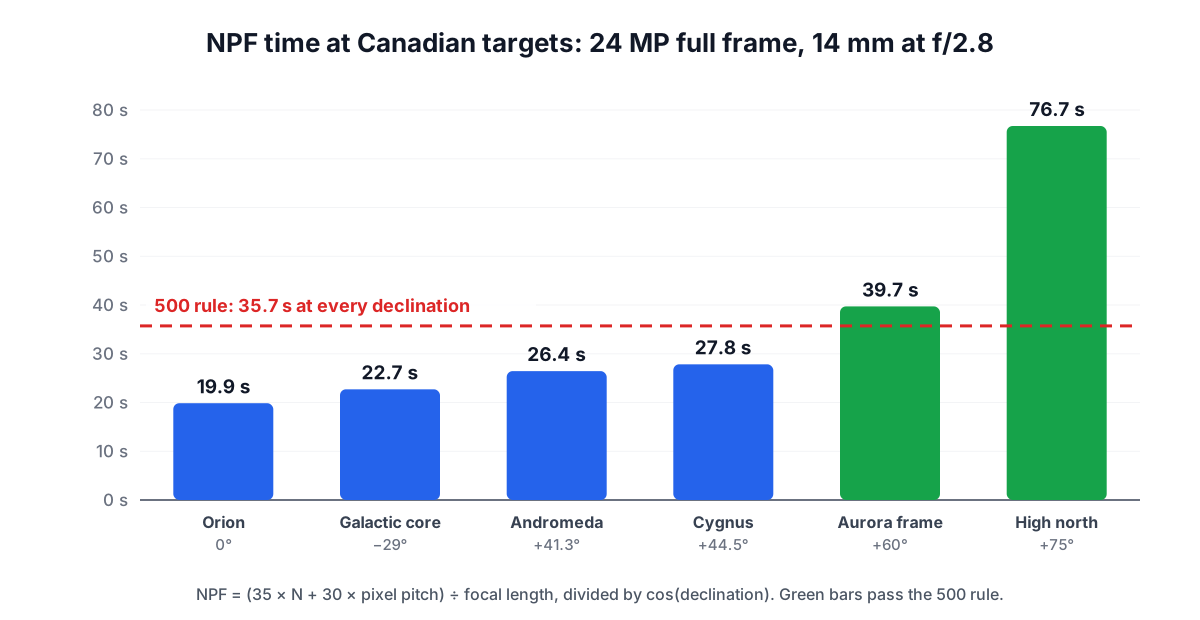
The NPF rule, from Frédéric Michaud of the Société Astronomique du Havre, is t = (35 × N + 30 × p) ÷ f, with N the f-number, p the pixel pitch in micrometres and f the real focal length; the calculator then divides by cos δ. On a 24 MP full-frame camera at f/2.8:
| Target (declination) | NPF at 14 mm | NPF at 20 mm | 500 rule at 14 / 20 mm |
|---|---|---|---|
| Orion, celestial equator (0°) | 19.9 s | 13.9 s | 35.7 / 25 s |
| Galactic core (−29°) | 22.7 s | 15.9 s | 35.7 / 25 s |
| Andromeda, M31 (+41.3°) | 26.4 s | 18.5 s | 35.7 / 25 s |
| Cygnus, NGC 7000 (+44.5°) | 27.8 s | 19.5 s | 35.7 / 25 s |
| Aurora frame, stars near +60° | 39.7 s | 27.8 s | 35.7 / 25 s |
| High northern sky (+75°) | 76.7 s | 53.7 s | 35.7 / 25 s |
Facing north the NPF limit passes the 500 rule; facing south or along the equator it is far shorter. That is the opposite of the usual "500 rule is too generous" message, and it is why Canadian night photographers need the declination term.
Worked examples for Canadian nights
Northern lights over a lake, 14 mm at f/1.8. Aim at stars around +70° on a 24 MP full-frame body and NPF allows 50.7 s. The aurora will blur long before that; bright, fast-moving curtains usually need a few seconds with a higher ISO. Use the NPF figure as the ceiling for the stars.
Aurora on a 45 MP camera. At 20 mm and f/1.8 facing +60°, pixels of 4.38 µm cut the limit to 19.4 s. At 14 mm and f/2.8 it is 32.8 s, against 39.7 s on a 24 MP body with the same lens.
Galactic core over a southern Ontario lake. 33 MP full frame, 20 mm, f/1.8, declination −29°: NPF 12.4 s, 500 rule 25 s. At 25 s each star crosses about 6.2 pixels of 5.1 µm.
Andromeda in fall with an APS-C kit. 24 MP APS-C (3.91 µm pixels, crop factor 1.53), 18 mm, f/2.8, declination +41.3°: NPF 15.9 s, 500 rule 18.1 s, which drags stars over 4.6 pixels.
Cygnus at Jasper with a fast 24 mm. 24 MP full frame, 24 mm, f/1.4, +44.5°: NPF 13.4 s; the 500 rule's 20.8 s gives a 4.3-pixel trail.
Jasper and the dark-sky preserves
The Royal Astronomical Society of Canada designates dark-sky preserves with park agencies. Parks Canada says Jasper National Park was designated on March 26, 2011, covers over 11,000 km² and is the second-largest dark-sky preserve in the world. It suggests Pyramid Island, Jasper Lake, Old Fort Point and the toe of the Athabasca Glacier, on clear new-moon nights, especially in fall and winter, and the park celebrates Dark-Sky Month each October, when Tourism Jasper runs the Jasper Dark-Sky Festival. Fall suits Canadian night photography generally: nights in the West and North are dark again, Cygnus and Andromeda are high, and the aurora season has begun.
Shooting in the cold
- Batteries. At −25 °C they drain fast. Keep spares inside your jacket and swap them rather than charging in the cold.
- Frost and dew. A lens heater and a hood slow both down; check the front element between frames.
- Focus. Lenses can shift focus as they cool. Refocus on a bright star with magnified live view after the first half hour.
- Stacking. Ten frames at the NPF limit, aligned and averaged, cut random noise by about √10, roughly 3.2 times, without longer trails.
The exposure value and exposure triangle guide explains how ISO and aperture make up for a short shutter, and the field of view and crop factor guide shows how much sky each lens covers.
Tools for this job
- Canadian NPF rule calculator: NPF, 500 rule and trail length with declination set for the Cygnus region.
- Exposure calculator: how far a sharp-star exposure falls short of a full exposure.
- Field of view calculator: how much of an aurora display or the Milky Way fits the frame.
- Depth of field calculator: a sharp foreground in the same shot.
Frequently asked questions
What shutter speed should I use for the northern lights?
For the stars, the limit is long when you face north: about 40 s at 14 mm and f/2.8 on a 24 MP full-frame camera for stars at +60°. For the aurora itself, a few seconds with a higher ISO usually keeps the curtains defined. Use the NPF figure as an upper limit.
Can I see the Milky Way core from Canada?
From the south of the country, low in the south in summer: about 17° up from Toronto and 10° from Calgary at its highest. North of about 61° it never rises. The Cygnus Milky Way, high overhead from late summer into fall, is the easier target almost everywhere.
Is the 500 rule good enough for night photography in Canada?
Facing south or along the celestial equator it is too long for sharp stars on modern cameras, letting stars drift 5 to 8 pixels. Facing north it can be shorter than NPF, so compare both for the direction you are shooting.
Why does the sky not get fully dark in June in Edmonton or Vancouver?
At the June solstice the Sun's lowest point is 90° − latitude − 23.4° below the horizon, which is less than the 18° needed for astronomical darkness anywhere north of about 48.6°. Vancouver, Calgary and Edmonton are north of that; Toronto is not.
Where can I photograph a dark sky in Canada?
Jasper National Park is a dark-sky preserve designated by the Royal Astronomical Society of Canada in 2011. Parks Canada suggests Pyramid Island, Jasper Lake, Old Fort Point and the toe of the Athabasca Glacier on new-moon nights in fall and winter.
Sources and further reading
- Jasper National Park's Dark-Sky Preserve, Parks Canada. Designation date, size, viewing spots, seasons, Dark-Sky Month in October and Tourism Jasper's festival.
- Object lookup: NGC 7000, NASA/IPAC Extragalactic Database. Declination +44.53°.
- Object lookup: M31, NASA/IPAC Extragalactic Database. Declination +41.27°.
- Object lookup: Sgr A*, NASA/IPAC Extragalactic Database. The galactic centre at −29.01°.
- La Règle NPF, Société Astronomique du Havre. Frédéric Michaud's NPF rule, in French.
- Computing Approximate Sidereal Time, US Naval Observatory. The sidereal day behind the sky's rotation rate.
Open the Star Trail Calculator: NPF and 500 Rule
More Photography
Every tool in the Photography section, free and in your browser.