
NPF Rule vs 500 Rule for Karoo Night Sky Photos
Shutter speeds that keep stars sharp under South African skies: the winter core, Omega Centauri and the Magellanic Clouds, by the NPF and 500 rules.
By Redbison Dev · · 10 min read

South Africa edition. Written for South African skies: the galactic core high on winter evenings, Omega Centauri and the Magellanic Clouds that most of the north never sees, longer lenses on southern targets, and stargazing at SAAO's Sutherland site in the Karoo. US edition
With a 24-megapixel full-frame camera and a 50 mm lens at f/1.8, Omega Centauri can be held sharp for about 7.2 seconds by the NPF rule, half again as long as the 4.9 seconds the same lens allows on the celestial equator. The old 500 rule gives 10 seconds and a trail of 4.1 pixels. South African skies put the richest part of the Milky Way and targets such as Omega Centauri and the Magellanic Clouds high overhead, and those far-southern positions change the shutter limit as much as the lens does. This edition works through both rules for South African targets with the South African NPF rule calculator.
Southern sky, slower stars
Every star circles the celestial pole once per sidereal day, but stars near the pole travel a smaller circle. Their image on the sensor moves at a speed proportional to cos δ, so a target at declination −60° drifts at half the speed of one on the equator. The NPF rule from Frédéric Michaud of the Société Astronomique du Havre, t = (35 × N + 30 × p) ÷ f, gives the limit on the equator from the f-number N, pixel pitch p in µm and real focal length f; the calculator divides it by cos δ. The 500 rule does neither.
Omega Centauri, at −47.5° in the NASA/IPAC Extragalactic Database, never rises north of about 42° N, and the Large Magellanic Cloud stays below the horizon for most of Europe and North America. From South Africa both are evening targets.
The two rules at South African targets
A full-frame 24 MP camera with two lenses, a fast 24 mm for wide fields and a 50 mm for single objects:
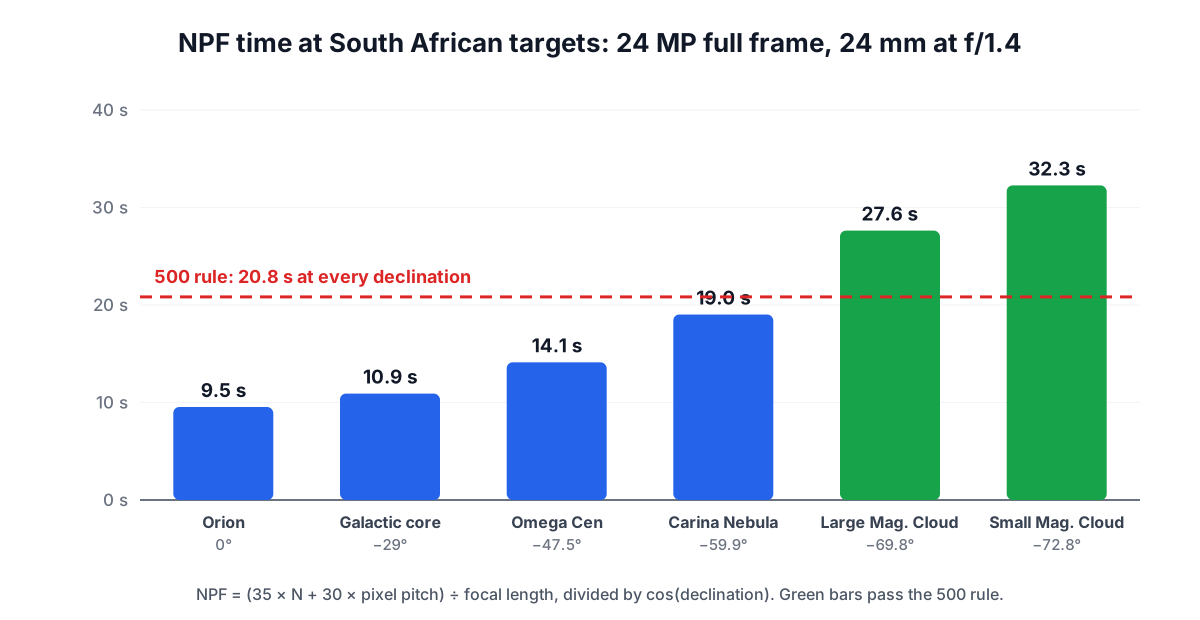
| Target | Declination | NPF, 24 mm f/1.4 | NPF, 50 mm f/1.8 | 500 rule, 24 / 50 mm |
|---|---|---|---|---|
| Orion, for comparison | 0° | 9.5 s | 4.9 s | 20.8 / 10 s |
| Galactic centre | −29.0° | 10.9 s | 5.6 s | 20.8 / 10 s |
| Omega Centauri | −47.5° | 14.1 s | 7.2 s | 20.8 / 10 s |
| Carina Nebula | −59.9° | 19.0 s | 9.7 s | 20.8 / 10 s |
| Large Magellanic Cloud | −69.8° | 27.6 s | 14.1 s | 20.8 / 10 s |
| Small Magellanic Cloud | −72.8° | 32.3 s | 16.4 s | 20.8 / 10 s |
At the Magellanic Clouds the NPF rule allows longer than the 500 rule with both lenses; on the core and Omega Centauri it allows far less. Longer lenses lose time fast: at 85 mm and f/1.8 the Omega Centauri limit is 4.2 s, and at 135 mm and f/2 it is 2.7 s, which is where a tracking mount starts to earn its place.
Worked examples
The core with an APS-C kit. 24 MP APS-C (3.91 µm pixels, crop factor 1.53), 11 mm, f/2.8, −29°: NPF 22.4 s. The 500 rule gives 29.6 s and a 5.3-pixel trail; 20 s keeps stars round with a margin.
The core and the Large Magellanic Cloud with one camera. Full frame, 24 MP, 20 mm, f/1.8: the core gets 13.9 s, the Large Magellanic Cloud 35.2 s, and the 500 rule 25 s for both. Stars at −69.8° drift at 0.504 µm/s, against 1.276 µm/s at −29°. If both are in one frame, the core's edge trails first, so use the core's figure.
Omega Centauri at 20 mm, for a wide field. Full frame, 24 MP, f/1.8, −47.5°: NPF 18.0 s, about 2.5 times the 50 mm limit. Wide, the cluster is a fuzzy star; at 50 mm it is a ball of stars, but only for 7.2 s at a time.
High resolution on the core. Full frame, 45 MP (4.38 µm pixels), 14 mm, f/2.8: NPF 18.7 s; at the 500 rule's 35.7 s each star crosses 7.3 pixels.
Sutherland and the Karoo
The South African Astronomical Observatory runs its main telescopes on a hilltop 1 800 metres above sea level near Sutherland. SAAO says the site was chosen for its year-round clear skies, semi-arid setting and absence of light and other pollution. It offers booked day tours, stargazing evenings and school tours, and says it cannot accommodate visitors who have not booked online, so book before you drive out. SAAO's own description of the Karoo is a fair warning for a night shoot: heat mirages in summer, and winter nights when temperatures plummet and the ground crunches underfoot. Dress for hours outside, and use a lens heater against dew and frost.
The season
The core's right ascension, 266.4° (17h 46m), puts it opposite the Sun in June. It is highest around midnight in mid-winter and well placed in the evening through July and August; by early summer it sets soon after dark, and towards the end of the year it is lost in the Sun's glare. Plan around a winter new moon. Omega Centauri and the Magellanic Clouds are visible in different parts of the year, so check what is up on your night before choosing the lens.
Stacking makes up for short exposures: ten frames at the NPF limit, aligned and averaged, cut random noise by about √10, roughly 3.2 times. The exposure value and exposure triangle guide explains the ISO and aperture trade, and the field of view and crop factor guide shows how much sky each lens takes in.
Tools for this job
- South African NPF rule calculator: NPF, 500 rule and trail length, starting at the core's declination.
- Exposure calculator: how far a sharp-star exposure falls short of a full exposure.
- Field of view calculator: how big Omega Centauri or the core will be in the frame.
- Depth of field calculator: a sharp foreground of koppies or a windmill in the same shot.
Frequently asked questions
How long can I expose Omega Centauri?
With a 24 MP full-frame camera and a 50 mm lens at f/1.8, about 7.2 s. At 20 mm it is about 18 s, and at 135 mm and f/2 only about 2.7 s, which is why telephoto shots of the cluster usually need a tracking mount.
What shutter speed should I use for the Milky Way in South Africa?
For the core with a 24 MP full-frame camera at 20 mm and f/1.8, about 13.9 s. With a 24 MP APS-C camera at 11 mm and f/2.8, about 22.4 s. Higher-resolution sensors get less.
Is the 500 rule ever shorter than the NPF rule?
Yes, near the south celestial pole. For the Large Magellanic Cloud with a 24 mm lens at f/1.4, NPF allows 27.6 s against the 500 rule's 20.8 s.
Can I visit the telescopes at Sutherland?
Yes, on a booked tour. SAAO offers day tours, stargazing evenings and school tours, and visitors must book online in advance.
When is Milky Way season in South Africa?
The core is highest around midnight in June and well placed in the evening in July and August. Winter new moons give the darkest frames, and the Karoo is cold on those nights.
Sources and further reading
- Visit Sutherland, South African Astronomical Observatory. The 1 800 m site, why it was chosen, booked tours and the Karoo climate.
- Object lookup: NGC 5139, NASA/IPAC Extragalactic Database. Omega Centauri, declination −47.48°.
- Object lookup: Sgr A*, NASA/IPAC Extragalactic Database. RA 266.42°, declination −29.01°.
- Object lookup: Large Magellanic Cloud, NASA/IPAC Extragalactic Database. Declination −69.76°.
- Object lookup: Small Magellanic Cloud, NASA/IPAC Extragalactic Database. Declination −72.83°.
- Object lookup: NGC 3372, NASA/IPAC Extragalactic Database. Carina Nebula, declination −59.87°.
- La Règle NPF, Société Astronomique du Havre. Frédéric Michaud's NPF rule, in French.
Open the Star Trail Calculator: NPF and 500 Rule
More Photography
Every tool in the Photography section, free and in your browser.