
NPF Rule vs 500 Rule for Milky Way Photos in the UK
Shutter speeds that keep stars sharp from UK latitudes: the Cygnus Milky Way overhead, the low galactic core, Andromeda and aurora frames, by the NPF and 500 rules.
By Redbison Dev · · 10 min read

United Kingdom edition. Written for UK skies: the Cygnus Milky Way and Andromeda that ride high here, the galactic core skimming the southern horizon, short midsummer nights, north-facing aurora frames, and the UK's dark sky reserves. US edition
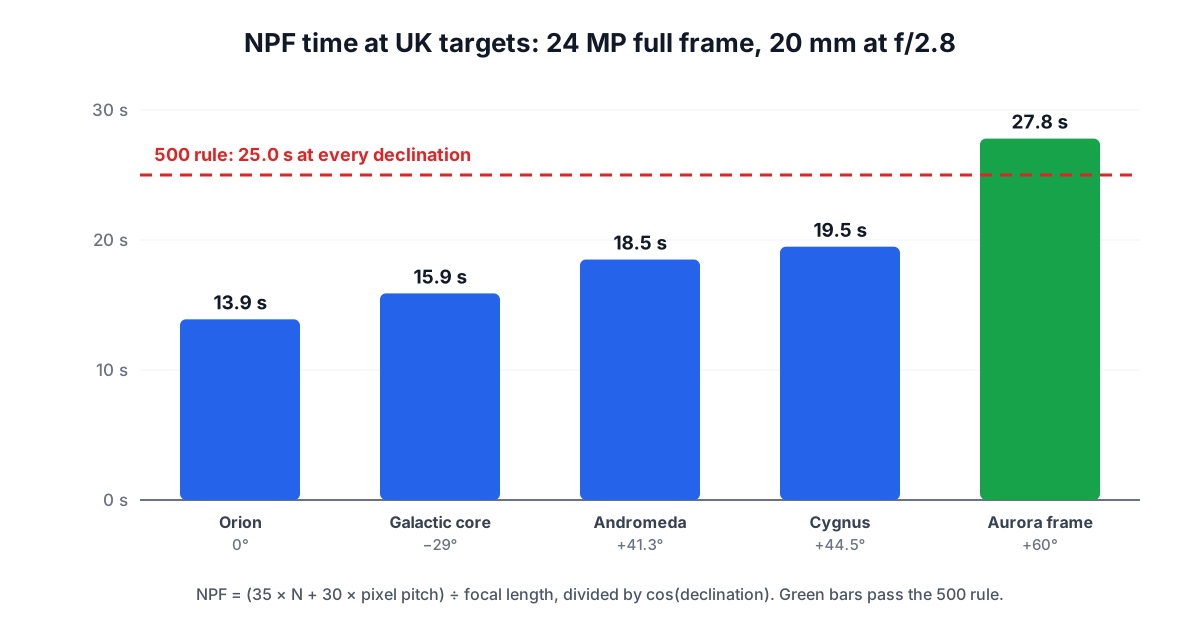
From a UK dark site with a 24-megapixel full-frame camera, a 20 mm lens at f/2.8 can stay open for about 19.5 seconds on the Cygnus Milky Way before stars start to trail, against 13.9 seconds for a target on the celestial equator such as Orion. The old 500 rule would allow 25 seconds, which on that sensor drags each star over 4.3 pixels near Cygnus and 6.1 pixels on the equator. This edition applies both rules to what British photographers actually point at: the summer and autumn Milky Way overhead, the galactic core low in the south, Andromeda, and the aurora to the north. The UK NPF rule calculator does the arithmetic with declination already set for the Cygnus region.
The UK sky is a northern sky
Most Milky Way rules of thumb are written with the bright galactic core in mind. From Britain that core, at declination −29°, is a poor target: it culminates about 9.5° above the horizon from London, 5° from Edinburgh and barely 1° from Shetland, so it sits in haze and in the light dome of the southern horizon. What rides high instead is the Cygnus stretch of the Milky Way, with Deneb passing within a few degrees of the zenith from southern England, and in autumn the Andromeda Galaxy.
Declination matters for the shutter, not just for framing. A star's image drifts across the sensor at a speed proportional to cos δ, so stars far from the celestial equator move more slowly and allow a longer exposure. The NASA/IPAC Extragalactic Database puts the North America Nebula (NGC 7000), beside Deneb, at +44.5° and the Andromeda Galaxy (M31) at +41.3°, so a frame centred there gains a third to two-fifths more time than one on Orion.
NPF and 500 rule at UK targets
The NPF rule (t = (35 × N + 30 × p) ÷ f, from Frédéric Michaud of the Société Astronomique du Havre) uses the aperture N, the pixel pitch p in micrometres and the real focal length f. The calculator divides it by cos δ for the declination you enter. For a 20 mm lens at f/2.8:
| Target (declination) | NPF, 24 MP full frame | NPF, 45 MP full frame | 500 rule |
|---|---|---|---|
| Orion, celestial equator (0°) | 13.9 s | 11.5 s | 25 s |
| Galactic core, low in the south (−29°) | 15.9 s | 13.1 s | 25 s |
| Andromeda, M31 (+41.3°) | 18.5 s | 15.3 s | 25 s |
| Cygnus, NGC 7000 (+44.5°) | 19.5 s | 16.1 s | 25 s |
| Northern sky for aurora frames (+60°) | 27.8 s | 22.9 s | 25 s |
The 500 rule gives every row the same 25 seconds because it knows nothing about pixels or declination. On a 45 MP body at the equator that 25 seconds means a trail of 8.3 pixels, which is plainly visible at 100%. Only facing north does it become reasonable, and even there NPF is the better guide.
Worked examples for British nights
Cygnus overhead from a dark sky reserve. 24 MP full frame, 20 mm, f/2.8, declination +44.5°. Pixel pitch is 6.00 µm and stars drift at 1.04 µm per second. NPF gives 19.5 s, which keeps the trail to 3.4 pixels; the 500 rule's 25 s gives 4.3 pixels. If the frame runs down to the southern horizon, stars at that edge are nearer the equator and trail first, so use about 14 s if you want them sharp too.
The same scene on a 61 MP camera. Pixels shrink to 3.76 µm and NPF falls to 14.8 s. At the 500 rule's 25 s the trail is 6.9 pixels. High-resolution bodies are where the 500 rule fails most clearly.
APS-C with a 16 mm lens at f/2. A 26 MP APS-C sensor (3.75 µm pixels, crop factor 1.53) aimed at Cygnus gets 16.0 s by NPF. The 500 rule, which uses the full-frame equivalent focal length, gives 20.4 s and a 4.5-pixel trail.
Micro Four Thirds, 12 mm at f/1.4. A 20 MP sensor with 3.35 µm pixels gets 17.5 s on Cygnus by NPF, against 20.8 s by the 500 rule with its crop factor of 2.
The core over the sea from the south coast. With the core only about 10° up, photographers often use a longer lens to make it bigger against the horizon. At 35 mm and f/1.8 on 24 MP the limit is 7.9 s; the 500 rule's 14.3 s smears stars over 5.3 pixels. At 24 mm and f/1.8 NPF gives 11.6 s. Short frames stacked later recover the noise.
Short nights and the season
Astronomical darkness needs the Sun at least 18° below the horizon. At the June solstice the Sun's lowest point is 90° − latitude − 23.4° below the horizon, which never reaches 18° north of about 48.6°, and all of the UK is north of that. So there is no true darkness anywhere in Britain for several weeks either side of midsummer, and the shortest nights are also the core's best nights. That is why most UK Milky Way work happens from August to October, when Cygnus is high after dark and the nights are dark again, with Andromeda and the winter Milky Way taking over later in autumn.
National Parks UK lists six International Dark Sky Reserves in national parks: Exmoor, the Brecon Beacons (Bannau Brycheiniog), Moore's Reserve in the South Downs, Snowdonia (Eryri), the North York Moors and the Yorkshire Dales, plus Northumberland as an International Dark Sky Park. Several run dark skies festivals through autumn and winter, which is when their skies are at their best for this kind of work.
Aurora frames: the star limit is rarely the problem
UK aurora photos face north, where stars sit at high declinations and move slowly. With a 14 mm lens at f/2.8 on 24 MP, the NPF limit is 19.9 s on the equator, 39.7 s at +60° and 76.7 s at +75°. A frame that includes the northern horizon also holds stars near +35° from most of Britain (a star due north on the horizon sits at 90° minus your latitude), which allow about 24 s at 14 mm and 17 s at 20 mm; use that if the horizon stars must stay sharp. The aurora itself is what sets the shutter: bright, fast curtains lose their structure long before those times, so many photographers drop to a few seconds and raise ISO. Treat the NPF figure as a ceiling for the stars, not a target.
Getting more light without trails
A sharp-star exposure from a British site is short and noisy. The fixes:
- Open up. f/1.8 rather than f/2.8 gains over a stop of light; the NPF time shrinks slightly but the light gain is much larger.
- Stack. Ten frames at the NPF limit, aligned and averaged, cut random noise by about √10, roughly 3.2 times.
- Fight dew. Clear British nights are damp; a USB lens heater keeps the front element clear through a long sequence.
- Check the forecast. A clear night near new moon matters more than any setting.
For exposure settings, the exposure value and exposure triangle guide explains the ISO and aperture trade, and the field of view and crop factor guide shows how much sky a lens covers.
Tools for this job
- UK NPF rule calculator: NPF, 500 rule and trail length, with declination set for Cygnus.
- Exposure calculator: how far a sharp-star exposure falls short of a full exposure.
- Field of view calculator: how much of the Milky Way a lens takes in.
- Depth of field calculator: keeping a foreground sharp in the same frame.
Frequently asked questions
What shutter speed should I use for the Milky Way in the UK?
For the Cygnus Milky Way with a 24 MP full-frame camera at 20 mm and f/2.8, about 19 s keeps stars round, or about 14 s if the frame reaches the southern horizon. A 45 MP camera gets about 16 s, and a 61 MP camera about 15 s.
Can you see the Milky Way core from the UK?
Only low in the south. The core culminates about 9.5° up from London and lower further north, so you need a clear southern horizon such as a south-facing coast. Most UK Milky Way photos show the Cygnus region instead.
Why is the 500 rule too long on my camera?
It ignores pixel size. On a 24 MP full-frame sensor at the celestial equator it lets a star drift about 6 pixels, and on a 45 MP sensor about 8. The NPF rule keeps the drift near 3 to 4 pixels.
Why can I not get properly dark skies in June?
At the June solstice the Sun never gets 18° below the horizon anywhere north of about 48.6°, and all of the UK is further north than that. Proper darkness returns from August.
Do I need a different exposure for aurora photos?
For the stars, no: facing north the NPF limit is long, about 40 s at 14 mm and f/2.8 for stars at +60°, but about 24 s if the frame includes the northern horizon, where stars sit near +35° from most of Britain. For the aurora itself, shorter exposures of a few seconds keep the curtains defined.
Sources and further reading
- Dark Skies, National Parks UK. The six International Dark Sky Reserves and Northumberland Dark Sky Park.
- Object lookup: NGC 7000, NASA/IPAC Extragalactic Database. Declination +44.53°.
- Object lookup: M31, NASA/IPAC Extragalactic Database. Declination +41.27°.
- Object lookup: Sgr A*, NASA/IPAC Extragalactic Database. The galactic centre at −29.01°.
- La Règle NPF, Société Astronomique du Havre. Frédéric Michaud's page on the NPF rule, in French.
- Computing Approximate Sidereal Time, US Naval Observatory. The sidereal day behind the sky's rotation rate.
Open the Star Trail Calculator: NPF and 500 Rule
More Photography
Every tool in the Photography section, free and in your browser.