
Investment Property Returns: Yield, Cash Flow and Gearing
Run an Australian investment property from weekly rent to net yield and cash flow, then see what negative gearing is worth, and what the 2026 tax reform law changes.
By Redbison Dev · · 6 min read
Australia edition. Australian dollars, rents quoted per week, NSW transfer duty in purchase costs, council rates and land tax, the RBA cash rate, and negative gearing including the limit for established homes bought after Budget night that the Treasury Laws Amendment (Tax Reform No. 1) Act 2026 put into law. US edition
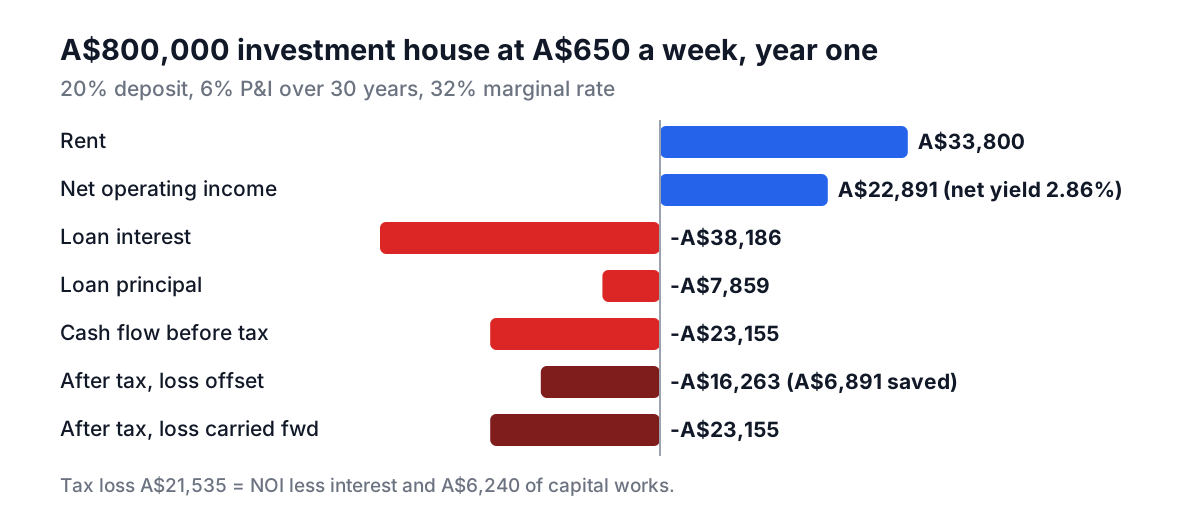
An A$800,000 house that rents for A$650 a week brings in A$33,800 a year, a gross yield of 4.2%. After vacancy, council and water rates, insurance, maintenance and a 7% agent's fee it earns A$22,891, a net yield of 2.9%. A 30-year principal and interest loan at 6% on 80% of the price costs A$46,045 a year, so the owner puts in A$23,155 before tax, about A$445 a week. Negative gearing gives part of that back, if the property qualifies. This guide works through the numbers with the investment property calculator, and what the 2026 tax reform law changes for established homes. The figures show the method; they are not advice on a particular property.
Weekly rent to net yield
Australian rents are quoted per week, so convert first: A$650 x 52 / 12 = A$2,816.67 a month, not A$2,600.
| Line | Amount |
|---|---|
| Rent, A$650 x 52 | A$33,800 |
| Vacancy at 3% (about 11 days) | -A$1,014 |
| Council and water rates | -A$2,800 |
| Landlord insurance | -A$1,800 |
| Maintenance | -A$3,000 |
| Property management, 7% of rent collected | -A$2,295 |
| Net operating income | A$22,891 |
| Loan repayments, A$640,000 at 6% over 30 years | -A$46,045 |
| Cash flow before tax | -A$23,155 |
Net yield (net operating income over price, the cap rate in US terms) is 2.86%. Of the A$46,045 in repayments, A$38,186 is interest and A$7,859 principal in year one, so the interest alone is A$15,295 more than the net rent.
Cash in at settlement is the A$160,000 deposit plus about A$34,400 of purchase costs. In NSW, transfer duty on a dutiable value of A$800,000 is A$11,602 plus A$4.50 per A$100 over A$387,000, which is A$30,187 under Revenue NSW's 2026-27 rates; conveyancing, inspections and loan fees bring the total to about 4.3% of the price. Other states have their own duty scales.
Negative gearing: what the loss is worth
For tax, the rental loss is net operating income less interest and capital works deductions. With A$6,240 a year of capital works (0.78% of the price, from a depreciation schedule for the building, which a quantity surveyor prepares) the loss is:
22,891 - 38,186 - 6,240 = -A$21,535
At a 32% marginal rate including the Medicare levy: A$6,891 saved
Cash flow after tax = -23,155 + 6,891 = -A$16,263, about A$313 a week
(the calculator works from unrounded figures: tax saved is A$6,891.27)
The loss is still real money: the owner spends A$23,155 to get A$6,891 back. Negative gearing reduces the cost of holding the property; it does not make a loss-making property profitable. The bet is on the price.
What the 2026 tax reform law changes
The Treasury Laws Amendment (Tax Reform No. 1) Act 2026, which put the 2026-27 Budget measure into law, limits negative gearing for residential property to new builds. From the 2027-28 income year, Schedule 2 inserts section 26-155 into the Income Tax Assessment Act 1997:
- If your deductions for using or holding residential dwellings exceed your income from them, the excess is not deductible that year. It can be applied in working out your net capital gain, and whatever remains is carried forward to the next income year (s 26-155(1)).
- Dwellings you acquired before 7.30 pm, by legal time in the ACT, on 12 May 2026 are outside the rule. For a purchase under a contract, the date you entered into the contract counts, not settlement (s 26-155(2)(a) and (3)).
- New residential dwellings are outside the rule (s 26-155(2)(b)).
So for the same house bought as an established property after Budget night, the 2026-27 year can still be negatively geared, but from 2027-28 the A$21,535 loss would be carried forward (or applied against a capital gain) instead of reducing tax on wages:
| Year one | Loss offset against wages | Loss carried forward |
|---|---|---|
| Cash flow before tax | -A$23,155 | -A$23,155 |
| Tax saved | A$6,891 | Nil |
| Cash flow after tax | -A$16,263 | -A$23,155 |
| Per week | about A$313 | about A$445 |
With this rent and rate the property makes no taxable profit within ten years in the calculator, so a carried-forward loss would not be used until the rent rises, the loan falls or the property is sold. The Budget also replaced the 50% capital gains tax discount with cost base indexation and a 30% minimum tax on net capital gains for gains arising from 1 July 2027, while letting investors in new residential properties choose either. Schedules 1 and 2 of the Act made these changes law in June 2026; check the ATO's guidance for how they apply to your purchase date.
Rates are moving
The RBA raised the cash rate target by 0.25 percentage points on 30 September 2026 and again on 4 November 2026, to 4.85%. Investment loan rates move with lenders' own pricing, but run the property at a higher rate before you buy. At 6.5% instead of 6%, repayments rise to A$48,543, the pre-tax cash flow falls to -A$25,652, and after tax it is -A$17,736 with the loss offset or -A$25,652 without it.
Costs owners miss
- Land tax. NSW charges land tax, with exemptions such as the principal place of residence, and other states have their own schemes. Check your state's thresholds and add any land tax to council and water rates.
- Strata levies for a unit, which belong in maintenance, and special levies as a separate scenario.
- Letting fees on top of management, and repairs between tenants.
- Selling costs and capital gains tax at the end, which the yield figures leave out.
Tools for this job
- Investment property calculator: yields, cash flow, tax saved or carried forward, and IRR.
- Rent vs buy calculator: for a home to live in; see renting versus buying in Australia.
- Investment returns calculator: compare after-tax cash flows with super or shares.
- For the loan itself, see how Australian home loans work.
Tax on property depends on your income, the purchase date and how the property is held. Talk to a registered tax agent before buying on the strength of a tax saving.
Frequently asked questions
How do I convert weekly rent to a yearly or monthly figure?
Multiply the weekly rent by 52 for the year and divide by 12 for the month. A$650 a week is A$33,800 a year and A$2,816.67 a month; multiplying by four understates it by about 8%.
Does negative gearing still work if I buy an established house now?
Under the Treasury Laws Amendment (Tax Reform No. 1) Act 2026, from the 2027-28 income year a loss on an established residential property acquired from 7.30 pm (ACT time) on 12 May 2026 is no longer deducted against wages. It can be applied in working out your net capital gain, and the rest is carried forward. New builds and properties acquired, or contracted for, before Budget night are outside the rule. Check the ATO's current guidance for your purchase.
How much tax does negative gearing save?
The rental loss times your marginal rate including the Medicare levy. In the example, a A$21,535 loss at 32% saves A$6,891, which cuts the weekly cost of holding the house from about A$445 to about A$313.
What net rental yield should I look for?
There is no official benchmark. Compare the net yield with your loan rate: at 2.86% against 6%, each borrowed dollar costs more than it earns in the property, so the cash flow is negative and the outcome depends on price growth.
Should I include land tax in the calculation?
Yes, if your state charges it on the property. Add the yearly land tax to council and water rates in the calculator. Revenue NSW lists the principal place of residence among its exemptions, which an investment property does not get; check your state's thresholds.
Sources and further reading
- Treasury Laws Amendment (Tax Reform No. 1) Act 2026, No. 49, 2026, Federal Register of Legislation. Assented to 26 June 2026. Schedule 1 (CGT adjustments) for CGT events from 1 July 2027; Schedule 2, s 26-155 (negative gearing) from the 2027-28 income year.
- Tax reform: negative gearing and capital gains tax, Australian Government, Budget 2026-27. New builds, existing holdings and the CGT changes.
- Budget Paper No. 2: Budget measures 2026-27, Australian Government. Established property acquired from 7:30PM (AEST) on 12 May 2026; losses carried forward from 1 July 2027.
- Current thresholds and rates (transfer duty), Revenue NSW. General transfer duty rates for 2026-27.
- Land tax, Revenue NSW. Who pays and exemptions such as the principal place of residence.
- Cash rate target, Reserve Bank of Australia. Recent changes to the cash rate.
Open the Real Estate Investment Analyzer
More Analysis Tools
Every tool in the Analysis Tools section, free and in your browser.