
Rental Yield on a Flat in India: Is Buying to Let Worth It?
Rental yield, EMI cover and tax on an ₹80 lakh flat: house property rules, the ₹2 lakh loss set-off in the old regime, and why the new regime changes the answer.
By Redbison Dev · · 6 min read

India edition. Rupees in lakh, a home loan EMI, stamp duty and registration in the purchase cost, society maintenance, and rental income taxed under house property rules with the 30% deduction, interest and the old and new regime treatment of losses. US edition
An ₹80 lakh flat that rents for ₹25,000 a month earns a gross rental yield of 3.75%. After society maintenance, municipal tax, insurance and a month or so of vacancy it earns ₹2,32,000 a year, a net yield of 2.9%. With a 20-year home loan at 8.5% on 80% of the price, the EMI is ₹55,541 a month, more than twice the rent, so the owner puts in about ₹4.3 lakh a year before tax. This guide works through those numbers, what the house property tax rules give back, and why the old and new tax regimes give different answers, using the rental property calculator for India. The figures show the method; they are not advice on a particular flat.
From rent to net yield
Indian listings quote rent per month and price in lakh or crore. The useful measures are:
- Gross rental yield: yearly rent over price. ₹3,00,000 / ₹80,00,000 = 3.75%.
- Net yield: rent after vacancy and the owner's running costs, before the loan, over price. Investors elsewhere call this the cap rate.
- Cash-on-cash: what is left after EMIs, over the cash you put in.
| Line | Amount |
|---|---|
| Rent, ₹25,000 x 12 | ₹3,00,000 |
| Vacancy at 5% (about 18 days) | -₹15,000 |
| Municipal (property) tax | -₹12,000 |
| Society maintenance | -₹36,000 |
| Insurance | -₹5,000 |
| Net operating income | ₹2,32,000 |
| EMI, ₹55,541 x 12 | -₹6,66,488 |
| Cash flow before tax | -₹4,34,488 |
The cash put in at the start is ₹16 lakh of down payment plus about ₹5.6 lakh for stamp duty, registration and brokerage (7% here; rates differ by state), ₹21.6 lakh in all.
EMI cover: the number that decides cash flow
Lenders abroad test whether rent covers the loan payment. Do the same check yourself: ₹25,000 of rent covers 45% of a ₹55,541 EMI. Net operating income of ₹2,32,000 covers 35% of the year's ₹6,66,488 of EMIs. Of those EMIs, ₹5,39,114 is interest and ₹1,27,375 repays principal in year one, so even the interest alone is more than twice the net rent.
The RBI's policy repo rate on its website in November 2026 is 5.50%. Home loans cost more than that, and the 8.5% used here is an example; put in the rate on your sanction letter. At a net yield of 2.9%, every rupee borrowed at 8.5% loses money while you hold the flat, so the investment case rests on the flat's price rising.
How the rent is taxed
Rental income is taxed under "Income from house property". The rules, section numbers and limits below follow the e-filing guidance for AY 2026-27 under the Income-tax Act, 1961. The Income-tax Act, 2025 now governs, with CBDT notifications under it in force from 1 April 2026 and its own section numbering, so for income earned from that date check that the same limits apply under it before you file. The working, for the first year:
Net annual value  = rent received - municipal tax paid
                  = 2,85,000 - 12,000 = 2,73,000
Standard deduction (30% of annual value)        = 81,900
Interest on the home loan                        = 5,39,114
Income from house property = 2,73,000 - 81,900 - 5,39,114 = -3,48,014
The 30% standard deduction is given whatever you actually spend, and it is the only allowance for repairs and upkeep, so society maintenance and insurance do not reduce the tax a second time. Interest on a let-out flat is deducted in full; the ₹2 lakh cap on interest applies to a self-occupied home in the old regime.
What happens to the ₹3,48,014 loss depends on your regime:
| Old regime | New regime | |
|---|---|---|
| Loss set off against salary this year | ₹2,00,000 (the maximum) | Nil |
| Tax saved at a 31.2% marginal rate | ₹62,400 | Nil |
| Loss carried forward | ₹1,48,014, for up to 8 assessment years | Not allowed: cannot be set off against other heads or carried forward |
| Cash flow after tax | -₹3,72,088 | -₹4,34,488 |
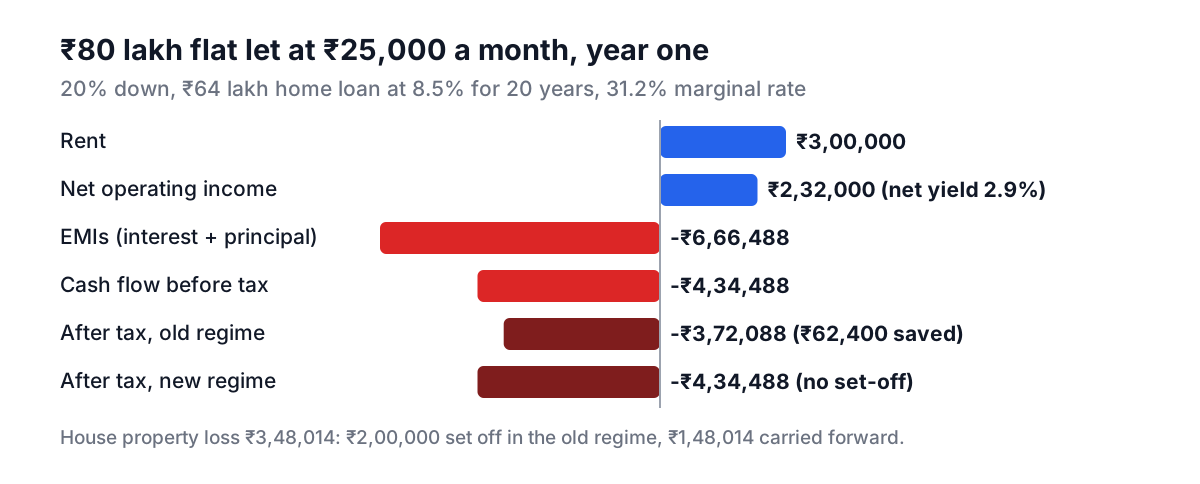
The e-filing help for salaried taxpayers explains both limits: in the old regime no more than ₹2,00,000 of house property loss is set off against other income in the year, with the rest carried forward for up to eight assessment years; in the new regime a let-out property loss cannot be set off against any other head or carried forward. Salaried taxpayers can choose their regime every year in the return, so a landlord with a large home loan should compare both before filing. Over ten years, with rent and price rising 5% a year, the calculator puts the old regime about ₹5.6 lakh ahead on this flat (-₹30.54 lakh against -₹36.10 lakh of after-tax cash flow).
The same flat with less borrowing
The loan, not the flat, makes the cash flow negative. Run the same purchase three ways:
| Down payment | Cash flow before tax | After tax, old regime | After-tax return on cash |
|---|---|---|---|
| 20% (₹64 lakh loan) | -₹4,34,488 | -₹3,72,088 | -17.2% |
| 50% (₹40 lakh loan) | -₹1,84,555 | -₹1,39,051 | -3.0% |
| 100% (no loan) | ₹2,32,000 | ₹1,72,377 | 2.0% |
Without a loan there is no interest to deduct, so income from house property is ₹1,91,100 (70% of ₹2,73,000) and tax at 31.2% is ₹59,623. A 2.0% after-tax return is the figure to set against a fixed deposit or a debt fund before buying for rent alone.
Price growth is the real bet
The rent rarely pays for a leveraged flat in a large city, so the return depends on the price when you sell. Do not assume a growth rate from a broker's brochure. The National Housing Bank's RESIDEX is the official housing price index, published quarterly by city with prices at assessment values; check the trend for your city before entering an appreciation figure. Remember too that the calculator does not include the cost of selling or the capital gains tax on the sale.
Costs owners leave out
- Stamp duty and registration differ by state; enter your own state's rate in the purchase cost.
- Brokerage on each new tenant. If you pay a broker one month's rent each time you re-let, that is about 8% of a year's rent; add it to the costs.
- Furnishing and repairs between tenants, which the 30% deduction already covers for tax but your bank account does not.
Tools for this job
- Rental property calculator (India): yield, EMI, cash flow and house property tax under both regimes.
- EMI calculator: the loan schedule year by year, explained in how EMIs and amortisation work.
- Rent vs buy calculator: if the flat is a home to live in; see renting versus buying in India.
- Investment returns calculator: compare the after-tax cash flows with an FD or mutual fund.
Your tax depends on all your income and on how the flat is held. For joint ownership, an under-construction flat or a sale, speak to a chartered accountant.
Frequently asked questions
What is a good rental yield for a flat in India?
There is no official benchmark. Compare the net yield with your home loan rate: the example earns 2.9% after costs against an 8.5% loan, so it runs at a loss and depends on price growth. If the net yield is below the loan rate, borrowing more makes the cash flow worse.
Can I claim society maintenance against rental income?
No. You deduct municipal tax you paid, then a flat 30% of the annual value, then home loan interest. The 30% is allowed whatever you spend and replaces separate claims for maintenance, repairs and insurance.
How much home loan interest can I claim on a let-out flat?
There is no cap on the interest deducted from a let-out property's income. What is capped is the loss: in the old regime only ₹2,00,000 a year can be set off against salary, and the rest is carried forward for up to eight assessment years.
Does the new tax regime allow a loss from a rented flat?
The interest still reduces income from that property, but a resulting loss cannot be set off against salary or other income, or carried forward, in the new regime. For the example flat that removes a ₹62,400 saving in the first year.
Is it better to buy a flat on loan or with cash for rent?
On cash flow alone, cash: the flat earns 2.0% after tax with no loan and loses about 17% of the cash invested in year one with an 80% loan. Borrowing only pays if the flat's price rises faster than the loan costs, which no one can promise.
Sources and further reading
- Return applicable and deductions for salaried individuals, Income Tax Department e-filing. Interest under section 24(b), the ₹2,00,000 loss set-off in the old regime, 8-year carry forward and the new regime rule.
- Notification No. 141/2026, Central Board of Direct Taxes. A notification under the Income-tax Act, 2025 (30 of 2025), deemed in force from 1 April 2026.
- ITR-2 validation rules, AY 2026-27, Central Board of Direct Taxes. Standard deduction equal to 30% of annual value; set-off limits in Schedule CYLA.
- New tax vs old tax regime FAQs, Income Tax Department e-filing. Choosing the regime each year in the return.
- Reserve Bank of India, Reserve Bank of India. Current policy repo rate.
- RESIDEX housing price index, National Housing Bank. Quarterly city-level house price indices.
Open the Real Estate Investment Analyzer
More Analysis Tools
Every tool in the Analysis Tools section, free and in your browser.