
Buy-to-Let Returns UK: Net Yield, ICR and Section 24
Work a UK buy-to-let from gross yield to net yield, cash-on-cash and after-tax cash flow, then test it the way lenders do with the 125% ICR and 5.5% stress rate.
By Redbison Dev · · 6 min read
United Kingdom edition. Pounds, interest-only buy-to-let mortgages, the lender's interest cover ratio under the PRA's SS13/16, Stamp Duty with the 5% surcharge on additional homes, and income tax under the Section 24 finance cost rules. US edition
A £250,000 flat let at £1,250 a month is a 6% gross yield. After voids, a letting agent, insurance and repairs it earns £10,772 a year, a net yield of 4.3%. After interest on an interest-only mortgage at 5% the owner keeps £1,397, and a higher-rate taxpayer then owes £2,434 of income tax on it, so the flat costs £1,037 a year to hold. This guide works through those numbers, the interest cover test a buy-to-let lender applies, and the tax rules that turn a small profit into a loss, using the UK buy-to-let calculator. The figures show the method for England in the 2026 to 2027 tax year; they are not advice on a particular purchase.
Gross yield, net yield and cash-on-cash
UK agents quote gross yield: annual rent over price. Net yield takes off the running costs a landlord pays before any mortgage, the figure US investors call net operating income over price, or the cap rate. Cash-on-cash is what is left after the mortgage, divided by the cash you put in.
For the example flat, bought with a 25% deposit and 7% purchase costs:
| Line | Amount |
|---|---|
| Rent, £1,250 x 12 | £15,000 |
| Voids at 4% | -£600 |
| Letting and management, 12% of rent collected | -£1,728 |
| Landlord insurance | -£400 |
| Repairs and replacements | -£1,500 |
| Net operating income | £10,772 |
| Interest-only mortgage, £187,500 at 5% | -£9,375 |
| Cash flow before tax | £1,397 |
Gross yield is 6.0%, net yield 4.31% and, on £80,000 of cash (a £62,500 deposit and £17,500 of purchase costs), cash-on-cash before tax is 1.75%. Council tax is left out because the tenant normally pays it; a leasehold flat would add service charge and ground rent to the costs.
The test that matters first: the net yield of 4.31% is below the 5% mortgage rate. Every borrowed pound costs more than it earns inside the flat, so borrowing reduces the return instead of increasing it.
Purchase costs: Stamp Duty at the higher rates
The 7% purchase cost is mostly Stamp Duty Land Tax. On GOV.UK's residential rates, a £250,000 purchase pays nothing on the first £125,000 and 2% on the next £125,000, £2,500. If you already own another residential property you usually pay 5% on top of those rates, which on £250,000 adds £12,500, so the bill is £15,000. With about £2,500 of conveyancing, survey and lender fees, that is £17,500, or 7% of the price. Scotland and Wales have their own taxes and surcharges, so use their rates there.
The lender's test: interest cover, not DSCR
A UK buy-to-let lender does not use the US debt service coverage ratio. The Prudential Regulation Authority's supervisory statement SS13/16 tells lenders to test the interest coverage ratio (ICR): expected monthly rent divided by the monthly interest at a stressed rate. It notes that the industry standard minimum ICR is 125%, and that tax, including the mortgage interest rules below, may push lenders to higher thresholds.
Lenders have to allow for likely rate rises over at least five years from the start of the mortgage, with regard to a rise of at least 2 percentage points, and assume a rate of at least 5.5% for those five years. A rate fixed for five years or more is the exception: the five-year look-ahead does not apply, although the lender should still consider the risk at refinancing.
For the example, £1,250 of rent against a £187,500 loan:
| Mortgage | Rate used in the test | Monthly interest | ICR | Largest loan at 125% |
|---|---|---|---|---|
| 5-year fix at 5% | 5% (fixed for five years) | £781.25 | 160% | £240,000 |
| 2-year fix at 5% | 7% (5% + 2 points) | £1,093.75 | 114% | £171,429 |
The same flat passes comfortably on a five-year fix and fails on a two-year fix, where the loan would have to fall by about £16,000. The 5.5% floor bites on cheaper short fixes: a 3% two-year rate plus 2 points is 5%, so the test uses 5.5%. The PRA also says lenders must take the borrower's tax into account, which can lead to higher minimum ratios, so ask a broker what each lender applies to you.
Tax: the Section 24 finance cost rules
For individual landlords, mortgage interest is no longer deducted from rental income. HMRC's guidance on the change says that, fully in place from 6 April 2020, you get a tax reduction at the basic rate, 20%, of the lowest of your finance costs, your property profits and your income above the Personal Allowance. Unused finance costs carry forward. From 6 April 2027 the reduction is due to be given at the property basic rate instead, covered below.
For the example flat, rental profit for tax is the £10,772 before interest:
| 40% taxpayer | 20% taxpayer | |
|---|---|---|
| Tax on £10,772 | £4,309 | £2,154 |
| Less 20% of £9,375 interest | -£1,875 | -£1,875 |
| Tax due | £2,434 | £279 |
| Cash flow after tax | -£1,037 | £1,118 |
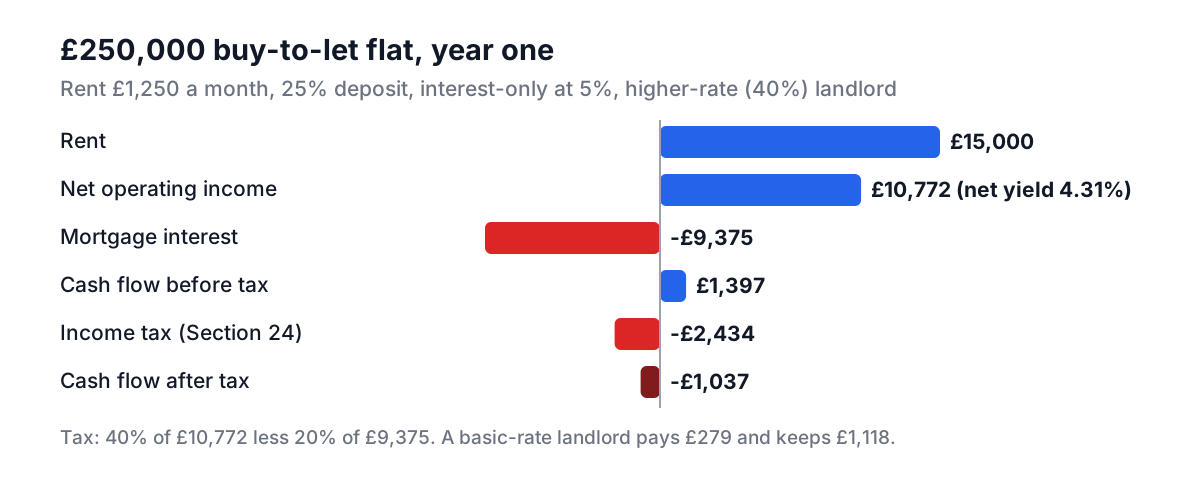
The basic-rate landlord keeps a small profit; the higher-rate landlord pays tax on income that the interest has already spent.
These are 2026-27 figures. Budget 2026 raises the tax rates on property income to 24% (property basic rate), 44% (property higher rate) and 49% (property additional rate) from 6 April 2027 in England, Wales and Northern Ireland, to be legislated in Finance Bill 2026-27. HMRC's technical note on the separate property rates says the finance-cost reduction will then be given at the property basic rate, so the 20% credit becomes 24%. Profit before interest is taxed 4 points more and the interest relieved 4 points more, so tax rises by 4% of the cash flow before tax: £71 in the second year for this flat (£1,777 before tax), whichever rate you pay.
Over ten years with 3% a year rent growth, treating the first year as 2026-27 and the next nine at the 2027-28 rates, after-tax cash flow totals £24,771 for the basic-rate owner and -£483 for the higher-rate owner, before any change in the flat's value. The analyser applies one tax rate and a 20% credit to every year, so at a 40% rate it shows £762 and at 20% it shows £26,016; those totals are too high from 2027-28. The split figures above use its yearly profit and interest, re-taxed at the new rates.
Sensitivity: rent and rates
The two inputs that move the result most:
- Rent of £1,400 instead of £1,250. Net operating income rises to £12,293 and cash flow before tax to £2,918, but a 40% taxpayer still ends the first year £124 down after tax.
- A rate of 7% at refinance. Interest becomes £13,125, cash flow before tax is -£2,353 and after tax at 40% -£4,507. Tax barely falls, because the credit is limited to the rental profit of £10,772 and the other £2,353 of interest carries forward. At the 2027-28 rates the bill is the same, because 44% less 24% of the profit is still 20% of it.
Use signed lets on comparable flats, not asking rents, and run the analysis at the rate you would get when the fix ends.
Costs that catch out new landlords
- Replacing furniture and appliances. HMRC allows the cost of replacing like-for-like domestic items, not the first purchase. Budget for it in repairs.
- No capital allowances inside a let home. HMRC's Capital Allowances Manual says plant or machinery for use in a dwelling-house is not qualifying expenditure, so leave the depreciation input at zero.
- Voids and arrears. 4% voids is about two weeks a year. A slow re-let in a soft market can double that.
- Selling costs and Capital Gains Tax. The yield figures ignore what you pay to sell and the tax on any gain.
Tools for this job
- UK buy-to-let calculator: yields, cash flow, Section 24 tax and IRR for one property.
- Mortgage calculator: repayment versus interest-only payments and the balance over time, explained in how UK mortgages work.
- Rent vs buy calculator: if the question is a home to live in rather than to let; see rent or buy in the UK.
- Investment returns calculator: compare the after-tax cash flows with another investment.
Buy-to-let tax depends on your whole income and how the property is owned. If you are weighing a limited company, a portfolio or a property in Scotland or Wales, take advice from an accountant or a regulated mortgage adviser.
Frequently asked questions
What net yield do I need for a buy-to-let to cash-flow?
Enough to cover your mortgage rate with room for voids and repairs. In the example a 4.31% net yield against a 5% interest-only rate leaves only £1,397 a year before tax, which a higher-rate taxpayer loses to Section 24. If the net yield is below the rate, borrowing reduces your return.
What is the 125% ICR on a buy-to-let mortgage?
Rent divided by the monthly interest at the test rate must be at least 125%, which the PRA's SS13/16 describes as the industry standard minimum. At a 7% stressed rate, £1,250 of rent supports a loan of up to £171,429; at 5.5%, £218,182.
Does Section 24 apply to a limited company?
HMRC's guidance on the restriction is written for individual landlords, and partnerships and trusts are covered in the Property Income Manual. Companies pay Corporation Tax on their own profit, but you pay tax again when you take money out, so compare both with an accountant.
How much Stamp Duty is due on a £250,000 second home or buy-to-let?
In England and Northern Ireland, £15,000: £2,500 at the standard rates plus 5% of the whole price because you already own a home. If you buy a new main home before selling your old one, you pay the higher rates at completion and can claim a refund if you sell the old home within 36 months of buying the new one. That does not apply to a buy-to-let.
Is a basic-rate taxpayer affected by Section 24?
Barely, as long as the rental profit does not push total income into the higher rate. In the example the tax is £279 at 20%, so the flat still produces £1,118 after tax. From 2027-28 the property basic rate of 24% and the 24% credit add 4% of the cash flow before tax, £71 in the second year.
Sources and further reading
- Changes to tax relief for residential landlords: how it is worked out, HM Revenue and Customs. The 20% reduction, its three limits and carry-forward.
- Stamp Duty Land Tax: residential property rates, GOV.UK. Bands and the extra 5% for additional properties.
- Underwriting standards for buy-to-let mortgage contracts (SS13/16), Prudential Regulation Authority. ICR definition, 125% industry standard, 2-point stress, 5.5% floor and the five-year fix exception.
- Work out your rental income when you let property, HM Revenue and Customs. Allowable expenses and replacing domestic items.
- Budget 2026, HM Treasury. Property income rates of 24%, 44% and 49% from 6 April 2027 in England, Wales and Northern Ireland, to be legislated in Finance Bill 2026-27.
- Change to tax rates for property, savings and dividend income: technical note, HM Revenue and Customs. Relief for residential finance costs at the property basic rate from 2027-28.
- Capital Allowances Manual CA23060, HM Revenue and Customs. Dwelling-houses in a property business.
Open the Real Estate Investment Analyzer
More Analysis Tools
Every tool in the Analysis Tools section, free and in your browser.