
Rental Yield and Cash Flow in NZ: Is a Rental Worth It?
Gross and net rental yield, cash flow and after-tax returns on an NZ rental, with full interest deductions, ring-fenced losses and no building depreciation.
By Redbison Dev · · 6 min read

New Zealand edition. Written for New Zealand landlords: weekly rents, gross and net yield, council rates, 100% interest deductibility from 1 April 2025, ring-fenced rental losses, no depreciation on the building, NZ tax rates, healthy homes standards and the bright-line test. US edition
A NZ$750,000 house renting at NZ$650 a week earns NZ$33,800 a year, a gross yield of 4.5%. After vacancy, council rates, insurance, maintenance and a property manager, the net operating income is NZ$20,552, a net yield of 2.74%. With a 30% deposit and a 5.5% loan, the interest alone is NZ$28,698, so the property needs about NZ$15,219 of the owner's own money in its first year, and New Zealand's ring-fencing rules mean that loss cannot reduce tax on a salary. This edition shows how to run those numbers for an NZ rental with the Rental Property Investment Calculator (New Zealand), and which NZ tax rules move the result. It explains the arithmetic; for your own purchase, talk to a tax adviser and a mortgage adviser.
Gross yield, net yield and the interest rate
New Zealand listings and investors usually talk in gross yield:
gross yield = weekly rent × 52 ÷ price
net yield   = net operating income ÷ price
Net operating income (NOI) is rent after vacancy, minus the costs of owning the property before any loan: council rates, insurance, maintenance, and management fees. It leaves out the mortgage on purpose, so you can compare properties regardless of how they are financed.
The test that matters is simple: if the net yield is below your interest rate, every borrowed dollar loses money each year until rents rise. At 2.74% net against a 5.5% loan, the first example cannot pay its own way on a 70% loan. Any profit has to come from price growth.
Worked example: a NZ$750,000 house
Inputs, as the calculator's NZ version opens: NZ$750,000 price, 30% deposit, 1% purchase costs (lawyer, LIM, inspection), 5.5% over 30 years, rent NZ$650 a week (NZ$2,816.67 a month), rates NZ$3,500, insurance NZ$2,800, maintenance NZ$3,000, 4% vacancy, 8% management, 3% growth, 33% tax, building depreciation 0, losses ring-fenced.
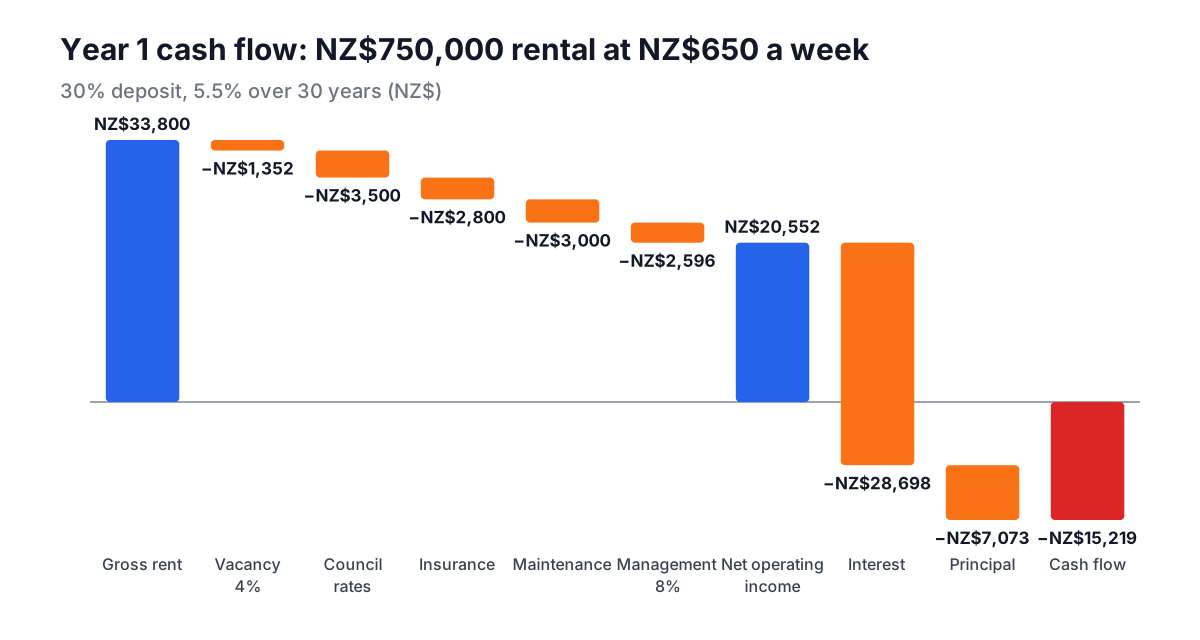
| Year 1 | NZ$ |
|---|---|
| Gross rent | 33,800 |
| Vacancy (4%) | −1,352 |
| Rates, insurance, maintenance, management | −11,896 |
| Net operating income | 20,552 |
| Mortgage repayments (interest 28,698, principal 7,073) | −35,771 |
| Cash flow before tax | −15,219 |
| Taxable rental loss (interest is deductible, principal is not) | −8,146 |
| Tax saved this year | 0 (loss ring-fenced) |
That is NZ$1,268 a month from the owner's other income. The shortfall shrinks every year as rents rise with the 3% growth assumption, but over ten years the property still needs NZ$108,486 of top-ups. In return the owner holds a house worth about NZ$1,007,937 after ten years, with NZ$433,340 still owing on the loan. Counting that equity, the ten-year internal rate of return on the cash put in is 6.19%. Drop growth to 2% (which in the calculator also slows rent growth) and the IRR falls to 3.64%, with NZ$123,834 of top-ups.
The NZ tax rules that shape the after-tax result
Interest is fully deductible again. Between 1 October 2021 and 31 March 2025 the interest limitation rules restricted how much mortgage interest a residential landlord could claim; in the 2024-25 year it was 80%. From 1 April 2025 Inland Revenue says you can claim 100% of the interest you incur. The calculator deducts all of it.
Losses are ring-fenced. Under the residential property deduction rules, deductions can only be used up to the rental income for the year. The excess is carried forward to years when the property makes income; it cannot reduce tax on wages. In the first example, the loss of NZ$8,146 saves nothing in year 1. Set against other income instead, it would have saved NZ$2,688 that year. The losses are not lost, but the relief arrives later, or not at all if the property is sold before it earns a profit. The rules do not apply to your main home.
No depreciation on the building. Inland Revenue set the depreciation rate for buildings with an estimated life of more than 50 years at 0% from the 2012 income year. Non-residential buildings had depreciation reintroduced for the 2021 to 2024 income years and are back at 0% from the 2025 year; residential rentals never had it back. That is why the depreciation box is 0. Chattels such as appliances are a separate question for your accountant.
Your marginal rate. Rental profit is added to your other income. From 1 April 2025 the rates are 10.5% to NZ$15,600, 17.5% to NZ$53,500, 30% to NZ$78,100, 33% to NZ$180,000 and 39% above that.
Bright-line test. A gain on residential property sold on or after 1 July 2024 is taxable if the sale is within 2 years of the bright-line start date, usually settlement.
Interest-only, and a higher-yield regional house
What does an interest-only loan, or a cheaper house with a higher yield, do to these numbers? The calculator handles both:
| Scenario | Gross yield | Net yield | Year 1 cash flow | Ten-year after-tax cash flow | IRR |
|---|---|---|---|---|---|
| NZ$750,000, 30% deposit, principal and interest | 4.5% | 2.74% | −NZ$15,219 | −NZ$108,486 | 6.19% |
| Same, interest-only | 4.5% | 2.74% | −NZ$8,323 | −NZ$39,528 | 6.19% |
| NZ$520,000 regional house, NZ$560 a week, 35% deposit, P and I | 5.6% | 3.39% | −NZ$5,411 | −NZ$30,501 | 7.59% |
| Same, interest-only | 5.6% | 3.39% | −NZ$971 | +NZ$18,718 | 7.70% |
The regional house has rates NZ$3,200, insurance NZ$2,400 and maintenance NZ$2,500, with the other inputs as before.
Two lessons. Interest-only improves monthly cash flow because none of the payment goes to principal, but it does not change the IRR on the first house: the money you are not paying off the loan simply stays owed. And yield matters more than price: the cheaper house's higher net yield brings it close to paying its way, and it starts to pay tax from year 3 once its small early losses are used up.
Costs NZ landlords leave out
- Healthy homes standards. All rental properties must comply with the standards for heating, insulation, ventilation, moisture ingress and drainage, and draught stopping. Ceiling and underfloor insulation is compulsory. Budget for any work before the first tenancy.
- Body corporate levies on a unit title.
- Insurance, which in NZ includes the Natural Hazards Commission levy; get quotes before you buy.
- Vacancy and letting costs between tenancies; 4% is about two weeks a year.
- Refixing risk. The 5.5% here is assumed for the whole period; NZ fixed terms end and reprice, so test 6.5% too.
Tools for this job
- Rental Property Investment Calculator (New Zealand): opens on the NZ$750,000 example; switch repayment to interest-only or change the loss relief setting to see what ring-fencing costs.
- Rent or Buy Calculator (New Zealand): the owner-occupier side of the same market.
- Home Loan Repayment Calculator (NZ): repayments at different rates and terms.
- Related: rent or buy in New Zealand and cap rate, cash-on-cash and DSCR in detail.
Frequently asked questions
What is a good rental yield in NZ?
There is no official benchmark. The useful comparison is net yield against your mortgage rate: when the net yield is below the rate, the property loses cash each year on borrowed money. A NZ$750,000 house at NZ$650 a week has a 4.5% gross yield and a 2.74% net yield, well below a 5.5% loan.
Can I offset rental losses against my salary in NZ?
No. Residential rental losses are ring-fenced: deductions can be used only up to the rental income for the year, and the excess is carried forward to later years when the property makes income.
Can I claim 100% of my rental mortgage interest?
From 1 April 2025, yes. Inland Revenue says you can claim 100% of the interest you incur on residential rental property. In the 2024-25 year it was 80%.
Does interest-only make a rental a better investment?
It improves cash flow, not the return. On the NZ$750,000 example the year 1 shortfall drops from NZ$15,219 to NZ$8,323, but the ten-year IRR stays at 6.19% because the loan is not being repaid.
Sources and further reading
- Residential property interest limitation rules, Inland Revenue. 80% in 2024-25 and 100% from 1 April 2025.
- Residential rental property deductions, Inland Revenue. Ring-fencing of rental losses; not applicable to your main home.
- Claiming depreciation, Inland Revenue. 0% for buildings over 50 years from 2012; non-residential reintroduced for 2021 to 2024.
- Tax rates for individuals, Inland Revenue. Rates from 1 April 2025.
- The bright-line test, Inland Revenue. The 2-year period for sales on or after 1 July 2024.
- Healthy homes standards, Tenancy Services. The five standards and compulsory insulation.
Open the Real Estate Investment Analyzer
More Analysis Tools
Every tool in the Analysis Tools section, free and in your browser.