
Rental Property Returns in Canada: Cap Rate and Cash Flow
Work an Ontario rental from cap rate to cash flow on a semi-annually compounded mortgage, the OSFI stress test, rent increase limits and CRA rules on losses and CCA.
By Redbison Dev · · 6 min read
Canada edition. Canadian dollars, fixed-rate mortgages compounded semi-annually under the Interest Act, the OSFI minimum qualifying rate, Ontario land transfer tax and rent increase guideline, and CRA rental rules on interest, losses and capital cost allowance. US edition
A CA$650,000 house in Ontario that rents for CA$2,800 a month earns CA$22,092 a year after vacancy, property tax, insurance and maintenance: a cap rate of 3.4%. A five-year fixed mortgage at 4.5% on 80% of the price costs CA$2,878.06 a month, so the owner puts in CA$12,445 a year before tax. This guide works through those numbers the way a Canadian lender and the CRA see them, with the Canadian rental property calculator: semi-annual compounding, the stress test, Ontario's rent increase guideline and the rules on rental losses and capital cost allowance (CCA). The figures show the method; they are not advice on a particular property.
Net operating income and cap rate
| Line | Amount |
|---|---|
| Rent, CA$2,800 x 12 | CA$33,600 |
| Vacancy at 3% | -CA$1,008 |
| Property tax | -CA$6,000 |
| Insurance | -CA$1,500 |
| Maintenance | -CA$3,000 |
| Net operating income (NOI) | CA$22,092 |
Cap rate is NOI over price: 22,092 / 650,000 = 3.40%. Gross yield, rent over price, is 5.17%. The example assumes you manage the unit yourself; a property manager's fee would come out of NOI too.
The mortgage: semi-annual compounding
Canadian fixed-rate mortgages state the rate compounded half-yearly. Section 6 of the Interest Act requires a blended-payment mortgage to state the rate "calculated yearly or half-yearly, not in advance", and the calculator treats a fixed rate as compounded half-yearly. A 4.5% rate compounded semi-annually equals 4.458% compounded monthly, so the payment is lower than a US-style calculator would show.
On a CA$520,000 loan over a 25-year amortization:
Payment            = CA$2,878.06 a month, CA$34,537 a year
Year-one interest  = CA$22,949
Year-one principal = CA$11,588
Cash flow          = 22,092 - 34,537 = -CA$12,445
Cash put in at closing is the CA$130,000 down payment plus about CA$13,000 of closing costs, CA$143,000, so the year-one cash-on-cash return is -8.7%. The cap rate (3.4%) is below the mortgage rate (4.5%), which is why borrowing makes the cash flow worse rather than better.
Ontario land transfer tax is most of the closing cost. On the Ontario government's rates for a single-family residence, CA$650,000 pays 0.5% of the first CA$55,000, 1% to CA$250,000, 1.5% to CA$400,000 and 2% above that: CA$275 + CA$1,950 + CA$2,250 + CA$5,000 = CA$9,475. Toronto adds a municipal land transfer tax, and other provinces have their own.
The stress test you have to pass
OSFI's minimum qualifying rate for uninsured mortgages is the greater of the contract rate plus 2% or 5.25%. For a 4.5% contract rate, that is 6.5%, and at 6.5% the same CA$520,000 loan would cost CA$3,483.08 a month. For an uninsured mortgage, expect the lender to check that you can carry that payment, not CA$2,878.06. Ask how much of the rent it counts towards your income, and note that OSFI reviews the rate at least once a year.
Tax: what the CRA allows
The CRA's Rental Income guide (T4036) sets the rules the calculator follows:
- Interest is deductible, principal is not. You can deduct interest on money borrowed to buy or improve the rental, but not the repayments of principal.
- A rental loss reduces other income. If the expenses were incurred to earn rental income, you can deduct a rental loss against your other sources of income, such as employment income.
- CCA cannot create or increase a rental loss. Capital cost allowance is optional, land is not depreciable, and when you sell for more than the building's undepreciated cost the CCA claimed can come back into income as recapture.
For the example, rental income less interest is 22,092 - 22,949 = -CA$857. At a 30% combined marginal rate (an assumption; use yours) that loss saves CA$257, so the after-tax cash flow is -CA$12,188. CCA would only add to the loss, so it is not claimed in this year.
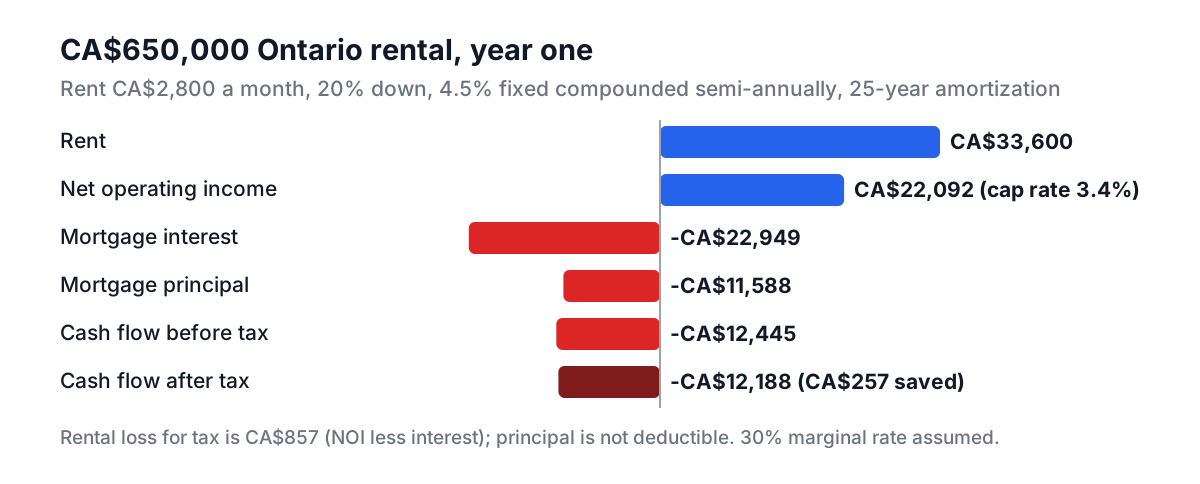
The tax loss is small because most of the negative cash flow is principal, which builds equity but is not an expense.
Rent growth is capped for many Ontario units
Ontario's rent increase guideline is 2.1% for 2026 and 1.9% for 2027. It applies to most tenancies, but units first occupied for residential purposes after November 15, 2018, are exempt. A landlord can raise the rent only if at least 12 months have passed since the last increase or the start of the tenancy, with at least 90 days' written notice.
The calculator grows rent and value at the same rate, so the guideline is a reason to use a modest rate for an older unit:
| Growth in rent and value | After-tax cash flow over 10 years | Equity from principal repaid | Price gain |
|---|---|---|---|
| 3% a year | -CA$96,535 | CA$142,732 | CA$223,546 |
| 2% a year | -CA$108,265 | CA$142,732 | CA$142,346 |
At 2% the owner funds about CA$108,000 from other income over ten years in return for CA$142,000 of principal repaid and a price gain of the same order, before selling costs and capital gains tax.
Changing the deal
- Larger down payment. With 35% down the payment falls to CA$28,061 a year and the cash flow to -CA$5,969; the property now shows a small taxable profit (CA$3,446), so tax adds CA$1,034 and the after-tax cash flow is -CA$7,003.
- Renewal at a different rate. The term (often five years) is shorter than the amortization. Rerun the analysis at the rate you expect at renewal.
- Condo fees and special assessments belong in maintenance; model a special assessment as a separate scenario.
Tools for this job
- Canadian rental property calculator: cap rate, cash flow, CRA tax treatment and IRR, with semi-annual compounding.
- Mortgage calculator: payments and amortization schedules, explained in how Canadian mortgages work.
- Rent vs buy calculator: for a home to live in; see renting versus buying in Canada.
- Investment returns calculator: compare the after-tax cash flows with other investments.
Rental tax depends on your province, income and ownership. For CCA, a corporation or a property you also live in, ask an accountant.
Frequently asked questions
What is a good cap rate for a rental in Ontario?
There is no official benchmark. Compare the cap rate with your mortgage rate: at 3.4% against 4.5%, every borrowed dollar costs more than it earns in the property, so the cash flow is negative and the return depends on price growth and principal repayment.
Can a rental loss reduce tax on my salary in Canada?
Yes. The CRA allows a rental loss to be deducted from other sources of income, such as employment income, if the expenses were incurred to earn rental income. In the example a CA$857 loss at a 30% rate saves CA$257.
Should I claim CCA on a rental property?
CCA is optional and cannot create or increase a rental loss, so it only helps in years when the property shows a profit. Claiming it lowers tax now, but it can be recaptured as income when you sell for more than the undepreciated cost. Land is never depreciable.
What rate do I qualify at for a rental property mortgage?
For an uninsured mortgage, OSFI's minimum qualifying rate is the greater of your contract rate plus 2% or 5.25%. At a 4.5% contract rate you qualify at 6.5%, a payment of CA$3,483.08 a month on CA$520,000 over 25 years.
How much can I raise the rent in Ontario?
For most units, no more than the guideline: 2.1% in 2026 and 1.9% in 2027, once every 12 months with 90 days' written notice. Units first occupied after November 15, 2018, are exempt from the guideline.
Sources and further reading
- Rental Income (Guide T4036), Canada Revenue Agency. Interest and principal, rental losses, CCA limits, land and recapture.
- Minimum qualifying rate for uninsured mortgages, Office of the Superintendent of Financial Institutions. Contract rate plus 2% or 5.25%.
- Calculating land transfer tax, Government of Ontario. Rates for single-family residences.
- Residential rent increases, Government of Ontario. Guideline for 2026 and 2027, the post-2018 exemption, 12-month and 90-day rules.
- Interest Act, section 6, Justice Laws Website. Mortgage rates stated yearly or half-yearly, not in advance.
Open the Real Estate Investment Analyzer
More Analysis Tools
Every tool in the Analysis Tools section, free and in your browser.