
Tap Drill Sizes for BSP and Metric Threads in Australia
Tap drills for BSP fittings and metric bolts in mm, how much thread an Australian supplier chart really leaves, and why BSP and NPT taps must not be swapped.
By Redbison Dev · · 10 min read
Australia edition. Written for Australian workshops: BSP fittings checked against an Australian supplier's chart, metric coarse bolts, imported NPT gear, and the nearest metric jobber drill to 75% thread. US edition
Most tap drill questions in Australian sheds and workshops are about two things: metric bolts and BSP fittings. Metric is easy, because the drill is the bolt size minus the pitch, so an M8 takes 6.8 mm and an M10 takes 8.5 mm. BSP is not, because the thread is named after a pipe bore and every chart picks its own depth. This edition shows how much thread each common chart drill really leaves, what to do when your drill stand only steps in half millimetres, and why a BSP tap in an NPT port ends badly. Every figure can be repeated in the tap drill size calculator for BSP and metric threads.
Percent of thread in one paragraph
A tapped hole sits somewhere between the thread's major diameter (0% thread, no grip) and its full depth (100%). The drill sets where. For 60° metric and UNC threads, full depth on the diameter is 1.299 × pitch; for 55° BSP and BSW threads it is 1.2807 × pitch, from the Whitworth thread depth of 0.640327 × pitch per side. So:
metric drill = D − 0.01299 × %thread × P
BSP drill    = D − 0.0128 × %thread × P
D is the major diameter and P the pitch, both in mm (P = 25.4 ÷ TPI for an inch-based thread). Bolt threads usually aim for about 75%. More than that adds tapping torque much faster than strength; in stainless or with a tired tap, 60 to 65% saves the tap.
Metric bolts: the chart drills work
The Australian supplier chart from AIMS Industrial lists the usual coarse tap drills, and they all leave between about 74% and 79% thread:
| Thread | Chart drill | Thread left |
|---|---|---|
| M3 x 0.5 | 2.5 mm | 77.0% |
| M5 x 0.8 | 4.2 mm | 77.0% |
| M6 x 1 | 5.0 mm | 77.0% |
| M8 x 1.25 | 6.8 mm | 73.9% |
| M10 x 1.5 | 8.5 mm | 77.0% |
| M12 x 1.75 | 10.2 mm | 79.2% |
| M16 x 2 | 14.0 mm | 77.0% |
| M20 x 2.5 | 17.5 mm | 77.0% |
For M12 in 316 stainless, a 10.5 mm drill drops the thread to about 66% and takes a lot of strain off the tap. For a form (roll) tap, the hole must be bigger again: about 7.45 mm for M8 at 65%, so check the tap maker's chart for 7.4 or 7.5 mm.
BSP: what the chart drills really give
BSP parallel threads (G, to ISO 228-1) seal with a bonded seal, O-ring or washer at the face. BSP taper threads (R external, Rc internal, to ISO 7-1) seal on the thread with tape or sealant. The thread form is the same 55° Whitworth profile. The AIMS chart gives one drill per size for both, and the calculator shows how deep each one cuts:
| Size | TPI | Major diameter | AIMS chart drill | Thread left | Nearest jobber drill to 75% | Thread left |
|---|---|---|---|---|---|---|
| 1/8" BSP | 28 | 9.728 mm | 8.8 mm | 79.9% | 8.9 mm | 71.3% |
| 1/4" BSP | 19 | 13.157 mm | 11.8 mm | 79.3% | 11.9 mm | 73.4% |
| 3/8" BSP | 19 | 16.662 mm | 15.0 mm | 97.1% | 15.5 mm | 67.9% |
| 1/2" BSP | 14 | 20.955 mm | 18.6 mm | 101.4% | 19.0 mm | 84.1% |
| 3/4" BSP | 14 | 26.441 mm | 24.3 mm | 92.1% | 24.5 mm | 83.5% |
| 1" BSP | 11 | 33.249 mm | 30.5 mm | 93.0% | 31.0 mm | 76.1% |
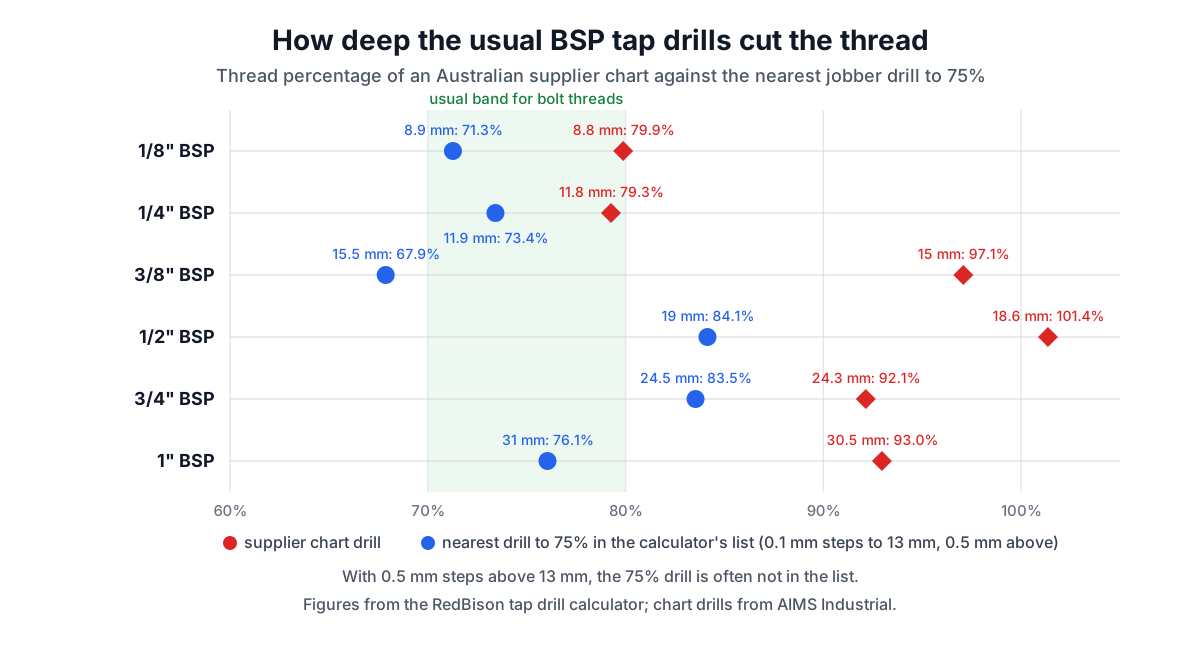
The two small sizes behave like bolt threads. From 3/8" up, the chart drills close to the minor diameter: 18.6 mm for 1/2" is just under the 18.631 mm minor, so the tap trims the bore as well as cutting the thread. That suits a taper thread, which narrows into the hole and needs full depth on the inner turns where it seals. For a parallel port sealed at the face, it is more thread than the joint needs and more torque than a 14 TPI hand tap enjoys.
The other column shows a practical snag. In the calculator's metric drill list, which steps in 0.1 mm up to 13 mm and in 0.5 mm above, the drills either side for 3/8" BSP are 15.0 mm (97.1%) and 15.5 mm (67.9%), with nothing near 75%. A UK pipework table lists 15.25 mm for parallel 3/8" BSP, which leaves 82.5%; it is worth buying that one drill if you cut many 3/8" ports.
Worked example: a hydraulic block for a log splitter
You are drilling a 6061 aluminium manifold for a small log splitter: two 1/2" BSP parallel ports for the hoses, one 1/4" BSP port for the gauge, and four M8 mounting holes.
- 1/2" BSP ports. In the calculator, choose "BSW / BSF / BSP", pick G 1/2 BSPP and check 18.6 mm and 19 mm. The chart drill leaves over 100%; 19.0 mm leaves 84.1%. The ports seal on bonded seals at the face, and aluminium is soft, so 19.0 mm gives plenty of thread with far less risk of snapping the tap.
- 1/4" BSP gauge port. 11.8 mm leaves 79.3%; 11.9 mm leaves 73.4%. Either is fine; use 11.8 mm in soft alloy.
- M8 mounting holes. 6.8 mm, 73.9%. Aim for at least one and a half diameters of thread in aluminium, about 12 mm, so the steel bolt does not pull the thread out.
If the block were steel and the 1/2" ports were tapered for thread sealant instead, the deeper chart drill would earn its place.
BSP and NPT are not interchangeable
Pumps, compressors and machinery imported from the US may have NPT ports. NPT is a 60° taper thread, tapering at 3/4 inch per foot, while BSP is 55°. The pitches clash at most small sizes:
| Nominal size | BSP TPI | NPT TPI |
|---|---|---|
| 1/8" | 28 | 27 |
| 1/4" | 19 | 18 |
| 3/8" | 19 | 18 |
| 1/2" | 14 | 14 |
| 3/4" | 14 | 14 |
| 1" | 11 | 11.5 |
At 1/4" a BSP fitting will start in an NPT port and bind after a turn or two. At 1/2" and 3/4" the pitch matches, so a BSP fitting can screw a fair way in and seem tight, but the flank angles differ and the joint relies on sealant to fill the gap. Use the matching thread or a proper adaptor.
Mistakes that break taps
- Drilling the taper size for a face-seal port. It is not wrong, just slow and hard on the tap. A parallel G port only needs about 80 to 85%.
- Mistaking BSW for UNC. 3/8" BSW and 3/8" UNC both have 16 TPI. A UNC tap leaves a 60° groove that a 55° Whitworth bolt barely fills. An 8 mm drill gives 75.0% for 3/8" BSW.
- Ignoring drill oversize. Twist drills cut a little large in steel, more when worn or hand-held, so real engagement is a few points below the figure on paper.
- Short blind holes. Plug taps have three to five pitches of lead that do not cut a full thread. Drill past the thread length you need.
Tools for this job
- Tap drill size calculator for BSP and metric threads: the thread percentage of any drill for BSP, BSW, BSF, metric and UNC threads.
- Bolt torque calculator: tightening torque and preload for the bolts going into the tapped holes.
- Speeds and feeds calculator: drilling and tapping rpm for the material.
The bolt torque and preload guide for Australia covers the joint once it is tapped, and the CNC speeds and feeds guide covers cutting speed. For pressure systems, follow the fitting or valve maker's port drawing.
Frequently asked questions
What drill size for a 1/4 BSP tap?
11.8 mm is the usual chart size and leaves 79.3% of the thread. 11.9 mm leaves 73.4% and is easier in stainless steel.
What size drill for a 3/8 BSP tap?
The AIMS chart gives 15.0 mm, which leaves 97.1%, almost the full thread. For a parallel port, a 15.25 mm drill (82.5%) is easier on the tap; a 15.5 mm drill leaves only 67.9%.
What is the tap drill for 1/2 BSP?
Charts give 18.6 mm, which is just under the minor diameter. A 19.0 mm drill leaves 84.1% and is the better choice for a parallel port sealed with a bonded seal.
Can I use one drill for BSPP and BSPT?
The thread form is the same, and many supplier charts use one drill for both. A taper thread benefits from the deeper drill because it narrows into the hole; a parallel port works well with a slightly larger one.
Sources and further reading
- Tapping drill size chart for thread cutting taps, AIMS Industrial. Australian supplier chart: BSP drills from 8.8 to 30.5 mm and metric coarse drills, one drill for BSPP and BSPT.
- Pipework: BSP threads, dcldesign. Major and minor diameters and pitch of BSP sizes, separate taper and parallel drills, and ISO 7 versus ISO 228 sealing.
- National pipe thread, Wikipedia. NPT angle, taper of 3/4 inch per foot and threads per inch by size.
- British Standard Whitworth, Wikipedia. The 55° form and 0.640327 × pitch depth shared by BSP to ISO 228.
- Whitworth coarse thread BSW (BS 84), gewinde-normen.de. BSW threads per inch and diameters.
- Machinery's Handbook, 32nd Edition, Industrial Press. The percent-of-thread convention and form tap formula.
Open the Tap Drill Size Calculator
More Mechanical
Every tool in the Mechanical section, free and in your browser.
- Torque and Power Calculator
- Gear Ratio Calculator
- Pulley and Belt Calculator
- Bolt Torque Calculator
- Spring Calculator
- Stress and Strain Calculator
- Bearing Life Calculator
- Hydraulic Cylinder Calculator
- Tap Drill Size Calculator
- Speeds and Feeds Calculator
- ISO Fits & Tolerances Calculator
- Bolt Circle Calculator
- Shaft Torsion Calculator
- Shaft Diameter Calculator
- Shaft Key Size Calculator