
Tap Drill Size Formula for Metric, BSW and BSP Threads
Tap drill size for metric and BSW taps worked in mm, the 55° Whitworth constant, BSP pipe threads on GI fittings to IS 554, and the ITI fitter tap set.
By Redbison Dev · · 10 min read
India edition. Built around the ITI Fitter syllabus from the Directorate General of Training, with metric/BIS and BSW taps in mm, and GI pipe threads to IS 554, the Indian adoption of ISO 7-1. US edition
The tap drill size for a metric coarse thread is the major diameter minus the pitch: 8.5 mm for M10 x 1.5 and 10.2 mm for M12 x 1.75. That simple rule leaves about 77% of the full thread depth, which is what most charts aim for. Indian workshops also use British Standard Whitworth (BSW) taps and BSP pipe threads on GI pipe, and those follow a 55° thread form with its own constant. This edition works both out in millimetres, the way the ITI Fitter trade teaches them, and every number can be checked in the tap drill size calculator for BSW, BSP and metric.
What the ITI syllabus expects you to know
The competency-based curriculum for the Fitter trade (two years, NSQF level 4), published by the Directorate General of Training, has a practical exercise to "drill and tap on M.S. flat" alongside the theory topic "determination of tap drill size". Its screw thread lesson names "taps British standard (B.S.W., B.S.F., B.A. & B.S.P.) and metric/BIS (coarse and fine)". The tool list for a workshop includes a Whitworth tap and die set, metric taps and dies in 5, 6, 8, 10 and 12 mm, and an adjustable BSP pipe die set for 3/4" or 1" pipe.
So a fitter in India is expected to handle three thread families with one set of drills. The formula below covers all of them except BA, which has its own thread form and is not in the calculator.
The tap drill formula, in mm
tap drill (60° metric)  = D − 0.01299 × %thread × P
tap drill (55° BSW/BSP) = D − 0.0128 × %thread × P
P (inch thread)         = 25.4 ÷ TPI
D is the major (nominal) diameter in mm and %thread is the percentage of thread depth you want, usually 75. At 100% the formula gives the minor (core) diameter: D − 1.299 × P for metric and D − 1.2807 × P for Whitworth. The Whitworth figure comes from its thread depth of 0.640327 × P on each side.
Exam-style working, M10 x 1.5 at 75%: 10 − 0.01299 × 75 × 1.5 = 10 − 1.461 = 8.539 mm. The nearest drill is 8.5 mm. Thread left with 8.5 mm = (10 − 8.5) ÷ (0.01299 × 1.5) = 77.0%.
3/8" BSW (16 TPI) at 75%: P = 25.4 ÷ 16 = 1.5875 mm. D = 9.525 mm. Drill = 9.525 − 0.0128065 × 75 × 1.5875 = 8.000 mm. A standard 8 mm drill lands on 75.0%.
Drills for the standard tap sets
| Tap | Pitch | Drill | Thread left |
|---|---|---|---|
| M5 x 0.8 | 0.8 mm | 4.2 mm | 77.0% |
| M6 x 1 | 1.0 mm | 5.0 mm | 77.0% |
| M8 x 1.25 | 1.25 mm | 6.8 mm | 73.9% |
| M10 x 1.5 | 1.5 mm | 8.5 mm | 77.0% |
| M12 x 1.75 | 1.75 mm | 10.2 mm | 79.2% |
| 1/4" BSW (20 TPI) | 1.27 mm | 5.1 mm | 76.9% |
| 5/16" BSW (18 TPI) | 1.411 mm | 6.6 mm | 74.0% |
| 3/8" BSW (16 TPI) | 1.5875 mm | 8.0 mm | 75.0% |
| 1/2" BSW (12 TPI) | 2.117 mm | 10.7 mm | 73.8% |
| 1/4" BSF (26 TPI) | 0.977 mm | 5.4 mm | 75.9% |
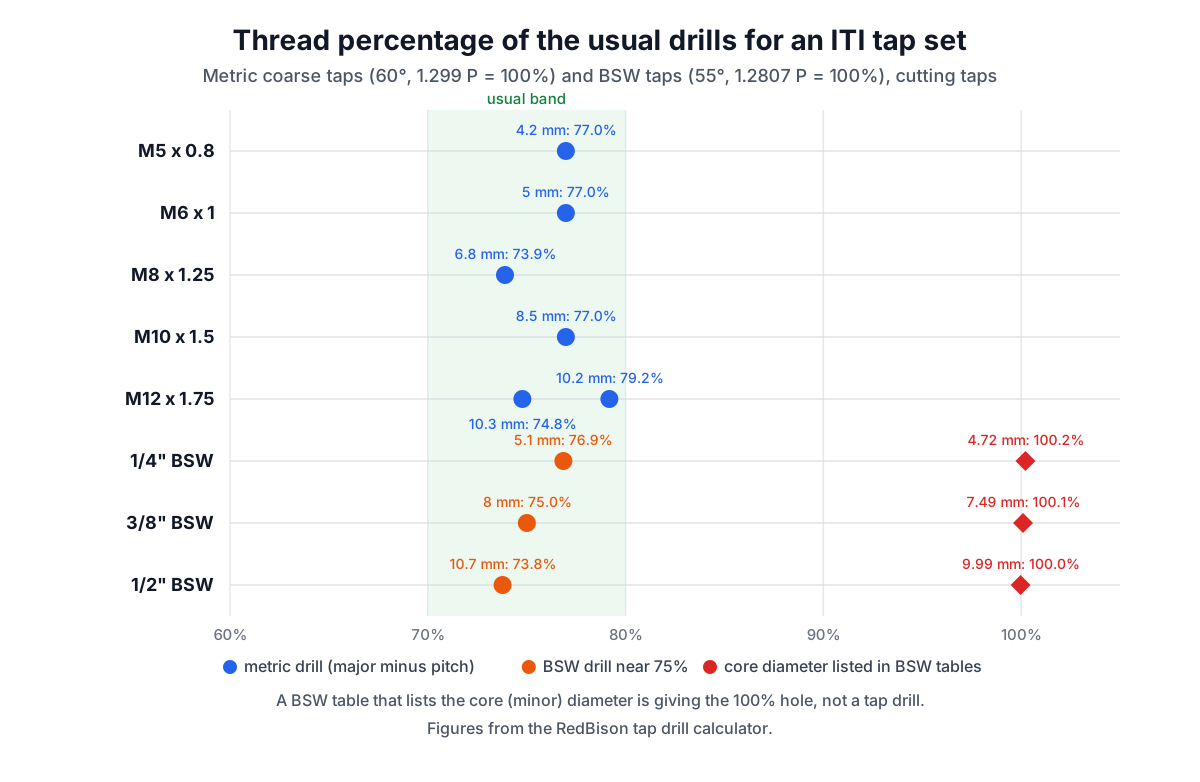
Be careful with BSW tables that list the core diameter as the drill. One common table gives 4.72 mm for 1/4" BSW and 7.49 mm for 3/8" BSW. Those are the minor diameters, so they leave a 100% thread, need the most tapping torque and can break small hand taps. The 75% drills, 5.1 mm and 8.0 mm, are what you want on an M.S. flat.
In hard material, drop the percentage. For M12 in stainless steel, 10.5 mm gives about 66% and still holds well if the thread is at least one diameter long.
GI pipe threads: BSP to IS 554
Galvanised iron (GI) water pipe and its fittings are joined with BSP taper threads that seal on the thread, with tape or hemp and jointing compound. The Indian Standard for those threads is IS 554:1999, "Pipe threads where pressure-tight joints are made on the threads", which the Bureau of Indian Standards adopted as identical to ISO 7-1:1994. It uses three symbols:
- R: taper external thread (on the pipe end).
- Rc: taper internal thread (in a socket, elbow or valve body).
- Rp: parallel internal thread that mates with an R pipe end.
The other BSP standard, ISO 228-1, covers G parallel threads that do not seal on the thread, such as a union nut or a pressure gauge port with a washer.
Pipe sizes are nominal bores, so the size does not tell you the diameter. A 1/2" BSP thread is 20.955 mm across the crests with 14 TPI (pitch 1.814 mm) and a minor diameter of 18.631 mm. A UK pipework table gives 18.75 mm for tapping a taper thread and 19.00 mm for a parallel one. The calculator shows what those leave:
| Thread | Drill | Thread left | Use |
|---|---|---|---|
| Rc 1/2 taper | 18.75 mm | 94.9% | sealing socket, cut with a taper tap |
| G 1/2 parallel | 19.0 mm | 84.1% | port sealed with a washer |
| 1/2" BSP at 75% | 19.2 mm | 75.5% | generic answer; no pipe chart uses it |
The taper drill sits almost on the minor diameter because a taper thread narrows into the hole, so the inner sealing turns need nearly full depth. For 3/4" BSP (14 TPI, 26.441 mm major), the same table gives 24.25 mm for taper (94.3%) and 24.5 mm for parallel (83.5%).
A worked job: bracket on a 10 mm M.S. flat
You need to tap two M10 holes and one 3/8" BSW hole in a 10 mm thick mild steel flat for a machine guard bracket, and fit a 1/2" GI pipe into a drilled and tapped boss.
- M10 x 1.5: drill 8.5 mm right through. The calculator gives 77.0%, and 10 mm of engagement equals one diameter, which is enough in mild steel.
- 3/8" BSW for an old guard bolt: drill 8.0 mm, 75.0%. Use the Whitworth tap from the set, not a 3/8" UNC tap, even though both have 16 TPI; the thread angles differ.
- 1/2" BSP Rc boss: drill 18.75 mm and cut with a taper pipe tap until the pipe makes up hand-tight plus the wrenching turns. If your stand stops at 18.5 mm and 19 mm, 18.5 mm is under the 18.631 mm minor diameter (the tap will trim the bore) and 19 mm leaves 84.1%, which is shallow for a sealing taper thread. Use a boring bar or the correct drill.
Common mistakes on the shop floor
- Confusing TPI and pitch. 20 TPI is a 1.27 mm pitch, not 20 mm or 0.05 mm.
- Cross-matching BSW and metric bolts. 1/4" BSW (6.35 mm, 1.27 mm pitch) and M6 x 1 look alike. Check with a pitch gauge first.
- Drill wander and oversize. A hand-held or worn drill cuts larger than its size, so the thread comes out a few points below the table.
- Blind holes drilled too short. The first three to five threads of a plug tap are chamfered. Drill deeper than the thread length you need.
Tools for this job
- Tap drill size calculator: metric, BSW, BSF and BSP drills in mm with the formula worked step by step.
- Speeds and feeds calculator: drilling rpm for the drill size and material.
- Bolt torque calculator: tightening torque for the bolt in the tapped hole.
For machining parameters, read the CNC speeds and feeds guide for India, and for the joint itself, the bolt torque and preload guide. For pressure piping, follow the fitting maker's drawing and the applicable IS standard.
Frequently asked questions
How do you calculate tap drill size for a metric thread?
Subtract the pitch from the major diameter for about 77% thread: M8 x 1.25 gives 6.75 mm, so use 6.8 mm. For an exact percentage use D − 0.01299 × % × P.
What is the tap drill size for 1/2 inch BSW?
10.7 mm, which leaves 73.8% of a 12 TPI Whitworth thread. A 10.5 mm drill leaves 81.2%. The core diameter, 9.99 mm, is the 100% hole and is too small for hand tapping.
What drill size is used for a 1/2 inch BSP GI pipe thread?
For a taper (Rc) socket that seals on the thread, 18.75 mm, about 94.9% thread. For a parallel G port sealed with a washer, 19.0 mm, 84.1%.
Is IS 554 the same as BSP?
IS 554:1999 is identical with ISO 7-1, which defines the 55° BSP threads that seal on the thread (R, Rc and Rp). Parallel BSP threads that seal with a washer are covered by ISO 228-1 and marked G.
Sources and further reading
- Competency based curriculum: Fitter (CTS 3.0, NSQF level 4), Directorate General of Training. Tapping exercises, the British and metric/BIS tap syllabus and the workshop tool list.
- IS 554:1999 Pipe threads where pressure-tight joints are made on the threads, Bureau of Indian Standards (via Public.Resource.Org). Identical with ISO 7-1:1994; R, Rc and Rp symbols and the 55° form.
- Pipework: BSP threads, dcldesign. Major and minor diameters and the taper and parallel tapping drills used in the BSP table.
- Whitworth coarse thread BSW (BS 84), gewinde-normen.de. BSW threads per inch and the core hole sizes quoted above.
- British Standard Whitworth, Wikipedia. The 55° form and thread depth of 0.640327 × pitch.
- Machinery's Handbook, 32nd Edition, Industrial Press. The percent-of-thread convention for 60° threads.
Open the Tap Drill Size Calculator
More Mechanical
Every tool in the Mechanical section, free and in your browser.
- Torque and Power Calculator
- Gear Ratio Calculator
- Pulley and Belt Calculator
- Bolt Torque Calculator
- Spring Calculator
- Stress and Strain Calculator
- Bearing Life Calculator
- Hydraulic Cylinder Calculator
- Tap Drill Size Calculator
- Speeds and Feeds Calculator
- ISO Fits & Tolerances Calculator
- Bolt Circle Calculator
- Shaft Torsion Calculator
- Shaft Diameter Calculator
- Shaft Key Size Calculator