
Tapping Drill Sizes UK: Metric, BSP and Whitworth Threads
How to pick a tapping drill for metric, BSP and BSW threads, why UK charts disagree on G 1/4 and G 1/2, and how much thread each chart drill really leaves.
By Redbison Dev · · 10 min read
United Kingdom edition. Written for UK workshops, with "tapping drill" wording, metric jobber drills, BSP parallel and taper pipe threads to ISO 228 and ISO 7, and BSW and BSF for restoration work. US edition
A UK tapping drill chart answers one question: which drill leaves enough thread for the tap to cut cleanly and the screw to hold. For ISO metric coarse threads the answer is nearly always the major diameter minus the pitch, so M10 takes 8.5 mm and M8 takes 6.8 mm. The trouble starts with the British 55° threads that still turn up on pipework, hydraulics and old machinery, where two charts can give drills 0.3 mm apart for the same size. This edition explains the arithmetic behind both families so you can see which chart is right for your job, and every figure here can be repeated in the UK tapping drill calculator.
One formula, two thread forms
Percent of thread measures how far the drilled hole sits between the major diameter of the thread (0%) and a reference full depth (100%). The reference depends on the flank angle.
| Thread family | Flank angle | 100% thread on diameter | Tapping drill |
|---|---|---|---|
| ISO metric, UNC, UNF | 60° | 1.299 × P | D − 0.01299 × % × P |
| BSW, BSF, BSP (G and R) | 55° | 1.2807 × P | D − 0.0128 × % × P |
D is the major diameter and P the pitch in millimetres. For an inch-based thread, P is 25.4 divided by the threads per inch (TPI). The 55° constant comes from the Whitworth thread depth of 0.640327 × P on each side; the 60° constant is the shop convention used in Machinery's Handbook. Because the two constants differ by only 1.4%, the drill rarely changes between forms at the same pitch. What changes is the tap: a 55° bolt in a 60° thread bears on only part of each flank.
75% is the usual target for bolts and studs. Going much deeper raises tapping torque sharply for very little extra strength, and in tough material such as stainless steel, 60 to 65% is kinder to the tap.
Metric tapping drills you will use every week
For metric coarse threads the familiar chart drills all fall between about 74% and 79% thread, which is why "major minus pitch" works:
| Thread | Chart drill | Thread it leaves |
|---|---|---|
| M5 x 0.8 | 4.2 mm | 77.0% |
| M6 x 1 | 5.0 mm | 77.0% |
| M8 x 1.25 | 6.8 mm | 73.9% |
| M10 x 1.5 | 8.5 mm | 77.0% |
| M12 x 1.75 | 10.2 mm | 79.2% |
| M12 x 1.75 | 10.3 mm | 74.8% |
| M16 x 2 | 14.0 mm | 77.0% |
| M20 x 2.5 | 17.5 mm | 77.0% |
Fine threads follow the same rule: M10 x 1.25 takes 8.8 mm (73.9%) and M8 x 1 takes 7.0 mm (77.0%). If you are cutting M12 in 304 stainless and taps keep binding, a 10.5 mm drill gives about 66%, which is still a sound thread with more than one diameter of engagement.
Form taps (roll taps) need a larger hole because they displace metal rather than cutting it. At 65% the formula D − 0.0068 × % × P gives 7.45 mm for M8 x 1.25; a 7.4 mm drill gives 70.6% and 7.5 mm gives 58.8%. Check the tap maker's chart before choosing between them.
BSP: parallel, taper and why charts disagree
British Standard Pipe threads are named after the old nominal bore of the pipe, not the thread itself, so the drill cannot be worked out from the name. A G 1/4 thread is 13.157 mm across the crests with 19 TPI, and G 1/2 is 20.955 mm with 14 TPI. There are two kinds:
- G (BSPP), ISO 228-1: parallel threads where the seal is not made on the thread. The joint seals on a bonded washer, O-ring or face.
- R, Rp and Rc (BSPT), ISO 7-1: threads where the pressure-tight joint is made on the thread, with sealant or tape. R is a taper external thread, Rc a taper internal thread and Rp a parallel internal thread that mates with R.
The dcldesign pipework table, a UK reference, lists separate drills for taper and parallel tapping. Running each through the calculator shows how deep each chart goes:
| Size | Minor diameter | Taper chart drill | Thread left | Parallel chart drill | Thread left |
|---|---|---|---|---|---|
| G 1/8 (28 TPI) | 8.566 mm | 8.6 mm | 97.1% | 8.8 mm | 79.9% |
| G 1/4 (19 TPI) | 11.445 mm | 11.5 mm | 96.8% | 11.8 mm | 79.3% |
| G 3/8 (19 TPI) | 14.950 mm | 15.0 mm | 97.1% | 15.25 mm | 82.5% |
| G 1/2 (14 TPI) | 18.631 mm | 18.75 mm | 94.9% | 19.0 mm | 84.1% |
| G 3/4 (14 TPI) | 24.117 mm | 24.25 mm | 94.3% | 24.5 mm | 83.5% |
| G 1 (11 TPI) | 30.291 mm | 30.4 mm | 96.3% | 30.75 mm | 84.5% |
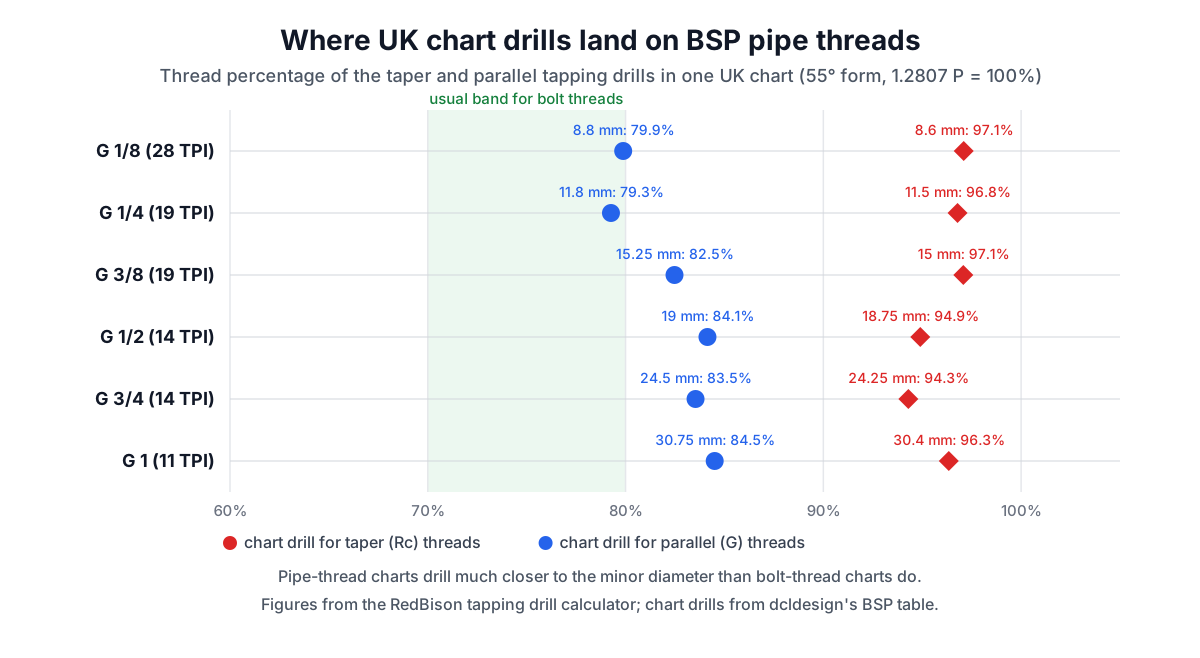
Two things stand out. First, the taper drills sit almost on the minor diameter. A taper thread gets narrower towards the bottom of the hole while a drilled hole is parallel, so the drill has to sit close to the minor diameter for the thread to keep its full form along the length where the seal is made. Second, even the parallel drills run 80 to 85%, deeper than a bolt chart would choose. That is why a generic 75% figure (11.87 mm for G 1/4, 19.21 mm for G 1/2) does not match any pipe chart. Neither is wrong; they serve different joints.
If your metric drills go in 0.5 mm steps above 13 mm, as the calculator's list does, 15.25 mm and 24.25 mm have to be bought as single drills, or the hole opened with a reamer or a boring bar.
Whitworth and BSF on restoration work
BSW (coarse) and BSF (fine) to BS 84 are no longer used for new designs but remain on vintage machinery and in restoration work. They share the 55° form with BSP. Two habits catch people out:
- Tables that list the core diameter. The gewinde-normen BSW table gives 4.72 mm for 1/4" BSW and 7.49 mm for 3/8" BSW. Those are the minor diameters, the 100% hole. Drilling them makes the tap cut a full-depth thread with maximum torque. At 75%, 1/4" BSW takes 5.1 mm (76.9%) and 3/8" BSW takes 8.0 mm (75.0%).
- Coarse Whitworth has deep threads. 1/2" BSW has 12 TPI, so 0.2 mm on the drill moves the thread by several points: 10.5 mm leaves 81.2% and 10.7 mm leaves 73.8%.
BSF is finer at the same diameter: 1/4" BSF has 26 TPI against 20 for BSW. Its tapping drill is therefore larger, 5.4 mm for 75.9%. 3/8" BSF (20 TPI) takes 8.3 mm (75.3%).
A worked example from a UK workshop
You are fitting a G 1/4 pressure gauge port to a 6082 aluminium manifold block, and a 3/8" BSF stud hole in a cast iron gearbox cover from a 1960s British machine.
For the gauge port, open the calculator, choose "BSW / BSF / BSP", pick G 1/4 BSPP and leave 75%. The theoretical drill is 11.873 mm and the nearest drill is 11.9 mm, which leaves 73.4%. The UK parallel chart drill, 11.8 mm, leaves 79.3%. The gauge seals on a bonded washer at the face, so either will hold; in soft alloy the 11.8 mm drill gives a little more grip.
For the stud, pick 3/8" BSF (20 TPI). The calculator gives 8.305 mm, so 8.3 mm (75.3%). In cast iron you could go to 8.4 mm (69.2%) and use a longer engagement of around 1.5 diameters, about 14 mm, rather than drilling smaller. Check the pitch with a 55° gauge first; a metric gauge will not seat on a Whitworth thread.
Mistakes that cost taps
- Running a UNC tap into a BSW hole. 1/4-20 UNC and 1/4" BSW share a 1.27 mm pitch, but the angles differ. At 1/2" the pitch differs too (13 TPI UNC against 12 TPI BSW), and the bolt cross-threads after a turn or two.
- Mixing BSP and NPT. Equipment from the US may carry NPT, a 60° taper thread. A 1/4" NPT has 18 TPI against 19 for G 1/4, so the pair binds.
- Using a parallel drill for a taper tap. An Rc hole drilled at 11.8 mm leaves the narrower inner part of the taper with a shallow thread, which is where the sealing turns are. Use the taper chart drill.
- Forgetting drill oversize. Twist drills usually cut a few hundredths of a millimetre oversize in steel, more if the drill is worn, so the real engagement is a few points below the figure shown.
- Blind holes drilled to thread depth. A plug tap has three to five pitches of lead that do not cut a full thread. Drill deeper than the thread you need.
Tools for this job
- UK tapping drill calculator: metric, BSP, BSW and BSF drills, the thread percentage of any drill you have, and a chart for the whole series.
- UK speeds and feeds calculator: spindle speed for the drill and the tap in your material.
- UK bolt torque calculator: tightening torque and preload once the thread is cut.
The UK guide to CNC speeds and feeds covers cutting speed for drilling and tapping, and the UK guide to bolt torque and preload shows how much clamp force a tapped joint can carry. For a pressure-rated system, follow the fitting maker's port drawing rather than a general chart.
Frequently asked questions
What is the tapping drill for 1/4 BSP?
For a G 1/4 parallel thread, 11.8 mm is the usual UK chart drill and leaves 79.3% thread; 11.9 mm leaves 73.4%. For an Rc 1/4 taper thread, charts give 11.5 mm, which is just above the 11.445 mm minor diameter and leaves 96.8%.
What size drill do I need for a 1/2 BSP tap?
For G 1/2 parallel, 19.0 mm leaves 84.1% of the thread. For Rc 1/2 taper, the dcldesign table gives 18.75 mm (94.9%). Some charts list 18.6 mm, which is under the 18.631 mm minor diameter, so the tap has to trim the bore as well.
Why does my Whitworth table give a smaller drill than this calculator?
Many BSW tables list the core (minor) diameter, which is the 100% hole: 4.72 mm for 1/4" BSW. A tapping drill for 75% thread is larger, 5.1 mm, and much easier on a small hand tap.
Can I use the same drill for BSPP and BSPT?
Some supplier charts list one drill for both, but a taper thread narrows into the hole, so a hole drilled to the parallel size leaves the inner sealing turns shallow. UK pipework tables give a separate, smaller taper drill, such as 11.5 mm against 11.8 mm for 1/4".
What tapping drill does M10 need?
8.5 mm for M10 x 1.5 coarse, which leaves 77.0% thread with a cutting tap. M10 x 1.25 fine takes 8.8 mm (73.9%).
Sources and further reading
- Pipework: BSP threads, dcldesign. Pitch, major and minor diameters and separate taper and parallel tapping drills for BSP sizes, and the ISO 7 and ISO 228 sealing distinction.
- Whitworth coarse thread BSW (BS 84), gewinde-normen.de. TPI, major diameters and the core hole sizes quoted above; 55° flank angle.
- Whitworth fine thread BSF (BS 84), gewinde-normen.de. TPI and diameters of the fine series.
- British Standard Whitworth, Wikipedia. Thread depth of 0.640327 × pitch, the 55° form shared by BSP to ISO 228, and its continued use in restoration work.
- Tapping drill size chart for thread cutting taps, AIMS Industrial. A supplier chart that uses one drill for BSPP and BSPT, for comparison with the UK table.
- Machinery's Handbook, 32nd Edition, Industrial Press. The percent-of-thread convention and form tap formula.
Open the Tap Drill Size Calculator
More Mechanical
Every tool in the Mechanical section, free and in your browser.
- Torque and Power Calculator
- Gear Ratio Calculator
- Pulley and Belt Calculator
- Bolt Torque Calculator
- Spring Calculator
- Stress and Strain Calculator
- Bearing Life Calculator
- Hydraulic Cylinder Calculator
- Tap Drill Size Calculator
- Speeds and Feeds Calculator
- ISO Fits & Tolerances Calculator
- Bolt Circle Calculator
- Shaft Torsion Calculator
- Shaft Diameter Calculator
- Shaft Key Size Calculator