
Gas Costs in L/100 km and Winter Tire Sizes in Canada
Price a road trip in Canadian dollars from L/100 km and cents per litre, read the EnerGuide label, and pick a winter tire size that keeps your speedometer honest.
By Redbison Dev · · 9 min read
Canada edition. Written for Canadian drivers: L/100 km as on the EnerGuide label, Statistics Canada pump prices for September 2026, an EV at an example all-in electricity rate, and winter tire sizing for Quebec's and B.C.'s seasonal rules with speeds in km/h. US edition
Canada measures fuel the metric way, in litres per 100 kilometres, but plenty of Canadians still think in miles per gallon, and every fall a few million of them swap to winter tires, often on smaller rims. Both habits change the numbers your car shows you. This guide prices a trip with the Canadian gas cost calculator, explains the EnerGuide rating and what winter does to it, and then sizes a winter set with the Canadian tire size calculator so the speedometer and odometer stay close to the truth.
L/100 km: lower is better
L/100 km is fuel per distance, the reverse of mpg. A car using 7.8 L/100 km burns 7.8 litres every 100 km, so a trip's fuel is distance x L/100 km / 100, and its cost is that times the price per litre. Pumps show cents per litre, so 184.3 on the sign is CA$1.843.
Statistics Canada put regular unleaded at self-serve stations at 184.3 cents a litre nationally in September 2026, with Toronto at 183.7, Montréal at 198.4, Calgary at 167.3 and Vancouver at 209.5. For a Toronto to Montréal round trip, 541 km each way, in a sedan at 7.8 L/100 km:
- 1,082 km x 7.8 / 100 = 84.40 litres
- 84.40 x CA$1.843 = CA$155.54, or CA$51.85 each for three people
- 14.4 cents per km
Filling up in Montréal for the drive home would cost more per litre, since the city averaged 14.1 cents above the national figure.
What the EnerGuide label tells you
Natural Resources Canada's EnerGuide label gives city, highway and combined ratings in L/100 km. The combined figure weights 55% city and 45% highway driving, and NRCan multiplies it over 20,000 km at a stated fuel price to estimate annual fuel cost. Run the same arithmetic at September's national price:
| Combined rating | Litres over 20,000 km | Cost at CA$1.843 |
|---|---|---|
| 7.8 L/100 km | 1,560 L | CA$2,875.08 |
| 10.5 L/100 km | 2,100 L | CA$3,870.30 |
The thirstier vehicle costs about CA$995 more a year at that price, which is the number to set against a difference in purchase price.
Winter consumption
Labels come from controlled tests, and Canadian winters are anything but controlled. Cold engines, warm-up idling, snow on the road and heaters all push real consumption up, and short trips suffer most. Rather than guess, measure it: fill to the first click, reset the trip odometer, drive normally, fill again and divide the litres by the kilometres. 48.3 litres for 612 km is 7.89 L/100 km.
To see what a winter penalty costs, rerun the trip at a higher figure. If winter driving pushed the sedan 20% above its 7.8 rating, to 9.36 L/100 km, the Toronto to Montréal round trip would take 101.28 litres and cost CA$186.65, CA$31.11 more.
An electric car on the same trip
An EV's equivalent is kWh per 100 km. Electricity rates vary widely by province and utility, so the calculator asks for your all-in price per kWh. As an example, take 20 kWh/100 km, a 10% charging loss and CA$0.20 per kWh:
- 1,082 km x 20 / 100 = 216.4 kWh at the wheels, 240.44 kWh from the wall
- 240.44 x CA$0.20 = CA$48.09, 4.4 cents per km
Cold weather reduces EV range too, and public fast chargers set their own prices, so treat the home figure as a starting point and enter the charger's rate for those kilometres.
Converting from mpg
If a review or an older car quotes mpg, divide 235.2 by US mpg or 282.5 by imperial mpg to get L/100 km. 30 mpg (US) is 7.84 L/100 km. The fill-up above, 7.89 L/100 km, is 29.8 mpg (US).
Reading a tire size
On 225/45R17 91H, 225 is the width in millimetres, 45 the sidewall as a percentage of the width (101.25 mm), R radial, 17 the rim diameter in inches, and 91H the load index and speed rating. The overall diameter is 17 x 25.4 + 2 x 101.25 = 634.3 mm. Winter tires add the three-peak mountain and snowflake pictogram, which Quebec requires on tires used during its winter period.
Sizing a winter set
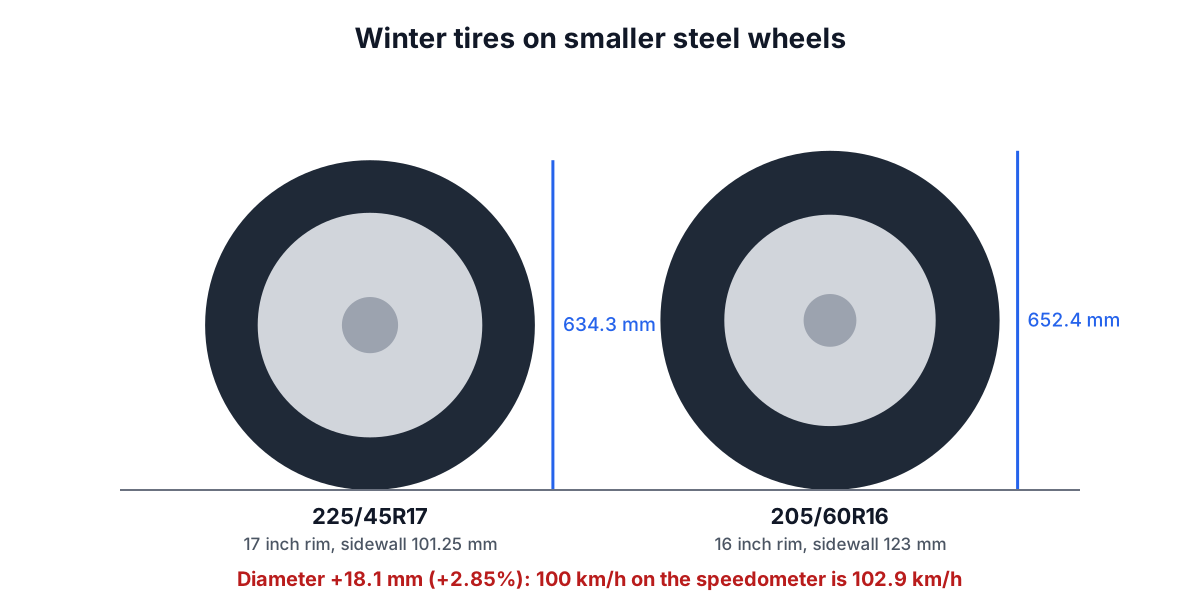
Many drivers buy winter tires on a smaller steel or alloy rim: the tires are often cheaper in smaller sizes, a taller sidewall copes better with potholes and slush, and the set can be swapped at home. The trade-off is that a different size changes the overall diameter, and the speedometer reads by wheel turns. True speed = indicated speed x new diameter / old diameter.
| Change | Diameter | At 100 km/h indicated | Within 3%? |
|---|---|---|---|
| 225/45R17 to 205/60R16 | +18.1 mm, +2.85% | 102.9 km/h | Yes |
| 225/45R17 to 215/60R16 | +30.1 mm, +4.75% | 104.7 km/h | No |
| 235/55R19 to 235/60R18 (SUV) | -1.9 mm, -0.26% | 99.7 km/h | Yes |
| 235/55R19 to 225/65R17 (SUV) | -16.8 mm, -2.27% | 97.7 km/h | Yes |
The tire trade's guideline is to stay within about 3% of the original diameter so speedometer, ABS and stability control stay close to calibration. Check also that the smaller rim clears the brake calipers, and that load index and speed rating meet the vehicle placard.
The same ratio skews winter fuel figures. On 205/60R16 the trip odometer under-counts by 2.85%, so the 612 km fill-up was really about 629.5 km, and 7.89 L/100 km was really 7.67. A winter set can make your car look thirstier than it is.
Winter tire rules by province
- Quebec requires winter tires on passenger vehicles registered in Quebec from December 1 to March 15. Tires must carry the winter pictogram or be studded, the fine for not complying is $200 to $300, and the province's guidance recommends at least 4.8 mm of tread for winter tires, never below 1.6 mm.
- British Columbia requires winter tires or chains on most designated routes from October 1 to April 30, ending March 31 on some routes outside mountain passes and high snowfall areas.
Other provinces and territories set their own rules, and some insurers offer a discount for winter tires, so ask yours.
Tools for this job
The Canadian gas cost calculator prices trips, fill-ups and EV charging. The Canadian tire size calculator compares winter and summer sizes in km/h. The Speed, Distance and Time Calculator plans the drive, and the EV versus gas cost guide for Canada compares the full cost of ownership.
Frequently asked questions
How do I calculate gas cost from L/100 km?
Multiply the distance in kilometres by the L/100 km figure, divide by 100 to get litres, and multiply by the price per litre. 1,082 km at 7.8 L/100 km is 84.40 litres; at CA$1.843 that is CA$155.54.
Can I use smaller rims for winter tires?
Often yes, if the rim clears the brakes and the tire keeps the overall diameter close to stock. 225/45R17 to 205/60R16 is +2.85%, within the usual 3% guideline; 215/60R16 at +4.75% is not.
Why does my fuel consumption look worse with winter tires?
Partly because winter driving really does use more fuel, and partly because a taller winter tire makes the odometer under-count. On 205/60R16 instead of 225/45R17 the odometer misses 2.85% of the distance, which inflates L/100 km by the same proportion.
When are winter tires required in Quebec and B.C.?
Quebec requires them from December 1 to March 15 for vehicles registered in Quebec. B.C. requires winter tires or chains on most designated routes from October 1 to April 30, with some routes ending March 31.
Sources and further reading
- Monthly average retail prices for gasoline and fuel oil, by geography (table 18-10-0001-01), Statistics Canada. September 2026 regular unleaded at self-serve stations.
- EnerGuide for vehicles, Natural Resources Canada. Ratings in L/100 km, the 55/45 combined weighting and the 20,000 km annual cost.
- Requirements for winter tires, Gouvernement du Québec. Dates, pictogram, fines and tread guidance.
- Winter tire and chain-up routes, Government of British Columbia.
- Unit Conversion, US National Institute of Standards and Technology. Exact values for the US gallon and the inch.
More Everyday Calculators
Every tool in the Everyday Calculators section, free and in your browser.
- Age Calculator
- Time Card Calculator
- Time Calculator
- GPA Calculator
- Final Grade Calculator
- Fuel Cost Calculator
- Tire Size Calculator
- Ring Size Converter
- Shoe Size Converter
- Cooking Measurement Converter
- Heat Index Calculator
- Wind Chill Calculator
- Week Number Calculator
- Day of the Week Calculator
- Recipe Scaler
- Unit Price Calculator