
Petrol Cost per km and Tyre Sizes in South Africa
Work out a trip's petrol cost in rand with inland or coastal prices, compare your cost per km with the SARS rate, and check a tyre change against your speedometer.
By Redbison Dev · · 9 min read
South Africa edition. Written for South African drivers: the Department of Mineral and Petroleum Resources' inland and coastal prices for October 2026, the SARS rate per kilometre for the 2027 year of assessment, bakkie diesel, and tyre changes with speeds in km/h. US edition
South African fuel prices are set by government once a month, differ between inland and coastal regions, and in 2026 have moved by large amounts from one month to the next. That makes a quick, honest cost per kilometre more useful here than almost anywhere. This guide prices trips in rand with the South African petrol cost calculator, compares the result with the SARS rate per kilometre used for travel allowances, and then looks at tyre sizes, which quietly change what your speedometer and trip meter tell you.
How the price is set
The Department of Mineral and Petroleum Resources (DMPR) adjusts regulated fuel prices monthly and publishes separate inland and coastal prices. In October 2026 (7 October to 3 November) it set 95 unleaded at R 30,25 a litre inland and R 29,38 at the coast, and 93 unleaded at R 29,88 inland and R 29,01 at the coast. The October adjustment alone added R 3,33 a litre to 95 unleaded. Check the DMPR page for the current month before you rely on these figures.
Diesel works differently: the department regulates its wholesale price, R 31,95 a litre inland for 0.05% sulphur diesel in October, and each retailer sets its own pump price on top. For a bakkie, use the price on the pump where you fill.
A trip in rand
Fuel = distance x L/100 km / 100; cost = fuel x price. For a 600 km holiday drive in a car using 7.5 L/100 km:
| Price used | Litres | Cost | Per km |
|---|---|---|---|
| Inland 95, R 30,25 | 45 | R 1 361,25 | R 2,27 |
| Coastal 95, R 29,38 | 45 | R 1 322,10 | R 2,20 |
The 87c a litre gap is worth R 39,15 on this trip. Return the same way with three people sharing and the 90 litres cost R 2 722,50, or R 907,50 each. Tolls are extra.
A bakkie using 9.5 L/100 km on the same 600 km needs 57 litres. At the inland wholesale diesel price of R 31,95 that is R 1 821,15, about R 3,04 a km, before the retailer's margin.
km/l or L/100 km
Many South Africans know their car's consumption as kilometres per litre. The conversion is 100 divided by the figure: 12.94 km/l is 7.73 L/100 km. The calculator accepts either.
Your real consumption
Brochure figures come from a laboratory cycle. To measure your own, fill to the first click, reset the trip meter, drive normally, fill again and divide: 47.3 litres after 612 km is 7.73 L/100 km. If the brochure said 6.5, your trips cost about 19% more than a brochure-based estimate. Average over a few tanks for a steady figure.
Your cost per km against the SARS rate
If your employer pays a travel allowance, SARS's rate per kilometre schedule sets the cost scale used to work out the taxable part. The schedule for the 2027 year of assessment took effect on 1 March 2026 and splits the cost per kilometre into fixed cost, fuel and maintenance for nine vehicle value bands. The fuel figure runs from 132,9c a km for a vehicle worth up to R 115 000 to 220,1c above R 805 000. Where no other allowance is paid, a simplified rate of 495c a km applies.
The table is fixed for the year, but pump prices are not. In March 2026, 95 unleaded cost R 20,30 inland; in October it was R 30,25. For a car using 7.0 L/100 km driven 1 500 business km in a month:
| Price | Fuel cost | Per km |
|---|---|---|
| March 2026, R 20,30 | R 2 131,50 | 142,1c |
| October 2026, R 30,25 | R 3 176,25 | 211,75c |
For a vehicle valued between R 115 000 and R 230 000, the scale's fuel figure is 148,4c. At March prices this car's real fuel cost was close to it; at October prices it is about 63c a km higher. Keep a logbook of all kilometres, business and private, because the fixed-cost part divides by the total distance you travel in the year. A registered tax practitioner can tell you how the scale applies to your package.
Reading a tyre size
On 185/60 R15 84H, 185 is the width in millimetres, 60 the sidewall as a percentage of the width (111 mm), R radial, 15 the rim in inches, and 84H the load index and speed rating. Overall diameter: 15 x 25.4 + 2 x 111 = 603.0 mm.
Changing tyre size and the speedometer
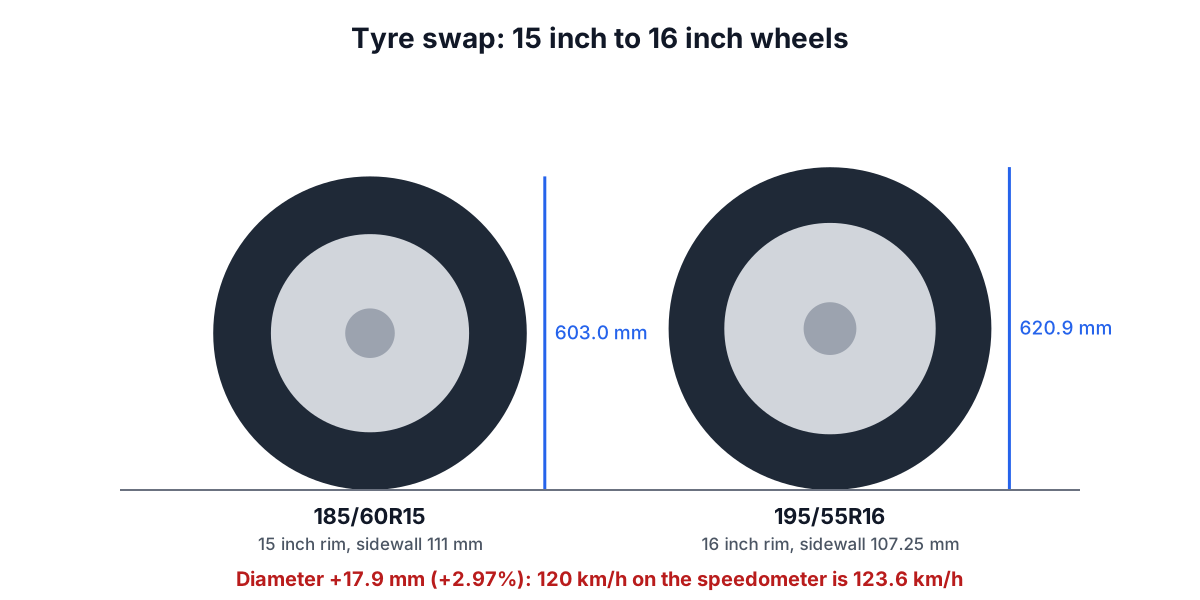
The speedometer counts wheel turns, so a taller tyre means you are going faster than it shows: true speed = indicated speed x new diameter / old diameter.
| Change | Diameter | At an indicated speed | Within 3%? |
|---|---|---|---|
| 185/60R15 to 195/55R16 (bigger mags) | +17.9 mm, +2.97% | 120 km/h is 123.6 km/h | Just |
| 185/60R15 to 195/50R16 | -1.6 mm, -0.27% | 120 km/h is 119.7 km/h | Yes |
| Bakkie 195/80R15 to 215/75R15 | +10.5 mm, +1.52% | 100 km/h is 101.5 km/h | Yes |
The tyre trade's rule of thumb is to stay within about 3% of the original diameter. The 195/55R16 sits right at the edge; the 195/50R16 keeps the car almost exactly where it was. Load index and speed rating must be at least the original specification, and your insurer may count a change of wheel and tyre size as a modification to declare.
Taller tyres also make the trip meter under-count, which makes your consumption look worse than it is. On 195/55R16 instead of 185/60R15, 612 km on the meter is really about 630.2 km, and 7.73 L/100 km is really 7.51.
Tools for this job
The South African petrol cost calculator prices trips with inland or coastal prices and compares your cost per km. The Tyre Size Calculator compares sizes in millimetres and km/h. The South African electricity cost calculator works out what charging or appliances cost at your tariff, and the wear-and-tear allowance guide covers the tax side of a business vehicle.
Frequently asked questions
Why is petrol cheaper at the coast than inland?
The DMPR sets separate regulated prices for inland and coastal regions. In October 2026 (7 October to 3 November), 95 unleaded cost R 30,25 inland and R 29,38 at the coast, 87c a litre less.
How do I work out petrol cost per km?
Multiply your L/100 km by the price per litre and divide by 100. At 7.5 L/100 km and R 30,25 that is R 2,27 a km; at 7.0 L/100 km it is R 2,12.
Does the SARS fuel cost per km change when petrol goes up?
No. The rate per kilometre schedule is fixed for the year of assessment from 1 March. In March 2026, when the 2026/27 table began, 95 unleaded cost R 20,30 inland; in October it was R 30,25.
Will bigger mags and tyres affect my speedometer?
Yes, by the change in overall diameter. 195/55R16 instead of 185/60R15 is 2.97% taller, so 120 km/h on the speedometer is 123.6 km/h.
Sources and further reading
- Fuel prices, Department of Mineral and Petroleum Resources. Inland and coastal prices for October 2026 (7 October to 3 November) and the monthly adjustments; the 2026 price history.
- Rate per Kilometre Schedule (2027 tax year), South African Revenue Service. Fixed, fuel and maintenance cost by vehicle value, and the simplified 495c rate.
- Rates per kilometre, South African Revenue Service.
- Unit Conversion, US National Institute of Standards and Technology. Exact value of the inch.
- Tire Safety: Everything Rides On It, US National Highway Traffic Safety Administration. Reading load index and speed rating.
More Everyday Calculators
Every tool in the Everyday Calculators section, free and in your browser.
- Age Calculator
- Time Card Calculator
- Time Calculator
- GPA Calculator
- Final Grade Calculator
- Fuel Cost Calculator
- Tire Size Calculator
- Ring Size Converter
- Shoe Size Converter
- Cooking Measurement Converter
- Heat Index Calculator
- Wind Chill Calculator
- Week Number Calculator
- Day of the Week Calculator
- Recipe Scaler
- Unit Price Calculator