
Petrol Costs, UK mpg and Tyre Sizes Explained
Journey cost from UK mpg and pence per litre, HMRC mileage and advisory fuel rates, home EV charging, and how a tyre size change moves your speedometer.
By Redbison Dev · · 9 min read
United Kingdom edition. Written for UK drivers: litres at the pump and mpg on the 4.546 litre imperial gallon, DESNZ pump prices, HMRC mileage and advisory fuel rates, the Ofgem price cap for home charging, and tyre sizes with speeds in mph and the 1.6 mm tread law. US edition
British motoring maths has a quirk that catches out almost everyone at some point: fuel is sold by the litre, yet economy is quoted in miles per gallon, and the gallon is the imperial one of 4.546 litres. Get that right and a journey cost is two lines of arithmetic. This guide works through it with the UK petrol cost calculator, adds the HMRC rates that business drivers are paid against, prices home charging for an electric car, and then turns to the other number on the car that changes what the dashboard tells you: the tyre size, with the UK tyre size calculator.
A journey in pounds and pence
The method is the same for every trip:
- Turn mpg into litres per mile: 4.546 litres divided by the mpg.
- Multiply by the miles to get litres.
- Multiply by the pump price in pounds per litre.
For a run from London to Manchester and back, 200 miles each way, in a petrol car doing 45 mpg, at the UK average of 172.78p a litre that the Department for Energy Security and Net Zero recorded for the week of 2 November 2026:
- 400 miles x 4.546 / 45 = 40.41 litres
- 40.41 x £1.7278 = £69.82, or £34.91 each for two people sharing
- 17.5p a mile
The most common slip is the price. A forecourt sign of 172.8 is pence, so the calculator wants 1.728; type 172.8 and the cost comes out a hundred times too high.
Diesel tells a different story from the price board. DESNZ recorded diesel at 198.58p a litre the same week, 26p more than petrol. A diesel doing 55 mpg covers the 200 miles one way for £32.83, 16.4p a mile, only a little cheaper than the 45 mpg petrol car at 17.5p. Compare cars on pence per mile, never on mpg alone.
UK mpg is not US mpg
US websites and forums quote mpg on the US gallon of 3.785 litres. The same car therefore has a smaller mpg figure in American sources. 45 mpg in the UK is 37.5 mpg (US), or 6.28 L/100 km. If a review says a car does "38 mpg" and it comes from an American source, it is roughly as frugal as a UK 45 mpg car, not worse.
L/100 km, the measure on most of the Continent, runs the other way: lower is better. It is the more honest measure for comparing savings, because the litres you save fall less and less as mpg climbs. Moving from 30 to 40 mpg over 10,000 miles saves about 379 litres; moving from 50 to 60 mpg saves about 152.
Your real mpg from a fill-up
Brochure figures come from a laboratory test, and motorway driving at 70 mph or above usually does worse. To find your own figure:
- Fill to the first click and reset the trip meter.
- Drive normally until the next fill.
- Fill to the first click again and note the litres on the receipt.
412 miles on 41.6 litres is 45.0 mpg (UK), 6.27 L/100 km. One tank is noisy, so average three or four. The calculator's fill-up mode does the division and shows every unit.
What HMRC pays per mile
If you use your own car for work, approved mileage allowance payments are 55p a mile for the first 10,000 business miles in a tax year from 6 April 2026 and 25p after that. That covers fuel and wear together. At the November pump price the 45 mpg car's fuel is 17.5p a mile, so most of the allowance is meant for depreciation, servicing, tyres and insurance.
Company car drivers meet a different number. HMRC's advisory fuel rates set what an employer can repay per mile for business fuel without a tax charge, and they are reviewed on 1 March, 1 June, 1 September and 1 December. The rate from 1 September 2026 for a 1,401 to 2,000cc petrol car is 17p a mile, built from 42.8 mpg and 159.9p a litre. At 172.78p the same car costs 18.35p a mile, so a driver repaid at 17p is about 1.35p a mile short until the next review. Run your own car's figures to see where you stand.
An electric car on a home tariff
For an EV the equivalent of mpg is miles per kWh, and what you pay for is the electricity drawn from the wall, which includes charging losses. Take a car doing 3.5 miles per kWh on the same 400 mile round trip, charged at home with a 10% loss, at 26.32p per kWh, Ofgem's average direct debit unit rate under the price cap for 1 October to 31 December 2026:
- 400 / 3.5 = 114.3 kWh at the wheels, 127.0 kWh from the wall
- 127.0 x £0.2632 = £33.42, about 8.4p a mile
That is under half the petrol car's 17.5p. A time-of-use EV tariff can cut it further, while public rapid chargers cost a lot more than the price cap rate, so type the price on the charger when you use one.
Reading a UK tyre size
The sidewall of most UK cars carries a size such as 205/55 R16 91V:
- 205: width in millimetres
- 55: sidewall height as a percentage of width, here 112.75 mm
- R: radial construction
- 16: wheel diameter in inches
- 91V: load index and speed rating, which must meet the car's specification
From those: overall diameter = 16 x 25.4 + 2 x 112.75 = 631.9 mm, and the tyre turns about 504 times per kilometre.
Changing size and the speedometer
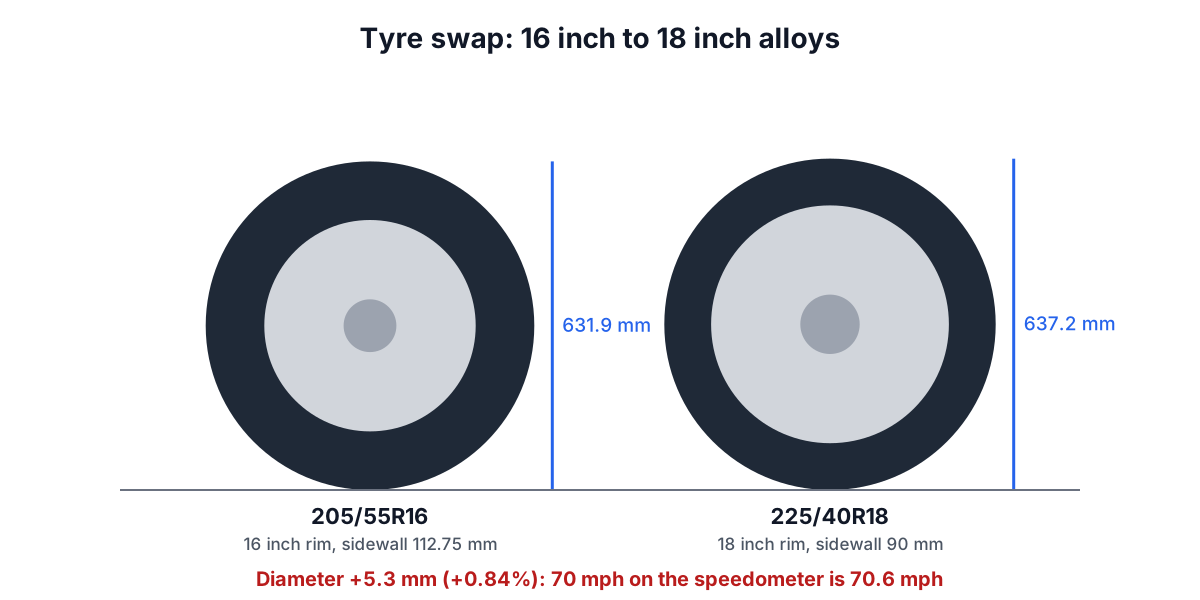
Your speedometer counts wheel turns and assumes the original tyre size. Fit a taller tyre and each turn covers more road, so true speed = indicated speed x new diameter / old diameter. Three common UK changes:
| Change | Diameter | Indicated | True speed |
|---|---|---|---|
| 205/55R16 to 225/40R18 (bigger alloys) | +5.3 mm, +0.84% | 70 mph | 70.6 mph |
| 205/55R16 to 215/55R16 (wider, same wheel) | +11.0 mm, +1.74% | 30 mph | 30.5 mph |
| 225/45R17 to 215/60R16 (winter set) | +30.1 mm, +4.75% | 70 mph | 73.3 mph |
The trade keeps a replacement within about 3% of the original diameter; the winter set above is outside it, while 205/60R16 at +2.85% would be inside. The UK Construction and Use Regulations require a speedometer and allow vehicles to meet ECE Regulation 39 instead, and type-approved speedometers are set up not to read below true speed, so a car on its original tyres usually reads a little high. A taller tyre eats into that margin, and in a 30 mph zone with cameras, half a mile an hour matters.
The same ratio skews your fuel figures. On 205/60R16 instead of 225/45R17 the trip meter under-counts by 2.85%, so the 412 miles on the meter were really about 423.8, and the 45.0 mpg fill-up result was really 46.3 mpg.
The legal side of tyres
Regulation 27 of the Road Vehicles (Construction and Use) Regulations 1986 makes it an offence to use a car with tyres unsuitable for the use or mixed unsuitably with others on the vehicle, and sets the minimum tread for cars and light vans at 1.6 mm across the central three-quarters of the tread, around the whole circumference. Check the handbook for approved sizes, keep load and speed ratings at least as high as the original, and tell your insurer before fitting non-standard wheels or sizes, since many treat them as modifications.
Tools for this job
The UK petrol cost calculator prices journeys, finds your real mpg and handles EV charging. The UK tyre size calculator compares sizes in millimetres with speeds in mph. For journey times, the Speed, Distance and Time Calculator plans the drive, and the UK electricity cost calculator prices charging alongside the rest of your bill.
Frequently asked questions
How do I convert UK mpg to litres per 100 km?
Divide 282.5 by the UK mpg figure. 45 mpg (UK) is 6.28 L/100 km. For US mpg divide 235.2 instead, which is why the same car shows about 37.5 mpg in American sources.
How much does HMRC allow per mile for fuel in a company car?
That is the advisory fuel rate, set by engine size and fuel type and reviewed quarterly. From 1 September 2026 a 1,401 to 2,000cc petrol car is 17p a mile, based on 159.9p a litre; at 172.78p a litre the real fuel cost of the same car is 18.35p.
Does a bigger tyre make my speedometer read low?
Yes, by the same percentage as the diameter grows. Going from 225/45R17 to 215/60R16 adds 4.75%, so 70 mph on the dial is 73.3 mph on the road.
What is the legal minimum tyre tread in the UK?
1.6 mm for cars, light vans and light trailers, across a continuous band in the central three-quarters of the tread and around the whole tyre, under regulation 27 of the Construction and Use Regulations 1986.
Sources and further reading
- Weekly road fuel prices, Department for Energy Security and Net Zero. UK average pump prices; 172.78p petrol and 198.58p diesel for the week of 2 November 2026.
- Advisory fuel rates, HM Revenue and Customs. Rates from 1 September 2026 and the quarterly review dates.
- Business travel mileage for employees' own vehicles, GOV.UK. 55p and 25p a mile from 6 April 2026.
- Energy price cap unit rates and standing charges, Ofgem. 26.32p per kWh by direct debit, 1 October to 31 December 2026.
- The Road Vehicles (Construction and Use) Regulations 1986, regulation 27, legislation.gov.uk. Unsuitable tyres and the 1.6 mm tread rule.
- The Road Vehicles (Construction and Use) Regulations 1986, regulation 35, legislation.gov.uk. Speedometers in mph and km/h, and ECE Regulation 39 as an alternative.
- Weights and Measures Act 1985, Schedule 1, legislation.gov.uk. The imperial gallon.
More Everyday Calculators
Every tool in the Everyday Calculators section, free and in your browser.
- Age Calculator
- Time Card Calculator
- Time Calculator
- GPA Calculator
- Final Grade Calculator
- Fuel Cost Calculator
- Tire Size Calculator
- Ring Size Converter
- Shoe Size Converter
- Cooking Measurement Converter
- Heat Index Calculator
- Wind Chill Calculator
- Week Number Calculator
- Day of the Week Calculator
- Recipe Scaler
- Unit Price Calculator