
Three-Phase Power Formula in Canada: 600 V and 208 V
The √3 formula on Canadian 347/600 V and 120/208 V services: hp to amps at 600 V, why 347 V lighting works, chargers on 208 V and per-phase loading.
By Redbison Dev · · 10 min read
Canada edition. Uses the 347/600 V and 120/208 V wye services Canadian utilities supply at 60 Hz, motors in hp under the federal efficiency rules, and the Canadian Electrical Code for the wiring step. US edition
A 10 hp motor on a 600 V three-phase service, at 91% efficiency and power factor 0.85, draws 9.3 A in each line. Put the same motor on a 208 V service and it draws 26.8 A. That factor of almost three is the main attraction of a 347/600 V service for a larger building, and it falls straight out of the formula P = √3 × V × I × PF. This edition works the formula for the voltages Canadian utilities supply. Every figure can be reproduced in the Canadian three-phase power calculator.
Canadian service voltages
BC Hydro's list of standard secondary services is one example: 120/240 V single-phase, three-wire; 120/208 V wye, three-phase, four-wire; and 347/600 V wye, three-phase, four-wire. It lists 277/480 V wye and 240 V, 480 V and 600 V delta only as non-standard, metered sub-services that need customer-supplied transformers. Other utilities publish their own conditions of service, so check yours. Canadian systems run at 60 Hz.
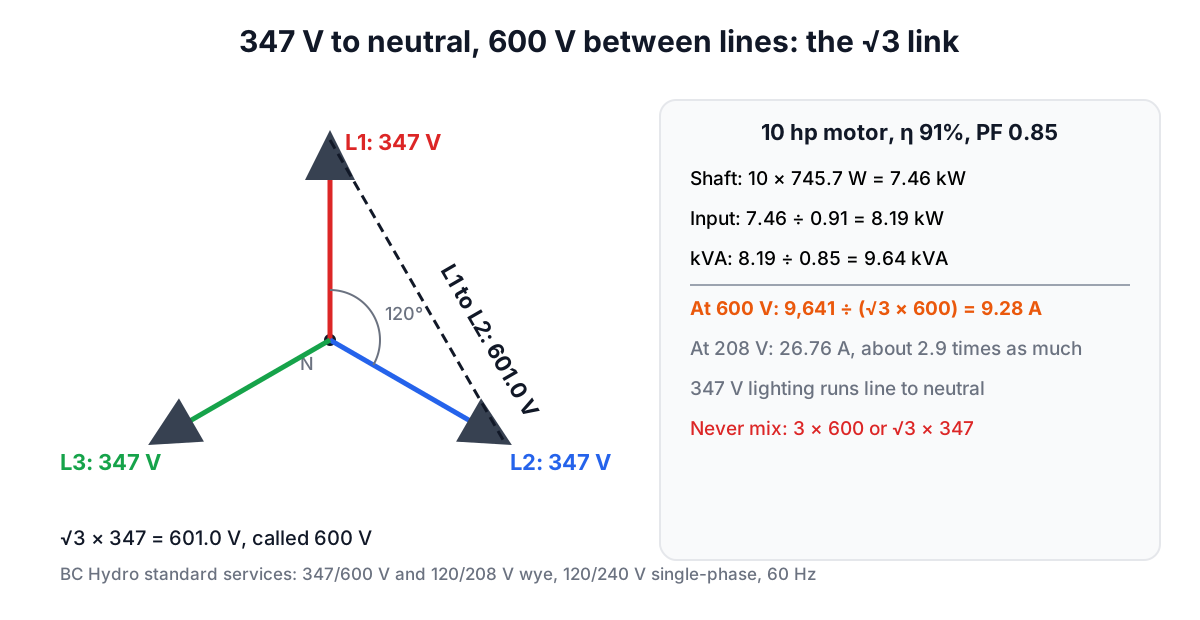
In each wye pair, the smaller number is line to neutral and the larger is line to line, and they differ by √3: 120 × 1.732 = 207.8 V, called 208 V, and 347 × 1.732 = 601.0 V, called 600 V. The √3 comes from the geometry. The three phase voltages are 120° apart, and the voltage between two lines is the length of the gap between two such phasors, 2 × sin 60° = √3 times either one.
Same load, two forms of the formula
A balanced load takes V(LN) × I × PF from each phase, so the total is 3 × V(LN) × I × PF, or, with V(LN) = V(LL) ÷ √3, the familiar √3 × V(LL) × I × PF. On a 600 V service with 100 A per line at power factor 0.85:
| Measured voltage | Formula | Real power | Apparent power |
|---|---|---|---|
| 600 V line to line | √3 × 600 × 100 × 0.85 | 88.33 kW | 103.92 kVA |
| 347 V line to neutral | 3 × 347 × 100 × 0.85 | 88.49 kW | 104.10 kVA |
The 0.2% gap is the rounding of 601 V to 600 V. The real errors are 3 × 600, which overstates the load by 73%, and √3 × 347, which understates it by 42%. In the calculator, choose line to line for 600 V or 208 V and line to neutral for 347 V or 120 V, and the two agree.
Why 347 V lighting and 600 V feeders
The 347 V leg makes the 600 V system convenient in commercial buildings: lighting connects line to neutral and runs directly from the service, with no step-down transformer. Receptacles and small equipment then come from 600 to 120/208 V dry-type transformers.
The current saving is large. A 30 kW load at power factor 0.95 draws 87.65 A per line at 208 V and only 30.39 A at 600 V. Smaller conductors, smaller switchgear and less voltage drop follow from that. The Canadian transformer sizing guide picks up the 600 V to 208 V step.
Motors: horsepower in, amps out
The federal Energy Efficiency Regulations, 2016 state motor sizes in both hp and kW: Natural Resources Canada regulates motors from 0.75 kW (1 hp) to 375 kW (500 hp) with a nominal voltage of not more than 600 V AC, at 50, 50/60 or 60 Hz. For most such motors made on or after June 1, 2016, efficiency is set by NEMA MG-1, Table 12-12.
The nameplate hp is shaft output. One hp is 745.7 W, so the current is:
I = (hp × 745.7) ÷ (η × √3 × V × PF)
| 10 hp motor, η 91%, PF 0.85 | Current per line |
|---|---|
| 600 V | 9.28 A |
| 575 V nameplate voltage | 9.68 A |
| 208 V | 26.76 A |
If the nameplate gives 575 V, calculate at 575 V; the current is 4% higher than at 600 V. For conductor and overcurrent sizing, the Canadian Electrical Code, Part I, as adopted by your province, governs; use it, not this running estimate, for the wiring. Starting current is several times the running figure and needs its own check.
Chargers and heaters on 208 V
In a building with a 120/208 V service, a "240 V" appliance connected between two lines sees 208 V. For a charger limited to a set current, power falls in proportion: a 48 A charger delivers 11.52 kW at 240 V and 9.98 kW at 208 V, 13% less. A resistive heater rated at 240 V does worse, because its power falls with the square of voltage: (208 ÷ 240)² = 75% of its rating.
Unbalanced panels: one phase at a time
A 347 V lighting panel or a 120/208 V receptacle panel is rarely balanced. Work each phase line to neutral and size from the heaviest.
Take a 347/600 V lighting panel with 30 kVA on phase A, 24 kVA on B and 21 kVA on C. The phase currents are 86.5 A, 69.2 A and 60.5 A. The balanced formula on the 75 kVA total would give 72.2 A per line and undersize phase A by 17%. With resistive loads, the neutral carries √(86.5² + 69.2² + 60.5² − 86.5×69.2 − 69.2×60.5 − 60.5×86.5) = 22.9 A. A load connected line to line, such as a 208 V water heater, draws P ÷ (V × PF) from two lines and nothing from the third.
Power factor
Real power is S × PF, and reactive power is S × sin(arccos PF). For the 100 A, 600 V example, that is 88.33 kW and 54.74 kVAR out of 103.92 kVA. Where demand is billed in kVA, it is the 103.92 that counts; correcting the power factor reduces the kVA for the same kW.
Frequently asked questions
What three-phase voltages are standard in Canada?
BC Hydro's standard secondary services are 120/208 V and 347/600 V wye, three-phase, four-wire, plus 120/240 V single-phase, three-wire. It lists 277/480 V wye and 600 V delta as non-standard options that need customer-supplied transformers. Other utilities set their own conditions of service.
How many amps does a 10 hp motor draw at 600 V?
About 9.3 A per line at 91% efficiency and power factor 0.85, or 9.7 A at a 575 V nameplate voltage. For wiring and protection, use the nameplate current and the Canadian Electrical Code as adopted in your province.
Why does a 240 V heater give less heat on a 208 V service?
Its resistance is fixed, so power falls with the square of the voltage. At 208 V it delivers (208 ÷ 240)² = 75% of its rated output.
How do I size a feeder for an unbalanced 347 V lighting panel?
Calculate each phase at 347 V and use the heaviest. With 30, 24 and 21 kVA on phases A, B and C, phase A carries 86.5 A, while the balanced formula would suggest 72.2 A.
Do federal efficiency rules cover my motor?
If it is rated 1 to 500 hp (0.75 to 375 kW) at no more than 600 V AC, it falls within the scope Natural Resources Canada lists; for most motors made on or after June 1, 2016, the efficiency is set by NEMA MG-1, Table 12-12.
Sources and further reading
- Electrical service voltages, BC Hydro. Standard 120/240 V, 120/208 V and 347/600 V services and the non-standard options.
- Electric motors (1 to 500 HP/0.746 to 375 kW), Natural Resources Canada. Scope, NEMA MG-1 Table 12-12 and effective dates.
- CSA C22.1:24, Canadian Electrical Code, Part I, Standards Council of Canada catalogue entry.
- NIST Special Publication 811, National Institute of Standards and Technology. Appendix B unit conversion factors.
- IEC 60038: IEC standard voltages, International Electrotechnical Commission.
- The three-phase power formula (US edition), for 277/480 V systems and NEC motor tables.
Open the Three-Phase Power Calculator
More Electrical
Every tool in the Electrical section, free and in your browser.