
Three-Phase Power Formula Australia: kW to Amps at 400 V
Using √3 × 400 × I × PF on an Australian 230/400 V supply: motor kW to amps, when a motor must go three-phase, starting current limits and the 0.9 power factor rule.
By Redbison Dev · · 10 min read
Australia edition. Worked on the 230/400 V, 50 Hz supply in the Service and Installation Rules of NSW, with its phase, motor-starting and power factor limits; other states' distributors publish their own rules. US edition
A 22 kW motor on an Australian 400 V three-phase supply, with 92.6% efficiency and power factor 0.86, draws 39.9 A in each line. That is the running current from P = √3 × V × I × PF, and in Australia it is only half of the job: your distributor's service rules also decide whether the motor may go on single phase at all, how much current it may draw while starting, and what power factor the site must hold. This edition works the formula on the 230/400 V supply and shows where the Service and Installation Rules of NSW step in. The figures can be reproduced in the Australian three-phase power calculator.
The supply: 230/400 V, three-phase, four-wire
Clause 1.11.1 of the Service and Installation Rules of NSW (April 2026 edition) describes the supply as an approximately sinusoidal 50 Hz wave at a nominal 230/400 V from a three-phase, four-wire distribution system, and refers to AS IEC 60038:2022 for standard voltages. In outlying areas the supply may instead come from a 230/460 V two-phase, three-wire system, whose two phases are 180° apart rather than 120°. The rules also tell customers to contact the distributor if the 10-minute average voltage at the main switchboard is above 253 V with no load or generation connected.
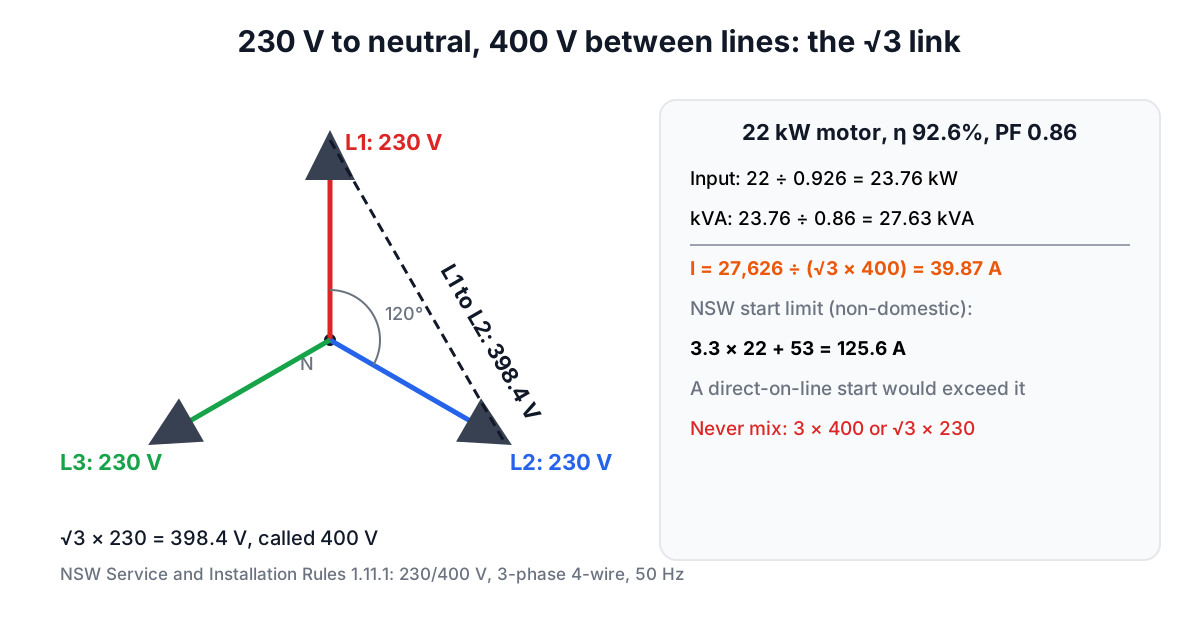
On the normal three-phase system, 230 V is each active to neutral and 400 V is between two actives. The two differ by √3 because the three phases are 120° apart: 230 × 1.732 = 398.4 V, rounded to 400 V. Older drawings and plates may say 240/415 V; the same √3 relationship holds.
The formula in both forms
A balanced load takes 230 × I × PF from each phase, so the total is 3 × 230 × I × PF, which is the same as √3 × 400 × I × PF. For 100 A per line:
| Power factor | Apparent power | Real power |
|---|---|---|
| 1.0 | 69.28 kVA | 69.28 kW |
| 0.9 | 69.28 kVA | 62.35 kW |
The traps are using 3 with 400 V (73% too high) or √3 with 230 V (42% too low). Pick "3-phase line to line" at 400 V or "line to neutral" at 230 V in the calculator and the two agree to within the 0.4% rounding of 398.4 V.
Motors: kW out, amps in
A motor's rated output in kW is its shaft output. The supply provides that plus the losses, so divide by efficiency first:
I = (rated kW × 1000) ÷ (η × √3 × 400 × PF)
For the 22 kW motor: input 22 ÷ 0.926 = 23.76 kW, apparent power 23.76 ÷ 0.86 = 27.63 kVA, current 39.87 A per line. In the calculator choose "Motor rated output (kW)"; entering the plate figure as real power would leave out the motor's losses and understate the current.
When the service rules require three phases
Table 1-1 of the NSW rules sets the number of phases:
| Situation | Phases required |
|---|---|
| Maximum demand not exceeding 100 A per phase | 1, 2 or 3 phases and neutral |
| Maximum demand exceeding 100 A per phase | 3 phases and neutral |
| A motor exceeding 2 kW | 3 phases and neutral |
Maximum demand is determined under AS/NZS 3000. The 100 A per phase line is 69.28 kVA on three phases at 400 V, or 62.35 kW at power factor 0.9.
A 2.2 kW bore or pool pump at 80% efficiency and power factor 0.9 draws 13.29 A on a single 230 V phase; as a three-phase motor at 85% and 0.8 it draws 4.67 A per line. Under Table 1-1 the 2.2 kW motor needs three phases, so ask the distributor before buying a single-phase unit.
Starting current: the limit that often decides
Clause 1.17.2.4 requires that a motor's starting current must not reduce the voltage at the connection point by more than 5% for more than 20 milliseconds, and Table 1-3 gives a general guide:
| Motor type | Starting current limit |
|---|---|
| Single phase, 230 V | 45 A |
| Three-phase 400 V, domestic | 53 A |
| Three-phase 400 V, non-domestic | 3.3k + 53 A |
| Three-phase 400 V, lift motor | 200 A |
| Three-phase 400 V, fire and smoke control equipment | 1.5 × (3.3k + 53) A |
Here k is the continuous output in kW of the largest motor, or group of motors started together. For the 22 kW motor in a non-domestic installation the limit is 3.3 × 22 + 53 = 125.6 A, about three times its 39.9 A running current. A direct-on-line start of an induction motor draws several times running current, so a motor of this size usually needs a soft starter, star-delta starter or variable speed drive to stay inside the limit. The motor maker's data gives the starting current to compare. The distributor may agree to exempt some equipment (clause 1.17.2.5).
Power factor: hold 0.90 or better
Clause 6.1.1 of the NSW rules requires the customer to keep the maximum demand power factor between 0.90 lagging and unity, and says correction equipment must not make the installation leading at any time. Power factor changes the current for the same work:
| 60 kW load at 400 V | Apparent power | Current per line |
|---|---|---|
| PF 0.8 | 75.0 kVA | 108.3 A |
| PF 0.9 | 66.7 kVA | 96.2 A |
Lifting this load from 0.8 to 0.9 takes 15.94 kVAr of capacitors and cuts the current by 11%. The Australian power factor correction guide explains the sizing, and the power factor calculator works it at 400 V and 50 Hz. The rules require shunt capacitors to comply with IEC 60831-1.
Unbalanced switchboards
A switchboard that feeds single-phase circuits from a three-phase supply is rarely balanced. Work each phase at 230 V and let the heaviest phase decide. With 40 A, 30 A and 20 A on the three phases, the balanced formula on the total would suggest 30 A per line and hide the 40 A phase. The neutral carries the imbalance: √(40² + 30² + 20² − 40×30 − 30×20 − 20×40) = 17.3 A for resistive loads.
From current to cable
The running current is where cable selection begins, under the Australian wiring standards, with the distributor's rules on top. Have a licensed electrician design the circuit; in Victoria, for example, Energy Safe Victoria says a Certificate of Electrical Safety must be issued for all electrical installation work. For a site large enough to need its own transformer, the Australian transformer sizing guide and transformer calculator take the kVA from here.
Frequently asked questions
When do I need three-phase power in NSW?
Under Table 1-1 of the Service and Installation Rules of NSW, when maximum demand exceeds 100 A per phase or when a motor exceeds 2 kW. Other states' distributors set their own thresholds, so check your local rules.
How many amps does a 22 kW motor draw at 400 V?
About 39.9 A per line at 92.6% efficiency and power factor 0.86. Its starting current is several times higher, and in a non-domestic installation in NSW it is limited to 3.3 × 22 + 53 = 125.6 A.
Is Australian three-phase 400 V or 415 V?
The nominal supply is 230/400 V, as in clause 1.11.1 of the NSW rules. Older equipment and drawings may say 240/415 V. Use the voltage on your drawing consistently.
What power factor does my business have to maintain?
Under clause 6.1.1 of the NSW rules, between 0.90 lagging and unity at maximum demand, without ever going leading. A 60 kW load at 0.8 needs about 15.9 kVAr of correction to reach 0.9.
What is a 230/460 V supply?
A two-phase, three-wire supply used in some outlying areas, with the two phases 180° apart. The NSW rules say to contact the distributor for advice on supply arrangements in those areas.
Sources and further reading
- Service and Installation Rules of NSW (April 2026), NSW Government. Clause 1.11 (supply), Table 1-1 (number of phases), clause 1.17.2.4 and Table 1-3 (motor starting), clause 6.1.1 (power factor).
- Service and Installation Rules, NSW Government. The industry code electricians and Accredited Service Providers follow when connecting customers.
- About Certificates of Electrical Safety, Energy Safe Victoria.
- IEC 60038: IEC standard voltages, International Electrotechnical Commission.
- NIST Special Publication 811, National Institute of Standards and Technology. Appendix B unit conversion factors, for imported equipment rated in horsepower.
- The three-phase power formula (US edition), for 120/208 V and 277/480 V systems.
Open the Three-Phase Power Calculator
More Electrical
Every tool in the Electrical section, free and in your browser.