
Three-Phase Power Formula SA: kVA, kW and Amps at 400 V
How √3 × 400 × I × PF works on a South African 400/230 V supply, what Eskom's 25, 50 and 100 kVA supply sizes really allow, and motor amps from a kW plate.
By Redbison Dev · · 10 min read
South Africa edition. Worked on the 400/230 V, 50 Hz supply Eskom's LV networks normally deliver, with the kVA supply sizes from the 2026/27 tariff booklet, kW motor plates, dual-phase supplies and SANS 10142-1. US edition
In South Africa a balanced three-phase load takes P = √3 × 400 × I × PF watts: 100 A per line at a power factor of 0.85 is 58.9 kW. The 400 is the voltage between two lines, the 100 A is the current in each line, and the power factor turns kVA, which loads the supply and the cables, into kW, which turns the meter. Most South African questions, though, start from the other end: "I have a 25 kVA supply, will an 11 kW borehole pump fit?" This edition works through the formula with Eskom's supply sizes and kW motor plates, and every figure can be checked in the three-phase power calculator for South Africa.
What the supply actually is
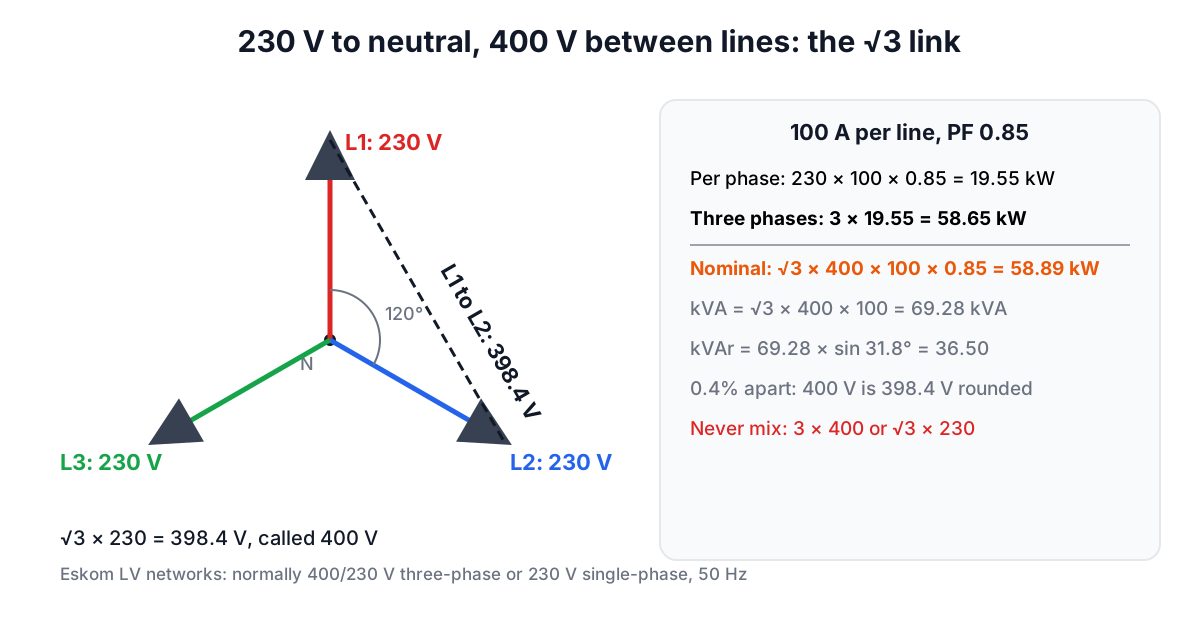
Eskom's connection charges procedure describes its low-voltage networks as "normally supplying at 400/230 volts three-phase or 230 volts single-phase". The frequency is 50 Hz; SANS 1019, the national standard for supply voltages, covers systems with a nominal frequency of 50 Hz and is based on IEC 60038. The two numbers in 400/230 V are linked by √3: three 230 V phases, 120° apart, measured between any two lines give 230 × 1.732 = 398.4 V, which is called 400 V.
Some older drawings and imported motor plates say 380/220 V. Use whichever voltage is on the paperwork you are checking against, but keep the pair together: 380 with 220, 400 with 230.
Two ways to write the same formula
Each phase of a balanced load delivers V(phase) × I × PF, so the total is 3 × 230 × I × PF. Because 230 V is 400 V divided by √3, the same total is √3 × 400 × I × PF. For 100 A at PF 0.85:
| Route | Working | Result |
|---|---|---|
| Per phase, times three | 3 × 230 × 100 × 0.85 | 58.65 kW |
| Line voltage with √3 | 1.732 × 400 × 100 × 0.85 | 58.89 kW |
| Apparent power | 1.732 × 400 × 100 | 69.28 kVA |
| Reactive power | 69.28 × sin 31.8° | 36.50 kVAr |
The 0.4% gap is only 400 V being a rounded 398.4 V. The errors that matter are mixing the pairs: 3 × 400 × 100 × 0.85 gives 102 kW (73% too high) and √3 × 230 × 100 × 0.85 gives 33.9 kW (42% too low).
Eskom supply sizes, in amps
South African supplies are sold by size in kVA, and the tariff booklet pairs each size with a current per phase. These are the sizes listed for Homepower, Businessrate and Landrate in the 2026/27 booklet (charges for non-local authorities from 1 April 2026 to 31 March 2027), with what the calculator gives at 230 V single-phase or 400 V three-phase:
| Supply in the booklet | Booklet current | Current at the kVA size | kVA at the booklet current |
|---|---|---|---|
| Single-phase 16 kVA | 80 A | 69.57 A at 230 V | 18.4 kVA |
| Three-phase 25 kVA | 40 A per phase | 36.08 A at 400 V | 27.7 kVA |
| Three-phase 50 kVA | 80 A per phase | 72.17 A at 400 V | 55.4 kVA |
| Three-phase 100 kVA | 150 A per phase | 144.34 A at 400 V | 103.9 kVA |
The booklet also lists dual-phase supplies of 32 kVA (80 A per phase), 64 kVA (150 A per phase) and 100 kVA (225 A per phase). On a dual-phase supply only two live conductors arrive, so a three-phase motor cannot run on it directly; plan loads per phase.
The kVA figure is the one to plan with. Your notified maximum demand (NMD), which the booklet and the connection procedure define as the contracted maximum demand per point of supply, is in kVA, and the breaker rating is a little above it.
Motors: kW on the plate is shaft output
Motors built to IEC standards are rated in kW of mechanical output at the shaft. The electrical input is the output divided by the efficiency, and the current then follows from the power formula:
I = (kW output × 1000) ÷ (efficiency × √3 × 400 × PF)
Worked example: 11 kW borehole pump on a 25 kVA farm supply. The rating plate gives 11 kW, 90% efficiency and PF 0.86. In the calculator choose "3-phase line to line", 400 V, "Motor rated output (kW)", 11, PF 0.86 and efficiency 90%. Input power is 11 ÷ 0.90 = 12.22 kW; apparent power is 12.22 ÷ 0.86 = 14.21 kVA; current is 20.51 A per line, with 7.25 kVAr of reactive power.
Against a 25 kVA supply, the running pump takes 14.21 kVA, or 57% of the size. That leaves about 10.8 kVA for everything else that runs at the same time, before allowing for the starting current. A direct-on-line start draws several times the running current for a few seconds; whether that trips the supply or dims the house depends on the line and the starter, so ask the pump supplier for the starting method and current.
Two comparisons from the same plate:
- On a 380 V plate voltage the same motor draws 21.59 A, 5% more, because current scales inversely with voltage.
- As a single-phase motor at 230 V, the same 14.21 kVA would draw 61.79 A from one phase. That is one reason larger pump motors are built three-phase: three conductors share the current.
Unbalanced loads on a three-phase house or farm
The √3 formula assumes equal current in each line. A house or smallholding on a three-phase supply is mostly single-phase loads, each between one line and neutral, so the right method is per phase:
| Phase | Loads | Current at 230 V |
|---|---|---|
| L1 | 3 kW geyser + 6 kW stove | 39.13 A |
| L2 | 4 kW pool pump and plug circuits | 17.39 A |
| L3 | 2 kW second geyser | 8.70 A |
The total is 15 kW, which through the balanced formula would suggest 21.7 A per line. L1 actually carries 39.13 A, close to the 40 A per phase of a 25 kVA supply on its own. Moving the stove to L3 brings L1 down to 13.04 A and L3 up to 34.78 A, a better spread. A three-phase motor or heater draws equally from all three lines and does not unbalance anything.
kW, kVA and kVAr on a South African account
- kVA is supply size, NMD and the basis of network capacity charges on the business time-of-use tariffs, which the booklet applies to the annual utilised capacity: the higher of the NMD and the measured maximum demand.
- kW and kWh are the energy you pay for per unit.
- kVAr is reactive power. On tariffs with a reactive energy charge, the booklet bills kVArh supplied in excess of 30% of the kWh, which it equates to a power factor of 0.96 or less. Separately, the Distribution Network Code (clause 6.3) requires customers with demand above 100 kVA to keep power factor at no less than 0.9 lagging. The power factor correction guide for South Africa works through both.
Maximum demand is the highest average kVA or kW over a 30-minute integrating period in the month, so a motor start lasting seconds does not set it.
Common mistakes
- Using 230 V with √3. With 230 V the multiplier is 3. With 400 V it is √3.
- Treating the 11 kW plate as input power. It is output; the input is 12.22 kW and the current follows from that.
- Planning on the breaker, not the kVA. 40 A per phase at 400 V is 27.7 kVA, but the supply you contracted is 25 kVA.
- Adding single-phase loads into one balanced number. The heaviest phase trips first.
Tools for this job
- Three-phase power calculator for South Africa: amps, kW, kVA and kVAr at 400 V or 230 V, with kW motor ratings.
- Power factor correction calculator: the kVAr of capacitors to reach 0.96 and the kVA it frees.
- Transformer sizing calculator: when the load outgrows a 100 kVA LV supply and needs its own 11 or 22 kV transformer.
- Generator size calculator: a standby set for the same loads.
The transformer sizing guide for South Africa picks up where this one stops. Cable sizes and protection must follow SANS 10142-1, and the installation needs a Certificate of Compliance from a registered person, so have a registered electrician design anything you will build.
Frequently asked questions
How many amps is a 25 kVA three-phase supply?
At 400 V, 25 kVA is 36.08 A per line. Eskom's tariff booklet pairs the 25 kVA three-phase size with 40 A per phase, which at 400 V would be 27.7 kVA. Plan your load against the 25 kVA.
How many amps does an 11 kW motor draw at 400 V?
About 20.5 A per line for a motor with 90% efficiency and power factor 0.86, because the 11 kW on the plate is shaft output and the motor draws 12.22 kW from the supply. Check the plate's own full-load current; it will be close.
Is South Africa 380 V or 400 V?
Eskom describes its LV networks as normally supplying 400/230 V three-phase. Some older drawings and imported equipment are marked 380/220 V. Use the value on the document you are checking against, and keep the matching phase voltage with it.
Can I run a three-phase motor on a dual-phase supply?
Not directly. A dual-phase supply has two live conductors, and a three-phase motor needs all three. Options include a single-phase motor, a drive designed for that input, or upgrading to a three-phase supply size; ask Eskom or your municipality what your line can take.
Sources and further reading
- Connection charges for customers connected to Eskom's distribution network (procedure), Eskom Distribution. LV networks normally at 400/230 V three-phase or 230 V single-phase; definition of NMD.
- Tariffs and Charges Booklet 2026/2027, Eskom. Supply sizes in kVA and amps per phase, annual utilised capacity, maximum demand over 30-minute periods and the reactive energy charge above 30% of kWh.
- South African Distribution Network Code, version 6.2, NERSA and Eskom Distribution. Clause 6.3: power factor of at least 0.9 lagging above 100 kVA.
- SANS 1019:2021 Standard voltages, currents and insulation levels for electricity supply, SABS. Standard voltages for 50 Hz systems, based on IEC 60038.
- Management of certificates of compliance for electrical installations, Eskom Distribution. SANS 10142-1 and the registered persons who may issue a CoC.
- The three-phase power formula (US edition), RedBison. The derivation of √3 with North American voltages.
Open the Three-Phase Power Calculator
More Electrical
Every tool in the Electrical section, free and in your browser.