
Hourly Rate to Salary, Overtime and Pay Rises in Ireland
Turn an Irish hourly rate into a yearly salary with paid leave, see why overtime premiums do not count towards the minimum wage, and test a pay rise against CSO CPI.
By Redbison Dev · · 8 min read
Ireland edition. Written for employees in Ireland: the €14.15 National Minimum Wage from 1 January 2026, four working weeks of annual leave and ten public holidays, overtime premiums excluded from minimum wage pay, the 48-hour average week and pay rises against CSO inflation. US edition
At Ireland's National Minimum Wage of €14.15 an hour, which applies to workers aged 20 and over from 1 January 2026, a 39-hour week pays €551.85 and a year €28,696.20 before tax. Annual leave and public holidays are paid, so the yearly figure counts all 52 weeks. Overtime has two traps: the rate depends on your contract, and any overtime premium your employer does pay cannot be counted when checking you were paid the minimum wage. This guide works through those numbers with the Salary Converter (Ireland), the Overtime Calculator and the Pay Raise Calculator. All figures are gross, before PAYE, USC and PRSI. The Workplace Relations Commission's information service can help with a specific problem.
Hourly to annual
This guide uses a 39-hour week, the Irish calculator's default; enter your own contract's hours. At the minimum wage rates from 1 January 2026:
| Age | Rate | 39-hour week | Year (52 weeks) |
|---|---|---|---|
| 20 and over | €14.15 | €551.85 | €28,696.20 |
| 19 | €12.74 | €496.86 | €25,836.72 |
| 18 | €11.32 | €441.48 | €22,956.96 |
| Under 18 | €9.91 | €386.49 | €20,097.48 |
The youth rates are 90%, 80% and 70% of the full rate.
Leave and public holidays are paid
Employees get annual leave on whichever of three measures gives most, up to four working weeks: four working weeks in a leave year in which they work at least 1,365 hours; a third of a working week for each calendar month with at least 117 hours worked; or 8% of the hours worked. For a five-day week, four working weeks is 20 days. There are also ten public holidays: New Year's Day, the first Monday in February (or 1 February if it is a Friday), St Patrick's Day, Easter Monday, the first Mondays in May, June and August, the last Monday in October, Christmas Day and St Stephen's Day.
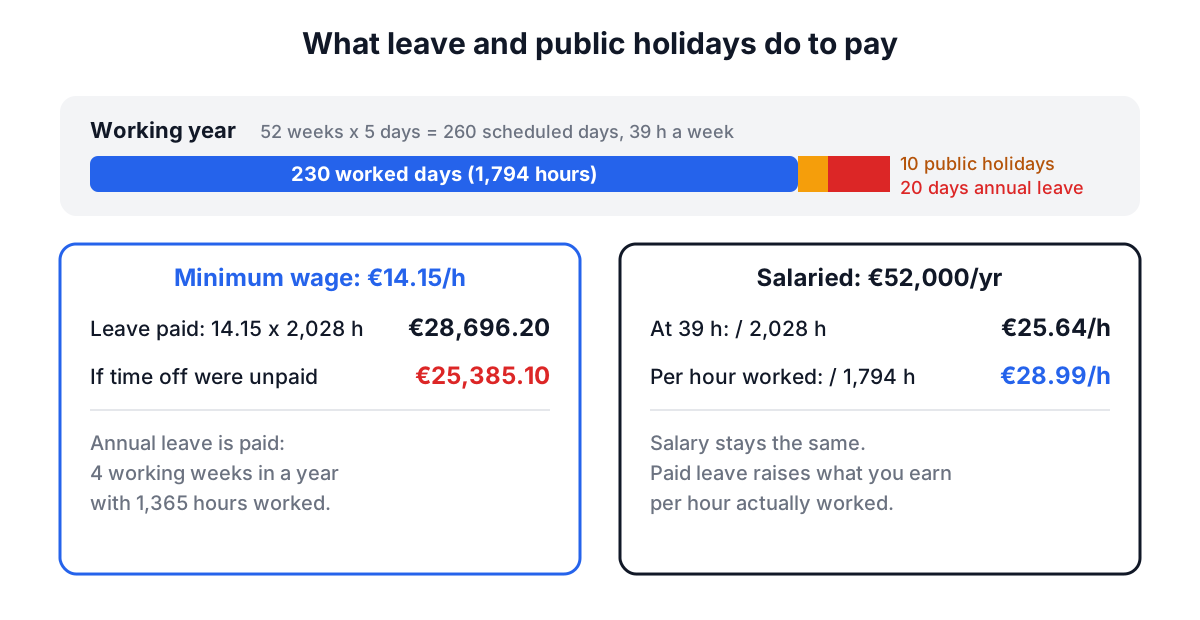
On 39 hours over five days there are 260 scheduled days; take off 10 public holidays and 20 days of leave and 230 remain, or 1,794 hours.
- The minimum wage earner's €28,696.20 is earned over 1,794 hours at work: €16.00 for each hour actually worked. If the time off were unpaid, the year would be €25,385.10, so paid leave and public holidays are worth €3,311.10.
- A €52,000 salary is €25.64 per paid hour but €28.99 per hour actually worked, the number to compare with contract work that pays nothing for days off.
Overtime in Ireland
No statutory rate, but a firm minimum wage test
The Workplace Relations Commission's guidance on working hours sets limits on hours but no overtime rate; any rate comes from your contract or an agreement that covers you. The rule that catches people is about the minimum wage. The Workplace Relations Commission lists "premiums including overtime" as pay that does not count, or is not reckonable, towards the minimum wage. Basic pay, shift allowances, bonuses and commission do count.
So the test is reckonable pay averaged over all hours worked, not the total pay. Take a worker on a basic €13.50 an hour, with time and a half after 39 hours, who works 47 hours:
Total pay:      39 × €13.50 + 8 × €20.25  = €526.50 + €162.00 = €688.50   (€14.65 average)
Reckonable pay: 47 × €13.50               = €634.50                        (€13.50 an hour)
Minimum needed: 47 × €14.15               = €665.05
The average of €14.65 looks fine, but the reckonable pay is €30.55 short, because the overtime premium cannot make up the difference. Reckonable pay (basic pay plus any shift allowance, fee, bonus or commission, but not premiums) averaged over the hours worked must be at least €14.15 an hour. For a worker with no shift allowance or bonus, that means a basic rate of at least €14.15.
Paid overtime when the contract offers it
For someone on €18 an hour with time and a half after 39 hours, a 47-hour week is 39 × €18 = €702 plus 8 × €27 = €216, €918 in total, an average of €19.53 an hour. Paid at the basic rate for the extra hours, the week would be €846. Enter your contract's threshold and multiplier in the Overtime Calculator.
The 48-hour average week and rest
The maximum average working week is 48 hours. The average is normally taken over 4 months; over 6 months for seasonal work, work with a foreseeable surge or work ensuring continuity of service; and over 12 months where a Labour Court approved collective agreement allows it. Employees are also entitled to 11 consecutive hours of daily rest, 24 hours of weekly rest, a 15-minute break after 4½ hours of work and a 30-minute break after 6 hours. Payment for breaks is not a statutory entitlement.
Working a public holiday
For each public holiday, the employer chooses which of four things the employee gets: a paid day off on the day, a paid day off within a month, an extra day of annual leave, or an extra day's pay. If you work on St Stephen's Day and your employer gives the extra day's pay, an 8-hour shift at €18 an hour brings an extra €144 on top of the day's wages. Full-time workers qualify straight away; part-time workers qualify once they have worked 40 hours in the previous 5 weeks.
Pay rises against inflation
real rise = (1 + rise) ÷ (1 + inflation) − 1
The CSO says consumer prices rose by 4.1% in the 12 months to September 2026. On a €52,000 salary:
| Rise | New salary | Extra a year | Real change at 4.1% CPI |
|---|---|---|---|
| 3% | €53,560 | €1,560 | −1.06% |
| 5% | €54,600 | €2,600 | +0.86% |
A 3% rise looks generous in a year of 4.1% inflation but buys less than last year's pay. For minimum wage earners, compare each January's new rate with the CPI change over the year before it.
Frequently asked questions
Is overtime paid at time and a half in Ireland?
Only where your contract or an agreement covering you says so; the WRC's working hours guidance sets limits on hours, not an overtime rate. Whatever you are paid, overtime premiums do not count towards the minimum wage, so your reckonable pay (basic pay plus any shift allowance, bonus or commission) averaged over the hours you work must be at least €14.15 an hour if you are 20 or over.
What is the minimum wage as an annual salary in Ireland?
€14.15 an hour from 1 January 2026 is €551.85 for a 39-hour week and €28,696.20 a year before tax, with annual leave and public holidays paid.
Can my employer make me work more than 48 hours?
Not on average. The maximum average working week is 48 hours, normally averaged over 4 months, or over 6 or 12 months in the cases the Workplace Relations Commission sets out.
What do I get for working on a public holiday?
Your employer decides between a paid day off on the day, a paid day off within a month, an extra day of annual leave or an extra day's pay. Part-time workers qualify after working 40 hours in the previous 5 weeks.
Sources and further reading
- National Minimum Wage, Workplace Relations Commission. €14.15 from 1 January 2026, youth rates, and reckonable and non-reckonable pay.
- Annual leave, Workplace Relations Commission. The three ways of calculating leave.
- Public holidays, Workplace Relations Commission. The ten public holidays and the four entitlements.
- Working hours, Workplace Relations Commission. The 48-hour average, reference periods and rest breaks.
- Consumer Price Index September 2026, Central Statistics Office. Prices up 4.1% in the 12 months to September 2026.
More Pay & Shopping
Every tool in the Pay & Shopping section, free and in your browser.