
Hourly to Salary, Award Overtime and Pay Rises in Australia
Turn an award hourly rate into weekly, fortnightly and annual pay, work out 150% and 200% overtime past 38 hours, and test a pay rise against ABS CPI.
By Redbison Dev · · 8 min read
Australia edition. Written for Australian employees: a 38-hour week, fortnightly pay, the General Retail Industry Award's minimum rates and overtime tiers as an example of how awards work, annual leave loading, and pay rises measured against ABS CPI and the Wage Price Index. US edition
A retail worker on the General Retail Industry Award's Level 1 minimum of A$27.81 an hour earns A$1,056.80 for a 38-hour week, about A$54,950 a year or A$2,113.56 a fortnight. Work five 9-hour days instead and the 7 hours past 38 are overtime: 3 at 150% and 4 at 200%, which lifts the week to A$1,404.41. This guide works through pay conversion, award overtime and pay rises the way Australian payslips show them, using the Salary Calculator, the Overtime Pay Calculator (Australia) and the Pay Rise Calculator (Australia).
Awards differ, and an enterprise agreement or contract can replace the award's numbers. Treat the retail award here as a worked example of how the rules fit together, and check your own award or agreement for your figures.
From an hourly rate to weekly, fortnightly and annual pay
Full-time hours in the General Retail Industry Award are built around 38 a week. The award lets the employer roster those 38 hours in several ways (38 in one week, 76 over two weeks and so on up to an average over a longer agreed period), with options such as 5 days of 7 hours 36 minutes (General Retail Industry Award 2020, clause 15.6).
The award's minimum rates, consolidated to 1 July 2026, are A$1,056.80 a week (A$27.81 an hour) for Level 1, the level that covers shop assistants and checkout operators, and A$1,119.10 (A$29.45) for Level 4. At 38 hours and 52 weeks:
| Rate | Weekly | Fortnightly (÷ 26) | Annual |
|---|---|---|---|
| A$27.81 an hour (Level 1) | A$1,056.78 | A$2,113.56 | A$54,952.56 |
| A$95,000 salary | A$1,826.92 | A$3,653.85 | A$95,000 |
| A$95,000 as an hourly rate (÷ 1,976 h) | A$48.08 an hour |
The award quotes the weekly rate, and the hourly figure is that divided by 38 and rounded, which is why the calculator's A$1,056.78 is 2 cents under the award's A$1,056.80. For a payslip check, use the award's weekly figure.
Leave, public holidays and casuals
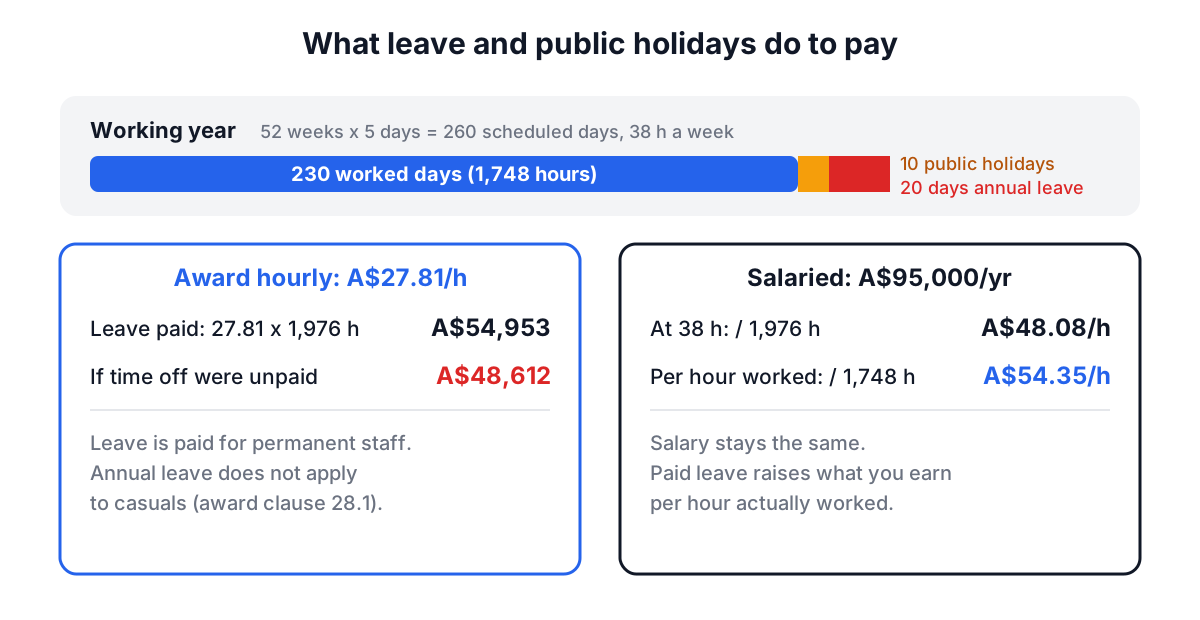
When your days off are paid, as annual leave is for a permanent employee, the year's pay does not shrink when you take them; the pay per hour actually worked goes up instead. Take 20 days of annual leave and 10 paid public holidays as an example (how many public holidays you get depends on your state or territory):
| Case | Per year | Per hour actually worked (1,748 h) |
|---|---|---|
| A$27.81/h, permanent, leave paid | A$54,952.56 | A$31.44 |
| A$27.81/h, time off unpaid | A$48,611.88 | A$27.81 |
| A$95,000 salary | A$95,000 | A$54.35 |
Two retail-award details change these numbers in practice:
- Annual leave loading. During paid annual leave, the award adds at least 17.5% of the minimum hourly rate for the ordinary hours of leave (clause 28.3). On 20 days at Level 1 that is 152 hours × A$27.81 × 17.5% = A$739.75 on top of normal pay.
- Casuals. Annual leave does not apply to casual employees (clause 28.1), so the "unpaid" row is closer to a casual's position. Casuals' overtime rates in the award already include the casual loading: 175% and 225% instead of 150% and 200%.
Award overtime: 150%, then 200%
If an award or enterprise agreement covers you, it says when overtime starts and what it pays. In the General Retail Industry Award (clause 21.2, Table 10), a full-time employee is on overtime for time worked:
- beyond the ordinary hours of work;
- outside the span of ordinary hours;
- outside the roster conditions in clause 15.
A full-time employee works an average of 38 ordinary hours a week (clause 9), and clause 15 caps ordinary hours at 9 on any day, or 11 on one day a week (clauses 15.4 and 15.5), so in practice time beyond those limits is overtime.
Overtime is calculated on a daily basis, at these rates for full-time and part-time employees (Table 11): Monday to Saturday, 150% for the first 3 hours and 200% after that; Sunday 200%; public holidays 250%. If an employee starts work again without a 12-hour break, the award pays 200% until they have one (clause 16.6).
The Overtime Pay Calculator (Australia) models that pattern. You set the daily ordinary maximum (9) and the hours at 150% before the rate steps up (3). At A$27.81:
| Week | Ordinary hours | At 150% | At 200% | Week's pay |
|---|---|---|---|---|
| Five 9-hour days (45 h) | 38 | 3 h (A$125.14) | 4 h (A$222.48) | A$1,404.41 |
| Five 7.6-hour days plus 6 hours on Saturday | 38 | 3 h (A$125.14) | 3 h (A$166.86) | A$1,348.78 |
In the first week no single day passes 9 hours, but the week reaches 38 on Friday after 2 hours, so Friday's last 7 hours are overtime: the first 3 at 150% and the next 4 at 200%. In the second, all 6 Saturday hours are past 38: 3 at 150% and 3 at 200%. Seven overtime hours add A$347.63 to a week, a third of the ordinary pay.
The calculator does not model Sunday or public holiday rates, weekend penalty rates on ordinary hours, or shift loadings. For those, and for awards with different tiers, check your award or agreement.
Pay rises against CPI and the Wage Price Index
A rise is measured against the old pay, and two rises compound: 3% then 4% is 1.03 × 1.04 = 7.12%. What it is worth depends on prices:
real change = (1 + rise) / (1 + inflation) − 1
The ABS reported that the Consumer Price Index rose 4.3% in the 12 months to September 2026, up from 4.0% to August; trimmed mean inflation was 3.6% (ABS, CPI). The Wage Price Index, the ABS measure of how fast hourly pay rates are rising, grew 3.2% over the year to the June quarter 2026, seasonally adjusted: 3.1% in the private sector and 3.4% in the public sector (ABS, WPI).
On a A$95,000 salary, the Pay Rise Calculator (Australia) gives:
| Rise | New salary | Extra a fortnight | Real change at 4.3% CPI |
|---|---|---|---|
| 3.2% (WPI) | A$98,040 | A$116.92 | −1.05% |
| 4.5% | A$99,275 | A$164.42 | +0.19% |
A rise that matched the WPI still fell behind the September CPI figure; you needed more than 4.3% to gain buying power. For context, the Reserve Bank's target is consumer price inflation of 2 to 3 per cent a year (RBA, about monetary policy), so 4.3% is well above it. The headline CPI and the trimmed mean tell different stories here (4.3% against 3.6%), so for a pay discussion it helps to quote both, and to say which you are using. Both change each release.
Putting it together
- Convert offers to the same basis: weekly from the award or contract, then fortnightly and annual.
- Check whether you are permanent or casual, because that decides whether leave is paid and which overtime rates apply.
- Add realistic overtime from your roster, with the tiers in your award.
- Test any rise against the latest CPI and WPI.
Then add what these sums leave out: tax, super, salary sacrifice, and any penalty rates for weekends. The Time Card Calculator helps you total rostered hours before checking overtime.
Tools for this job
- Salary Calculator: weekly, fortnightly and annual pay from an hourly rate, with paid or unpaid leave.
- Overtime Pay Calculator (Australia): award overtime past the daily maximum or 38 hours, at 150% then 200%.
- Pay Rise Calculator (Australia): new pay, extra per fortnight and the real change after CPI.
Related reading: the Australian guide to inflation and savings explains CPI in more depth, and the US edition of this guide covers US overtime law.
Frequently asked questions
How much is A$27.81 an hour a year in Australia?
At 38 hours a week for 52 weeks it is A$54,952.56, or A$2,113.56 a fortnight, before tax. A$27.81 is the Level 1 minimum in the General Retail Industry Award, consolidated to 1 July 2026, where the weekly rate is A$1,056.80.
When does overtime start under the retail award?
For a full-time employee, overtime is time worked beyond the ordinary hours of work, outside the span of ordinary hours, or outside clause 15's roster conditions; the award sets ordinary hours at an average of 38 a week and no more than 9 a day (11 on one day a week). Monday to Saturday it pays 150% for the first 3 hours and 200% after that.
What is annual leave loading?
An extra payment during annual leave. In the retail award it is at least 17.5% of the minimum hourly rate for the ordinary hours of leave, which on 20 days at Level 1 comes to A$739.75.
Is a 3.2% pay rise above inflation?
Not against the 4.3% annual CPI the ABS reported for the 12 months to September 2026: 1.032 / 1.043 − 1 is about −1.05%. It matched the 3.2% Wage Price Index growth to the June quarter, so it kept pace with other workers but not with prices.
Do casuals get overtime at 150%?
Under the retail award, casuals get 175% for the first 3 overtime hours Monday to Saturday and 225% after that, because the rates include the casual loading. Annual leave does not apply to casuals.
Sources and further reading
- General Retail Industry Award 2020 (MA000004), Fair Work Ombudsman. Ordinary hours (clause 15), minimum rates (clause 17), overtime triggers and Table 11 rates (clause 21), annual leave and 17.5% loading (clause 28); consolidated to 1 July 2026.
- Consumer Price Index, Australia: latest release, Australian Bureau of Statistics. CPI up 4.3% in the 12 months to September 2026; trimmed mean 3.6%.
- Wage Price Index, Australia: latest release, Australian Bureau of Statistics. WPI up 3.2% over the year to the June quarter 2026.
- About monetary policy, Reserve Bank of Australia. The 2 to 3 per cent inflation target.
- How to measure changes in the cost of living, OpenStax. How a consumer price index works.
More Pay & Shopping
Every tool in the Pay & Shopping section, free and in your browser.