
Monthly Salary, Overtime and Hikes: Pay Maths for India
Turn a monthly salary into per-day and per-hour rates, work out double-rate overtime under the OSH Code, and check an appraisal hike against inflation, in rupees.
By Redbison Dev · · 8 min read
India edition. Written for Indian employees: monthly salary and CTC instead of hourly pay, the 26-day month, overtime at twice the ordinary rate beyond 8 hours a day or 48 a week under the OSH Code, 2020, and hikes measured against the RBI's 4% CPI target. US edition
Indian pay is often quoted per month or as an annual CTC, so the first sum runs the other way from the US one: a ₹26,000 monthly wage over a 6-day, 48-hour week is ₹1,000 a day and ₹125 an hour, and every overtime hour under the new labour codes pays at least double, ₹250. This guide works through the three numbers that matter in an Indian pay discussion: what your salary is per day and per hour, what overtime adds, and whether this year's hike beats inflation. It uses the Salary Calculator, the Overtime Wages Calculator (India) and the Pay Raise Calculator, so you can repeat each figure.
This explains the arithmetic and the published rules. It is not legal or tax advice; your state's rules, your appointment letter and any settlement with a union can change the answer, and a labour lawyer or your HR team can confirm what applies to you.
CTC, gross and in-hand are three different numbers
An offer letter in India often leads with cost to company (CTC): everything the employer expects to spend on you in a year. That can include items you never see in a monthly pay slip, such as the employer's provident fund contribution, gratuity, insurance premiums and variable pay that depends on performance. Monthly gross salary is the fixed part paid each month, and in-hand pay is what reaches your bank after your own deductions and tax.
For the sums below, start from fixed monthly salary, not CTC. A ₹9,00,000 CTC with ₹1,80,000 of variable pay and employer costs is ₹7,20,000 of fixed pay, or ₹60,000 a month. Dividing the full CTC by 12 would overstate your monthly pay by a quarter.
Monthly salary to per-day and per-hour rates
A common way to get a daily rate is to divide a month by 26 working days, which is what a 6-day week gives: 52 weeks × 6 days / 12 months = 26. With 8-hour days that is 208 hours a month, and the Salary Calculator gives the same answer when you enter a monthly amount with 48 hours over 6 days:
| Monthly salary | Per year | Per day (26-day month) | Per hour (48-hour week) |
|---|---|---|---|
| ₹26,000 | ₹3,12,000 | ₹1,000 | ₹125.00 |
| ₹60,000 | ₹7,20,000 | ₹2,307.69 | ₹288.46 |
The per-hour figure changes with your schedule. The same ₹60,000 on a 5-day, 45-hour week is ₹307.69 an hour, because you work fewer hours for the same money.
What paid holidays and leave do
A salaried employee is paid through holidays and leave, so the salary stays the same and the pay for each hour actually worked rises. A daily-rated worker who is paid only for days worked loses money instead. Take 10 holidays and 18 days of leave a year, on a 6-day, 48-hour week:
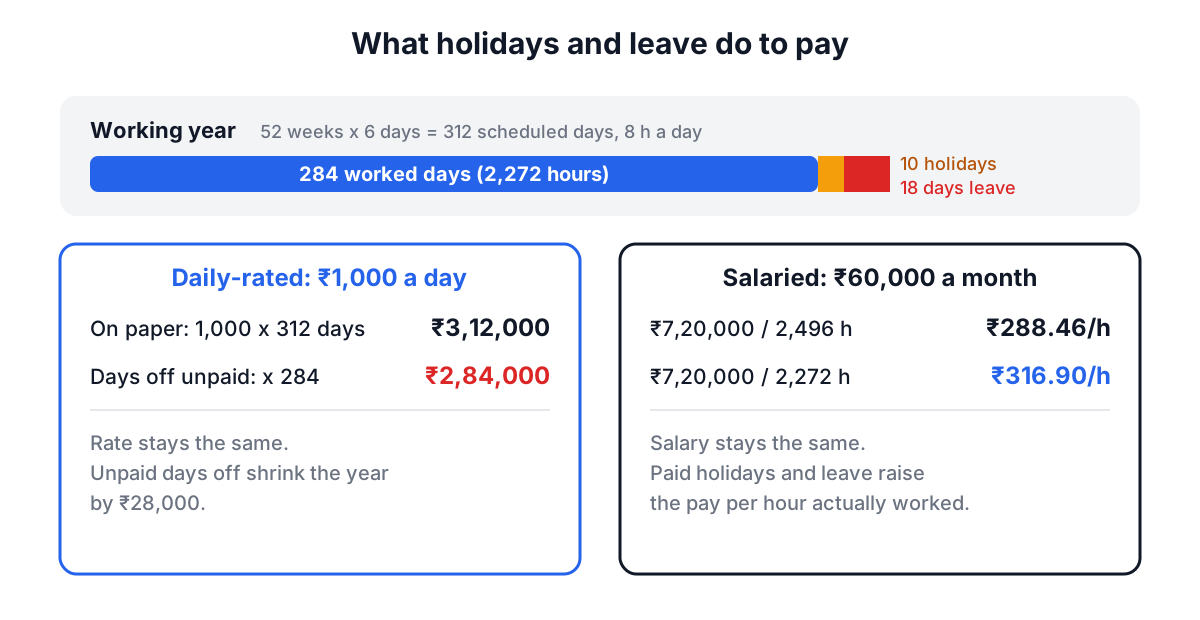
- Monthly salary of ₹60,000, leave paid: still ₹7,20,000 a year, but spread over 284 worked days (2,272 hours), so ₹316.90 per hour worked instead of ₹288.46.
- Daily wage of ₹1,000, days off unpaid: ₹3,12,000 on paper for 312 days, but ₹2,84,000 for the 284 days actually worked. The 28 days off cost ₹28,000.
Tick "paid leave" in the calculator when your holidays and leave are paid, and leave it off for daily-rated or contract work paid only for days worked.
Overtime under the OSH Code: double, not time and a half
Since the labour codes took effect, the Occupational Safety, Health and Working Conditions Code, 2020 sets working hours. The government's explainer of 22 November 2025 states that no employee shall be required to work more than 8 hours in a day and 48 hours in a week, that overtime needs the worker's consent, and that overtime is paid at double the normal wage rate (PIB, OSH Code explainer). The Code on Wages, 2019 likewise says overtime wages must be at least twice the normal rate (PRS, Code on Wages).
The explainer also allows a longer normal day when the week is shorter: 12 hours a day in a 4-day week, 9.5 hours in a 5-day week and 8 hours in a 6-day week, all without overtime. And it leaves the overtime cap to each state; the explainer gives the earlier limit as 75 hours a quarter.
The Overtime Wages Calculator (India) counts overtime both ways, by the day and by the 48-hour week, and pays whichever gives more hours. At ₹125 an hour:
| Week | Normal hours | Overtime hours | Overtime pay at ₹250 | Week's pay |
|---|---|---|---|---|
| Six days of 10 hours (8-hour normal day) | 48 | 12 | ₹3,000 | ₹9,000 |
| Six days of 9 hours (8-hour normal day) | 48 | 6 | ₹1,500 | ₹7,500 |
| Five days of 10.5 hours (9.5-hour normal day) | 47.5 | 5 | ₹1,250 | ₹7,187.50 |
| Four days: 13, 12, 12, 12 hours (12-hour normal day) | 48 | 1 | ₹250 | ₹6,250 |
Two lessons come out of the table. First, overtime adds a third to the week in the first row, because each extra hour earns double: 60 hours of work pays like 72 hours at the normal rate. Second, the shift pattern decides what counts. Twelve-hour days are normal hours in a 4-day week, so only the 13th hour on the first day is overtime; the same 12-hour day in a 6-day week would be 4 overtime hours.
What goes into the "normal rate"
Overtime is double the normal rate of wages. The Code on Wages counts basic pay, dearness allowance and retaining allowance as wages, and leaves out bonus, house rent allowance, conveyance allowance, commission and several other items (Code on Wages text, PRS). So the overtime rate is usually based on basic pay plus DA, not your gross pay. One catch: if the excluded items come to more than half of total pay, the excess is added back to wages. Use the hourly figure in your employer's wage register.
Not everyone is covered: whether the overtime provisions apply depends on your role and on the law that governs your workplace. If your appointment letter says nothing about overtime, ask HR which law applies before you count on the money.
Appraisal hikes and inflation
A hike is measured against the old pay: (new − old) / old × 100. Two successive hikes multiply rather than add: 10% followed by 8% is 1.10 × 1.08 = 1.188, an 18.8% rise over two years, not 18%.
The number that matters is the hike after inflation:
real hike = (1 + hike) / (1 + inflation) − 1
The Reserve Bank of India's target is 4% CPI inflation, with a tolerance band from 2% to 6%, retained for 1 April 2026 to 31 March 2031 (RBI, monetary policy overview). The target is a useful benchmark, but for your own appraisal use the latest year-on-year CPI figure published by MoSPI (mospi.gov.in) for the 12 months before the hike.
On fixed pay of ₹7,20,000, the Pay Raise Calculator gives:
| Hike | Inflation | New fixed pay | Extra a year | Real change |
|---|---|---|---|---|
| 8% | 4% (RBI target) | ₹7,77,600 | ₹57,600 | +3.85% |
| 8% | 6% (top of band) | ₹7,77,600 | ₹57,600 | +1.89% |
| 3% | 6% | ₹7,41,600 | ₹21,600 | −2.83% |
| Job switch to ₹9,36,000 | 4% | ₹9,36,000 | ₹2,16,000 | +25.00% (30% nominal) |
A 3% hike in a 6% inflation year is a pay cut in real terms: the new ₹7,41,600 buys what ₹6,99,623 bought a year earlier. When comparing a job switch, compare fixed pay with fixed pay; a larger CTC that is mostly variable pay may not raise what you take home.
A checklist for your next pay discussion
- Strip CTC down to fixed monthly pay before comparing offers.
- Convert it to per-day and per-hour figures for your actual schedule, with paid leave on or off.
- If you work overtime, check it is paid at double the normal rate of wages, counted by the day or the 48-hour week, whichever is more.
- Measure any hike against the latest CPI, not against last year's hike.
Then add what none of these sums include: income tax under the regime you choose, your own PF deduction, and the value of leave, insurance and commuting time.
Tools for this job
- Salary Calculator: monthly, daily and hourly rates from any pay period, with paid or unpaid leave.
- Overtime Wages Calculator (India): double-rate overtime under the OSH Code, by day or by the 48-hour week.
- Pay Raise Calculator: hike percentage, new pay and the real change after inflation.
Related reading: the India guide to inflation and savings explains CPI in more depth, and the India freelance rate guide works the same arithmetic for the self-employed.
Frequently asked questions
How do I calculate per-day salary from a monthly salary?
Divide the monthly salary by the working days your employer uses. For a 6-day week that is usually 26 days, so ₹26,000 a month is ₹1,000 a day. Divide again by the hours in a normal day for the hourly rate: ₹125 at 8 hours.
What is the overtime rate under the new labour codes?
At least twice the normal rate of wages. The OSH Code sets 8 hours a day and 48 hours a week as the normal limit, allows 9.5-hour days in a 5-day week and 12-hour days in a 4-day week, and requires the worker's consent for overtime. At ₹125 an hour, each overtime hour pays ₹250.
Is CTC the same as my salary?
No. CTC is the employer's total yearly cost, which can include its PF contribution, gratuity, insurance and variable pay. Compare offers on fixed monthly pay and then on take-home pay after deductions.
Is an 8% hike good if inflation is 6%?
It keeps you ahead, but only by about 1.89% in buying power: 1.08 / 1.06 − 1. At the RBI's 4% target the same hike is worth about 3.85% in real terms.
Do allowances count when calculating overtime?
Mostly not. The Code on Wages counts basic pay, dearness allowance and retaining allowance as wages, and leaves out bonus, house rent allowance, conveyance allowance, commission and several other allowances, so the overtime rate is usually based on basic pay plus DA, not your gross pay. If the excluded items exceed half of total pay, the excess is added back. Use the hourly figure in your employer's wage register.
Sources and further reading
- Occupational Safety, Health and Working Conditions (OSH) Code, 2020: explainer, Press Information Bureau, 22 November 2025. 8 hours a day and 48 a week, 12, 9.5 and 8-hour days by week length, consent, double wages, state-set overtime limits.
- The Code on Wages, 2019, PRS Legislative Research. Overtime at least twice the normal rate of wages.
- The Code on Wages, 2019: bill text, PRS Legislative Research. Clause 2(y): wages include basic pay, dearness allowance and retaining allowance; bonus, HRA, conveyance allowance, commission and other items are excluded, with any excess over one-half added back.
- Monetary policy: overview, Reserve Bank of India. The 4% CPI inflation target with a 2% to 6% band.
- Ministry of Statistics and Programme Implementation, Government of India. Monthly CPI releases.
- How to measure changes in the cost of living, OpenStax. How a consumer price index works.
More Pay & Shopping
Every tool in the Pay & Shopping section, free and in your browser.