
ETF Fees and Withholding Tax for Singapore Investors
What a TER, 30% US dividend withholding and reinvesting do to monthly ETF investing in S$ over 20 years, with fund domicile, US estate tax and inflation.
By Redbison Dev · · 6 min read
Singapore edition. Singapore edition in S$, built on MoneySense's guidance on choosing between ETFs that track the same index, the 30% US withholding on dividends of US-domiciled ETFs, IRAS rules on foreign dividends and the IRS estate tax filing threshold. US edition
For a Singapore investor putting S$1,000 a month into an ETF, two costs decide most of the difference between similar funds: the total expense ratio (TER) and the tax taken from dividends before they reach you. On S$10,000 to start and S$1,000 a month for 20 years at 6% a year with a 1.5% dividend yield, a 0.03% TER fund ends at about S$485,000. The same index through a US-domiciled ETF, with 30% US withholding taken from every dividend, ends at about S$460,000. That S$24,900 gap is more than twenty times the fund's own fee bill, and it comes from where the fund is domiciled, not from what it costs.
This edition works through fees, withholding, reinvesting and inflation in Singapore dollars with the ETF Investment Calculator (Singapore). The US version of this article is here. The figures use a steady return to show the mechanics; real markets swing, and nothing here recommends a particular fund. If your situation involves large holdings, estate planning or tax residence elsewhere, a licensed financial adviser is worth consulting.
What MoneySense tells you to compare
MoneySense, the Singapore Government's financial education site, points out that ETFs tracking the same index can differ in cost, currency, domicile and dividend treatment. Its checklist for choosing between them:
- Is the ETF authorised for sale to retail investors in Singapore?
- Is it classified as a Specified Investment Product (SIP)?
- What is the TER?
- What is the tracking difference?
- How liquid is it (trading volume and bid-ask spread)?
- What is the domicile?
- Does it distribute or accumulate?
It notes that TERs on similar ETFs range from as low as 0.03% to over 0.5% of net asset value. The calculator handles three of these directly: TER, domicile (through the dividend inputs) and distributing or accumulating (the reinvest switch).
The TER, compounded
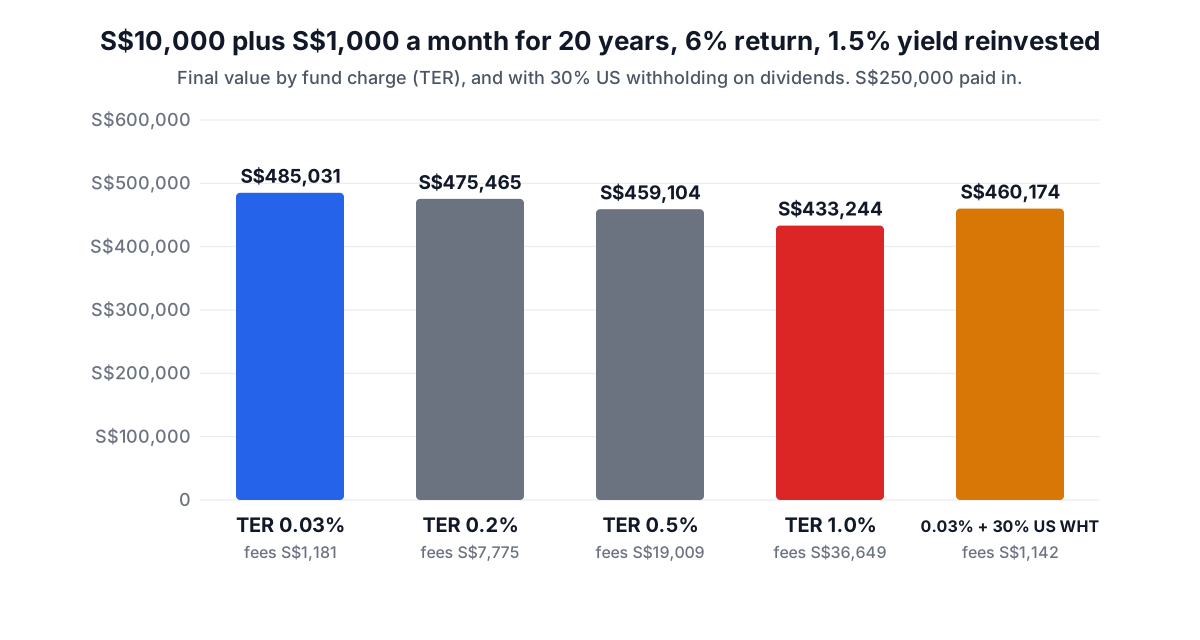
The TER is deducted from the fund's assets, not billed to you, so you only see it as a slightly lower return. Running S$10,000 plus S$1,000 a month for 20 years at a 6% return and 1.5% yield, dividends reinvested:
| TER | Final value | Fees paid | Lost against TER 0.03% |
|---|---|---|---|
| 0.03% | S$485,031 | S$1,181 | |
| 0.2% | S$475,465 | S$7,775 | S$9,566 |
| 0.5% | S$459,104 | S$19,009 | S$25,927 |
| 1.0% | S$433,244 | S$36,649 | S$51,787 |
Fees paid understate the cost. At 1.0% you pay S$36,649 in fees but end S$51,787 behind the cheapest fund, because the money taken as fees also stops compounding.
MoneySense gives the same point with a lump sum: S$50,000 over 20 years. On our assumptions, 0.1% TER gives S$157,358 and 0.5% gives S$145,888, a gap of about S$11,470.
Domicile: the 30% you do not see
MoneySense's example is direct: an ETF domiciled in the US and held by a Singapore investor is subject to a 30% US withholding tax on dividends. The US withholds 30% on US-source dividends to non-residents unless a tax treaty lowers it, and Singapore does not appear on the IRS's list of countries with a US income tax treaty.
The calculator has no separate withholding field, so build it into the inputs. Take 30% of the yield off both the yield and the total return:
withholding drag = 30% × 1.5% = 0.45 points
return entered   = 6% − 0.45 = 5.55%
yield entered    = 1.5% − 0.45 = 1.05%
With TER 0.03%, the plan ends at S$460,174 instead of S$485,031. In TER terms, that is almost exactly what a 0.5% fund without withholding gives (S$459,104). A "cheap" US-listed fund can cost as much as an expensive one.
The drag grows with the yield. For a fund yielding 3.5% with the same 6% total return, 30% withholding takes 1.05 points a year: the plan ends at S$429,264 instead of S$485,031, about S$55,800 less.
Funds domiciled elsewhere may suffer a lower rate of withholding on the US dividends they receive, depending on that country's treaty with the US and the fund's own position. The rate is not always published simply, so check the fund's documents. To model, say, 15% lost at source, enter 6% − 0.225 = 5.775% and 1.5% − 0.225 = 1.275%: the plan ends at S$472,417, between the two.
Singapore tax on what reaches you
IRAS does not tax foreign dividends received in Singapore by resident individuals, unless they come through a partnership in Singapore. Dividends from Singapore companies under the one-tier system, from unit trusts in Singapore and most REIT distributions to individuals are also not taxable. So for most individual investors the withholding taken abroad is the only tax on dividends, which is why domicile matters more here than in countries that tax dividends at home.
Reinvest or take the cash
An accumulating ETF reinvests dividends inside the fund; a distributing ETF pays them out. On the 0.03% plan:
- Reinvested: S$485,031 at the end of 20 years.
- Paid out: S$407,643 at the end, plus S$52,900 of dividends received in cash along the way.
Reinvesting ends about S$24,500 ahead of the payout plan's balance and cash combined, because the dividends compound. Taking cash makes sense if you need the income, or if you reinvest it yourself on your own schedule.
US estate tax: the cost a projection cannot show
The IRS treats stock of US corporations as US-situated assets. If a non-resident who is not a US citizen dies holding US-situated assets with a fair market value above US$60,000, the executor must file a US estate tax return (Form 706-NA). On the plan above, a US-listed holding would pass the equivalent of US$60,000 long before the 20 years are up. This is not a reason to panic, but it is a reason to know which of your holdings are US-situated and to take advice if they are large.
Inflation: read the result at today's prices
Twenty-year totals look large. At 2% inflation a year, the S$485,031 is worth about S$326,412 at today's prices; at 3% it is S$268,550. Choose an inflation figure you believe and read the "at today's prices" line before deciding a plan is enough.
Stretch the same plan to 30 years and the final value roughly doubles to S$1,028,822 (S$567,983 at today's prices at 2%). The US-domiciled version reaches S$946,453, now about S$82,400 behind, because the withholding drag compounds for longer.
Currency
Most global ETFs are priced in US dollars, so your S$ result also depends on the exchange rate, which this projection does not model. MoneySense notes that some ETFs offer an SGD-hedged version to reduce currency exposure, and that whether hedging is worth it depends on your view of currency risk and your time horizon. The Currency Converter helps you see what a move in USD/SGD would do to a holding.
Common mistakes
- Comparing TERs and ignoring domicile. At a 1.5% yield, 30% withholding costs about as much as 0.48 points of TER.
- Double counting fees. A fund's published past return is already after its TER. If you use one as your assumption, set the TER to 0.
- Holding several ETFs on the same index. MoneySense says one is enough for a given exposure; more adds cost without diversification.
- Forgetting the bid-ask spread and brokerage. They are not in the TER and matter most for small, frequent purchases.
- Reading nominal figures as real. Always check the result at today's prices.
Tools for this job
- ETF Investment Calculator (Singapore): monthly investing in S$ with TER, dividend yield, reinvesting and inflation.
- Compound Interest Calculator: the growth formula on its own; see the compound interest guide.
- Currency Converter: what a USD/SGD move does to a US dollar holding.
- The guide to SIP vs lump sum investing compares regular investing with investing a sum at once.
Frequently asked questions
How much US withholding tax do Singapore investors pay on ETF dividends?
MoneySense says a US-domiciled ETF held by a Singapore investor is subject to a 30% US withholding tax on dividends. On a fund yielding 1.5% that takes 0.45 percentage points of return a year.
Is withholding tax worse than a high TER?
It can be. In the example, a 0.03% US-domiciled fund with 30% withholding ends at S$460,174, about the same as a 0.5% fund without withholding at S$459,104. The higher the yield, the more the withholding costs.
Do I pay Singapore tax on ETF dividends?
Generally not as a resident individual. IRAS does not tax foreign dividends received in Singapore by resident individuals unless received through a partnership in Singapore, and it lists dividends from Singapore unit trusts as not taxable.
Does US estate tax apply to Singaporeans holding US ETFs?
US-listed ETFs are US-situated assets, and the executor of a non-resident non-citizen must file Form 706-NA if such assets exceed US$60,000 at death. Ask an adviser how it applies to your holdings.
Sources and further reading
- How do I choose between ETFs that track the same index?, MoneySense (Singapore Government). TER range, 30% US withholding, the seven-point checklist, SGD-hedged versions.
- Dividends, Inland Revenue Authority of Singapore. Foreign dividends received by resident individuals not taxable; unit trust and REIT distributions.
- United States income tax treaties: A to Z, Internal Revenue Service. Countries with a US tax treaty; Singapore is not listed.
- Some nonresidents with U.S. assets must file estate tax returns, Internal Revenue Service. US corporate stock is US-situated; filing above US$60,000.
- Expense Ratio, US Securities and Exchange Commission. How a fund's annual expenses are expressed.
Open the ETF Investment Simulator
More Analysis Tools
Every tool in the Analysis Tools section, free and in your browser.