
AI for Sales, Marketing, Insurance and Restaurants in Canada
AI for cold emails, ads, renewal letters and menus in Canada: CASL consent and unsubscribes, Competition Act claims, priority allergens, Ontario tips and HST.
By Redbison Dev · · 10 min read
Canada edition. Written for Canadian businesses, with CASL, the Competition Act's rules on performance and environmental claims, Health Canada's priority allergens, Ontario's tip rules, provincial sales tax and bilingual copy in place of CAN-SPAM and the FTC. US edition
Canadian customer-facing teams use AI assistants for the same jobs as everyone else: prospecting emails, ad copy, renewal letters, menu descriptions and replies to reviews. The difference is the rulebook. A model trained mostly on American examples will cite CAN-SPAM, treat a business email as fair game without consent, promise that a product is "eco-friendly" without evidence, and forget that Quebec customers may need the French version. This guide covers the Canadian rules worth building into prompts, worked examples from the AI Prompts for Sales Teams (Canada), AI Prompts for Marketers (Canada), AI Prompts for Insurance Agents and Brokers (Canada) and AI Prompts for Restaurant Operators (Canada) kits, and a review routine.
Where drafting helps
| Role | Good fit | Keep human |
|---|---|---|
| Sales | Prospect summaries, cold email and LinkedIn variants, demo follow-ups, mutual action plans | Pricing, contract terms, the CASL consent basis for each contact |
| Marketing | Campaign briefs, ad variants, email sequences, content calendars, first drafts for French adaptation | Claims and their evidence, the final French copy, sign-off |
| Insurance | Plain-language explainers built from the policy wording, renewal emails, claim updates | Whether a loss is covered, suitability advice, licence disclosures |
| Restaurants | Menu descriptions, replies to reviews, specials posts, job ads, schedule drafts | Allergen information, prices, the final schedule, how tips are shared |
Canadian rules a model will not add for you
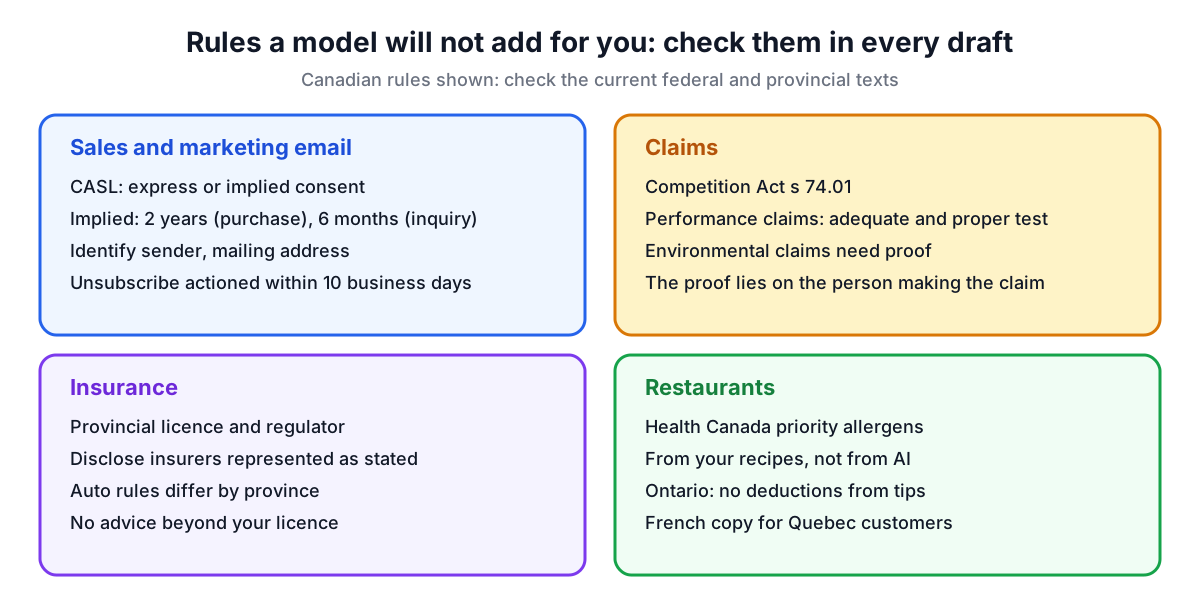
CASL: consent first. Under Canada's anti-spam legislation, individuals and businesses must get consent before sending commercial electronic messages such as emails or texts, and should be ready to prove it. The Government of Canada's guide to getting consent explains the two kinds. Express consent means the person agreed, verbally or in writing, and has no time limit unless they withdraw it. Implied consent arises only in set circumstances, such as an existing business relationship from a purchase or an inquiry, and it is time-limited: up to two years after a purchase, or six months after an inquiry or application. Every message must clearly identify you and your organization, give a current mailing address and a phone number, email or website, and include an unsubscribe mechanism; each unsubscribe request must be actioned within 10 business days at no cost to the recipient. The Canada sales kit asks you to record the consent basis for each contact before a cold email goes out.
Competition Act: claims need proof first. Section 74.01 of the Competition Act makes it reviewable conduct to make a public representation that is false or misleading in a material respect, or a claim about a product's performance, efficacy or length of life that is not based on an adequate and proper test. It also covers claims that a product protects or restores the environment or mitigates climate change, which need an adequate and proper test, and claims about a business's environmental benefits, which need adequate and proper substantiation; in both cases the proof lies on the person making the claim. "Our cleaner is 100% eco-friendly" is the kind of line a model writes without a second thought; flag it [EVIDENCE NEEDED].
Insurance. The Canada setting in the insurance kit tells the model that the agent is licensed by the provincial or territorial regulator, to follow the province named in your material for auto insurance, and to disclose conflicts and the insurers represented only as stated in your material. Anything that reads like advice your licence does not cover should come out.
Restaurants: allergens. Health Canada lists the priority food allergens as eggs, milk, mustard, peanuts, crustaceans and molluscs, fish, sesame seeds, soy, sulphites, tree nuts, and wheat and triticale, and it treats gluten sources and added sulphites as needing clear identification on prepackaged food. Menu allergen information must come from your recipes and supplier specifications, not from a model.
Restaurants: tips in Ontario. Ontario's guide to the Employment Standards Act says an employer generally cannot withhold, make deductions from, or make an employee return their tips, except as the Act permits. Tip pooling is allowed when the money is redistributed among employees, but an employer may share in the pool only in limited cases (for example as a sole proprietor, partner, director or shareholder in the business, subject to the conditions in the guide), and since June 21, 2024 an employer with a policy on sharing in the pool must post it in the workplace. Other provinces have their own rules; a job ad or staff memo drafted by AI must match yours.
Masking client and contact data
Client files and contact lists are personal information under PIPEDA or provincial private-sector law. The kits' masking helper runs in your browser. A made-up insurance client note:
Client: Emily Roy, policy no. TD-778812, 12 Elm Street, Halifax B3H 1A1, emily.roy@example.ca.
Client: [NAME-1], policy no. [POLICY-NO-1], [ADDRESS-1], Halifax [POSTCODE-1], [EMAIL-1].
A made-up sales contact in Montréal:
Contact: Marie Gagnon, marie@example.ca, 514-555-0123, Unit 4, 120 Main St, Montréal H2X 1Y4.
Contact: [NAME-1], [EMAIL-1], [PHONE-1], Unit 4, [ADDRESS-1], Montréal [POSTCODE-1].
"Unit 4" stays, because the helper looks for the street number and street name; delete unit numbers yourself if the rest of the line is staying.
Worked example: food cost and HST
Where menu prices are shown before sales tax and the tax is added on the bill, work out food cost on the menu price. Take a dish on the menu at $18.00 with ingredients costing $5.50, in Ontario, where the Canada Revenue Agency's rate table shows 13% HST:
food cost %        = $5.50 / $18.00 = 30.6%
gross margin       = ($18.00 - $5.50) / $18.00 = 69.4%
guest pays (13%)   = $18.00 x 1.13 = $20.34
In Quebec the same dish carries 5% GST plus 9.975% QST, and in Alberta 5% GST alone, so a specials post that quotes a "price with tax" needs the right province. The Margin and Markup Calculator (Canada, GST/HST) does the arithmetic without slips.
A CASL-aware prompt
With the region set to Canada, the sales kit's cold email template adds:
- Canada's Anti-Spam Legislation applies to B2B email too: you need express or implied consent (for example an address conspicuously published with no statement refusing messages, where the message is relevant to the person's role), sender identification and an unsubscribe.
- Before sending to a Canadian prospect, record the CASL consent basis (for example conspicuous publication relevant to their role) and include your name, company, mailing address and an unsubscribe.
The model cannot know your consent basis; it can only leave a place for it. If you cannot fill that place in, do not send the email.
Review before it reaches a customer
- Facts traced to your notes, policy wording or recipe file.
- Claims backed by tests or substantiation you could show the Competition Bureau.
- CASL elements: identification, mailing address, unsubscribe, and a recorded consent basis.
- Language: French copy written or checked by a fluent speaker for Quebec customers.
- Prices with the right province's tax, checked in a calculator.
Frequently asked questions
Does CASL apply to B2B cold emails?
Treat it as applying. The Government's consent guide says individuals and businesses must get consent before sending commercial electronic messages, and the Canada sales kit makes no exception for business email, so plan for express or implied consent, clear identification of the sender and a working unsubscribe in every message.
How long does implied consent last under CASL?
Up to two years after a purchase, or six months after an inquiry or application, according to the Government of Canada's consent guide. Express consent has no time limit unless the person withdraws it.
Can AI write environmental claims for Canadian ads?
It can draft the wording, but under section 74.01 of the Competition Act an environmental claim about a product needs an adequate and proper test, and a claim about a business's environmental benefits needs adequate and proper substantiation, with the proof on the person making it. Flag every such line for evidence.
What are Canada's priority food allergens?
Eggs, milk, mustard, peanuts, crustaceans and molluscs, fish, sesame seeds, soy, sulphites, tree nuts, and wheat and triticale, as listed by Health Canada. Take each dish's allergens from your recipes and suppliers, not from AI.
Can a restaurant owner share in the tip pool in Ontario?
Only in limited cases set out in Ontario's Employment Standards Act guide, for example a sole proprietor, partner, director or shareholder in the business, subject to the guide's conditions. Since June 21, 2024, an employer with a policy on sharing in the pool must post it in the workplace.
Sources and further reading
- Getting consent to send email, Government of Canada (fightspam.gc.ca).
- Canada's Anti-Spam Legislation (S.C. 2010, c. 23), Justice Laws Website.
- Competition Act, section 74.01, Justice Laws Website.
- Common food allergens, Health Canada.
- Your guide to the Employment Standards Act: tips and other gratuities, Government of Ontario.
- GST/HST calculator (and rates), Canada Revenue Agency.
Open the AI Prompts for Sales Teams
More AI for Professions
Every tool in the AI for Professions section, free and in your browser.