
AI for UK Sales, Marketing, Insurance and Restaurants
AI for cold emails, ads, renewal letters and menus in the UK: PECR and the soft opt-in, the fake reviews ban, insurance disclosure, the 14 allergens and tips law.
By Redbison Dev · · 10 min read

United Kingdom edition. Written for UK customer-facing teams, with PECR, the CMA's fake reviews rules, the Consumer Insurance Act 2012, the FSA's 14 allergens, the tips law and VAT-inclusive pricing in place of CAN-SPAM and the FTC. US edition
Customer-facing teams were among the first to use AI assistants, because so much of their writing is short and repetitive: cold emails, ad variants, renewal letters, menu descriptions, replies to reviews. In the UK each of those sits under a specific rule that a model trained mostly on American text tends to get wrong. It will cite CAN-SPAM for a London prospect, suggest "a few glowing reviews to get started", write "deductible" in a home insurance letter and list nine allergens instead of fourteen. This guide covers the UK rules worth building into your prompts, worked examples from the AI Prompts for Sales Teams (UK), AI Prompts for Marketers (UK), AI Prompts for Insurance Brokers and Agents (UK) and AI Prompts for Restaurants and Cafés (UK) kits, and a review routine.
Where drafting pays off, and where it stops
| Role | Good fit | Keep human |
|---|---|---|
| Sales | Prospect summary from your notes, cold email variants, demo follow-ups, mutual action plans | Pricing, discounts, contract terms, anything you claim about the prospect |
| Marketing | Campaign briefs, ad variants within character limits, email sequences, content calendars | Claims about results, environmental claims, sign-off |
| Insurance | Plain-English cover explainers from the policy wording, renewal emails, claim updates | Whether a loss is covered, advice on suitability, regulatory disclosures |
| Restaurants | Menu descriptions, replies to reviews, specials posts, job adverts, rota drafts | Allergen information, prices, the final rota |
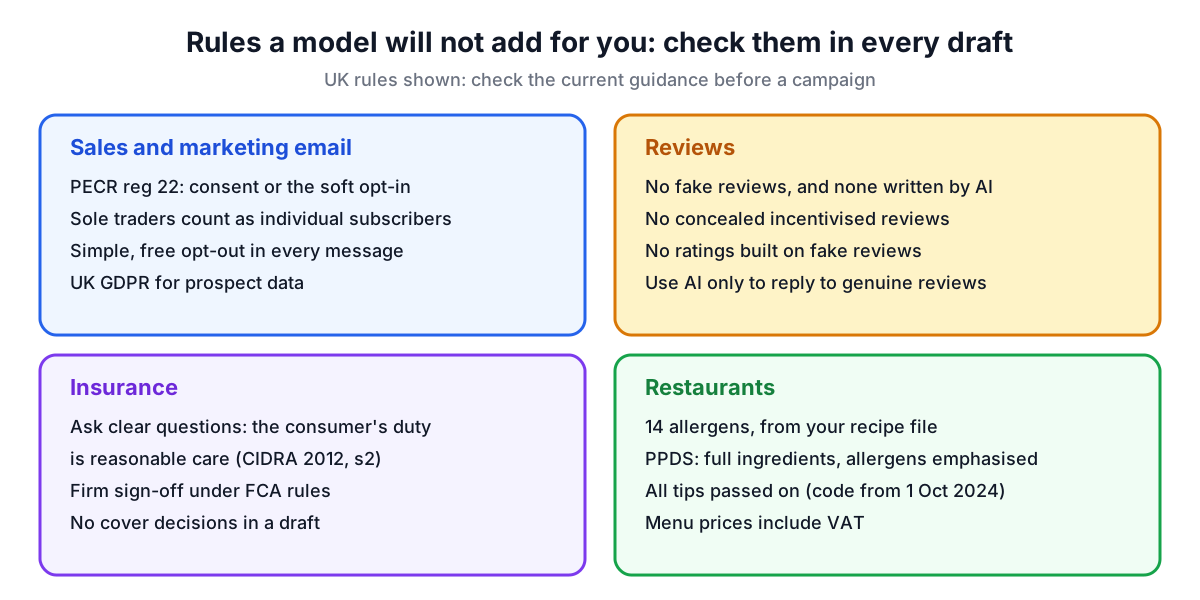
The UK rules a model will not add for you
Email marketing: PECR regulation 22. The Privacy and Electronic Communications Regulations stop you sending unsolicited marketing email to individual subscribers unless they have consented, or unless the soft opt-in applies: you got their details in the course of a sale or negotiations for a sale, you are marketing your own similar products or services, and you gave them a simple, free way to refuse at the time of collection and in every message after. Since 5 February 2026, an amendment made by the Data (Use and Access) Act 2025 adds a similar route for charities. Regulation 22 applies to individual subscribers, which is why the UK sales kit flags a sole trader or ordinary partnership as needing consent while an email to a limited company needs a clear opt-out.
Reviews: the fake reviews ban. The CMA's guide for businesses describes three kinds of banned content: fake reviews, concealed incentivised reviews (for example a review written in exchange for a free stay without saying so), and false or misleading consumer review information such as a star rating built on fake reviews. Businesses must not write fake reviews or commission others to write them. AI-written reviews of your own business fall squarely in the first category. Use AI to reply to genuine reviews, never to write them.
Insurance: disclosure and fair dealing. Under section 2 of the Consumer Insurance (Disclosure and Representations) Act 2012, a consumer's duty is to take reasonable care not to make a misrepresentation to the insurer. That is why the UK insurance kit asks for clear, specific questions to clients rather than "tell us everything relevant". Brokers and insurers are regulated by the FCA, whose Consumer Duty guidance sets the expectations for communications; your firm's compliance team will have its own sign-off rules for anything sent to customers.
Restaurants: allergens and tips. The Food Standards Agency's guidance lists the 14 allergens food law requires businesses to declare: celery, cereals containing gluten, crustaceans, eggs, fish, lupin, milk, molluscs, mustard, peanuts, sesame, soybeans, sulphur dioxide and sulphites above the threshold, and tree nuts. Food prepacked for direct sale needs a label with a full ingredients list with the allergens emphasised. For non-prepacked food you must give allergen information for every item that contains any of the 14, either in writing (on a menu, chalkboard or information pack) or verbally with a clearly visible written notice saying how to get it. Separately, the Employment (Allocation of Tips) Act 2023 makes it mandatory to pass all tips to workers without deductions, and its statutory code of practice came into force on 1 October 2024. A job advert or a menu note the model writes must not suggest otherwise.
Masking client and booking data
Client files, CRM exports and booking lists are personal data under UK data protection law. The kits' masking helper runs in your browser. A made-up insurance note:
Client: Priya Shah, policy number HX4471920, claim no. CL-88231, DOB 02/02/1985, 7 Mill Lane, Bristol BS1 4DJ.
Client: [NAME-1], policy number [POLICY-NO-1], claim no. [POLICY-NO-2], DOB [DATE-1], [ADDRESS-1], Bristol [POSTCODE-1].
A made-up restaurant booking:
Booking: Mr Tom Reid, table for 4, 08/11/2026, allergic to sesame, phone 07700 900321.
Booking: Mr [NAME-1], table for 4, [DATE-1], allergic to sesame, phone [PHONE-1].
The allergy stays, which is right for a prompt about the booking, but remember that an allergy linked to a person is health information. Once the name and phone number are gone, it no longer is.
Worked example: food cost on a VAT-inclusive menu
UK menu prices include VAT, and a food cost percentage worked out on the menu price flatters the dish. Take a dish sold at £14.50 including VAT at the 20% standard rate, with ingredients costing £3.80:
price before VAT    = £14.50 / 1.20 = £12.08
food cost %         = £3.80 / £12.08 = 31.4%
wrong way (on £14.50) = £3.80 / £14.50 = 26.2%
The five-point gap is the VAT, not profit. The UK restaurant kit's food cost prompt tells the model to take VAT out first and show that step, using the rate you give it. The arithmetic itself is better done in the Margin and Markup Calculator (UK) and the VAT Calculator (UK), which do not make arithmetic slips.
A UK cold email prompt
With the region set to United Kingdom, the sales kit's cold email template includes:
- Under PECR, B2B emails to limited companies and LLPs can be sent without prior consent if they are relevant and offer an opt-out, but sole traders and some partnerships count as individuals and need consent or the soft opt-in. Live calls must be screened against the TPS and CTPS.
- Personal data about prospects is processed under UK GDPR legitimate interests: keep it relevant to their role and honour objections promptly.
Paste your research notes, the offer and one real proof point, and ask for three short variants with a single call to action and an opt-out line. Everything the email says about the prospect must be something you found, not something the model inferred.
Reviewing drafts before they go out
- Facts: every feature, price, cover term, ingredient and customer detail traced to your source.
- Claims: anything you could not evidence to the ASA or a regulator comes out.
- Required lines: opt-out in marketing email, your firm's insurance disclosures, allergen information from the recipe file.
- Prices: VAT-inclusive for consumers, and the arithmetic checked in a calculator.
- Tone: read it as the customer would.
Frequently asked questions
Can I send B2B cold emails in the UK without consent?
PECR regulation 22 restricts unsolicited marketing email to individual subscribers, so the answer depends on who you are emailing. The UK sales kit treats emails to limited companies and LLPs as allowed if relevant and with an opt-out, and flags sole traders and ordinary partnerships as needing consent or the soft opt-in. Check the ICO's guidance before a campaign.
What is the PECR soft opt-in?
You may email marketing without prior consent where you got the person's details in the course of a sale or negotiations for a sale, you are marketing your own similar products or services, and you gave them a simple, free way to refuse when you collected the details and in every message since.
Is it illegal to use AI to write reviews of my business in the UK?
Writing fake reviews, or commissioning others to write them, is banned, and the CMA's guidance treats fake reviews, concealed incentivised reviews and misleading review information as banned content. An AI-written review of your own business is a fake review. Use AI only to help reply to real ones.
What are the 14 allergens restaurants must declare?
Celery, cereals containing gluten, crustaceans, eggs, fish, lupin, milk, molluscs, mustard, peanuts, sesame, soybeans, sulphur dioxide and sulphites above the threshold, and tree nuts. The information must come from your recipes and supplier specifications, never from a model.
How do I work out food cost percentage with VAT?
Take VAT out of the menu price first. A £14.50 dish at 20% VAT is £12.08 before VAT, so £3.80 of ingredients is a 31.4% food cost, not the 26.2% you get by dividing by the menu price.
Sources and further reading
- The Privacy and Electronic Communications (EC Directive) Regulations 2003, regulation 22, legislation.gov.uk.
- Short guide for businesses: publishing consumer reviews and complying with consumer protection law, Competition and Markets Authority.
- Consumer Insurance (Disclosure and Representations) Act 2012, section 2, legislation.gov.uk.
- Allergen guidance for food businesses, Food Standards Agency.
- Distributing tips fairly: statutory code of practice, GOV.UK.
- VAT rates, GOV.UK. The 20% standard rate.
- Consumer Duty, Financial Conduct Authority.
Open the AI Prompts for Sales Teams
More AI for Professions
Every tool in the AI for Professions section, free and in your browser.