
AI for Sales, Marketing, Insurance and Restaurants in India
AI for sales emails, ads, policy explainers and menus in India: CCPA rules on endorsements, dark patterns and service charges, TRAI, DPDP and food cost in rupees.
By Redbison Dev · · 10 min read
India edition. Written for Indian businesses, with CCPA guidelines on endorsements, dark patterns, greenwashing and service charges, the ASCI Code, TRAI's commercial communication rules, IRDAI and the DPDP Act in place of US rules. US edition
For Indian sales teams, marketers, insurance agents and restaurant owners, AI assistants are already part of the daily routine: WhatsApp follow-ups, Instagram captions, explanations of a health policy for a client's parents, menu descriptions for a cloud kitchen listing. The tools are quick, but they were mostly trained on American examples, and Indian consumer rules differ in ways that cost money. A model can easily suggest adding a 10% service charge to the bill, a countdown timer on a checkout page or an influencer post without "#ad". This guide covers the Indian rules to build into your prompts, worked examples from the AI Prompts for Sales Teams (India), AI Prompts for Marketers (India), AI Prompts for Insurance Agents (India) and AI Prompts for Restaurants and Cloud Kitchens (India) kits, and a review routine.
Where drafting helps
| Role | Good fit | Keep human |
|---|---|---|
| Sales | Prospect summaries, cold email and LinkedIn variants, follow-ups after a demo, mutual action plans for vendor registration and PO | Pricing, discounts, GST terms, anything about the client you have not verified |
| Marketing | Campaign briefs, ad variants, captions in English and Hinglish drafts, content calendars | Claims, endorsements and their disclosures, sign-off |
| Insurance | Plain-English explainers built from the policy wording, renewal reminders, claim status updates | Whether a claim is payable, which policy suits a client, any return on a life policy |
| Restaurants | Menu descriptions, replies to Zomato or Google reviews, specials posts, job posts | Prices, veg and non-veg marking, allergen and calorie information |
Indian rules a model will not add for you
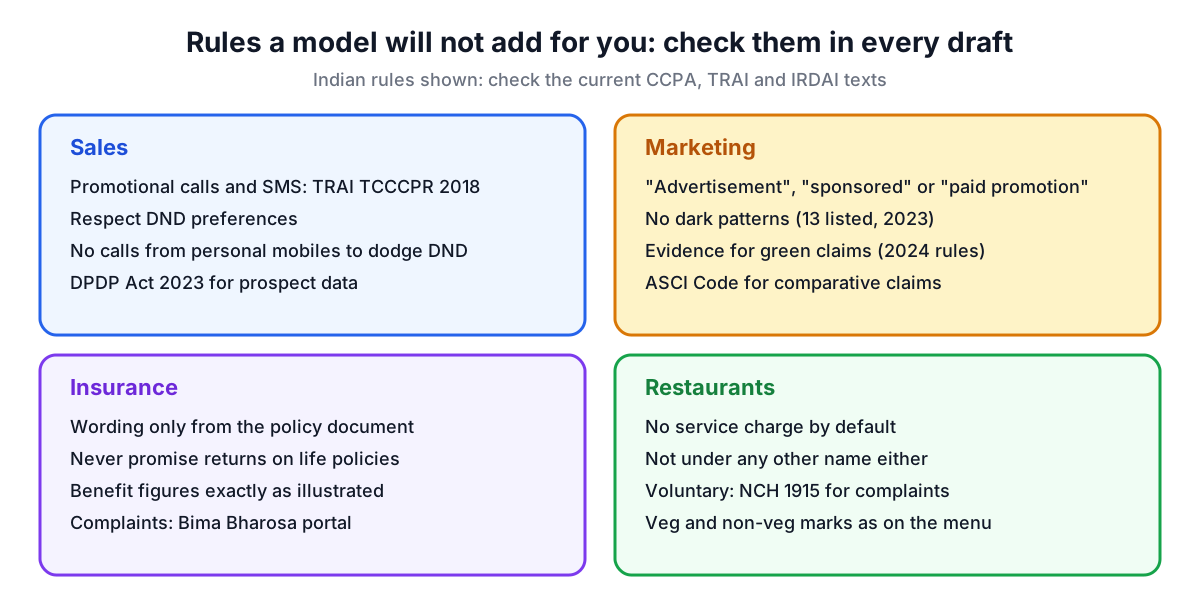
Endorsements. The Department of Consumer Affairs' "Endorsement Know-hows!" guide for celebrities and influencers says disclosures must be prominently and clearly displayed in the endorsement, using simple terms such as "advertisement", "sponsored" or "paid promotion", and that anyone with an audience must disclose a material connection with the advertiser. It builds on the Guidelines for Prevention of Misleading Advertisements and Endorsements for Misleading Advertisements, 2022, published on 9 June 2022. Influencers should also not endorse a product they have not used or checked.
Dark patterns. The Central Consumer Protection Authority issued the Guidelines for Prevention and Regulation of Dark Patterns, 2023 on 30 November 2023, listing 13 specified dark patterns, among them drip pricing, disguised advertisement, bait and switch and false urgency, which it treats as unfair trade practices under the Consumer Protection Act, 2019. A model asked to "make the checkout page convert better" will often propose exactly these, so the India marketing kit asks it to list any false urgency, pre-ticked add-ons, late hidden charges or confirm-shaming wording as findings.
Green claims. The CCPA's Guidelines for Prevention and Regulation of Greenwashing or Misleading Environmental Claims, 2024 were announced in October 2024. Flag every "eco-friendly", "sustainable" or "carbon neutral" line for evidence before it runs.
Promotional calls and SMS. TRAI's Telecom Commercial Communications Customer Preference Regulations, 2018 govern commercial calls and messages and customers' preferences. The India sales kit tells the model to send promotional calls and SMS only through registered routes and never to suggest calling from a personal mobile to get around DND preferences.
Restaurants: service charges. The CCPA's guidelines on service charges say a hotel or restaurant shall not add a service charge automatically or by default in the food bill, shall not collect it under any other name, and must tell the customer that it is voluntary, optional and at their discretion. Customers can complain to the National Consumer Helpline on 1915. In March 2025 the Delhi High Court dismissed petitions by restaurant associations and ruled that restaurants cannot impose a mandatory service charge. A menu note, a bill template or a reply to a complaint drafted by AI must reflect that.
Insurance. Agents act for an IRDAI-regulated insurer, and IRDAI's Master Circular on Protection of Policyholders' Interests 2024 sets the insurer's duties to policyholders. The India insurance kit tells the model never to promise returns or bonuses on life policies and to quote benefit illustrations only as given. For complaints, IRDAI's Bima Bharosa portal registers policyholder grievances and says each will be attended to within 14 days.
Data. Prospect lists, policyholder files and guest phone numbers are digital personal data under the Digital Personal Data Protection Act 2023, and the DPDP Rules 2025, notified on 14 November 2025, phase in over eighteen months. Keep CRM exports and customer lists out of tools your company has not approved.
Masking client and lead data
The kits' masking helper runs in your browser. A made-up policyholder note:
Client: Rohit Mehra, policy number 30045123456, PAN ABCPM1234K, mobile 98200 12345, nominee wife, sum insured ₹10 lakh.
Client: [NAME-1], policy number [POLICY-NO-1], PAN [NATIONAL-ID-1], mobile [PHONE-1], nominee wife, sum insured ₹10 lakh.
A made-up lead from a B2B pipeline:
Contact: Anil Kapoor, anil.kapoor@example.in, +91 99887 76655, GSTIN on file, deal ₹18.5 lakh.
Contact: [NAME-1], [EMAIL-1], [PHONE-1], GSTIN on file, deal ₹18.5 lakh.
The deal value and sum insured stay, which is usually what you want for a drafting prompt. The relationship ("nominee wife") stays too; in a small town, a relationship plus a sum insured can still point to one family, so read the text before pasting.
Worked example: food cost in rupees
If your menu prices are shown before GST, work out food cost on that price. A paneer dish on the menu at ₹380 with ingredients costing ₹120:
food cost % = ₹120 / ₹380 = 31.6%
gross profit = ₹380 - ₹120 = ₹260 (a 68.4% margin)
If the price a customer sees includes tax, take the tax out first, at the rate your accountant confirms, before dividing. The India restaurant kit asks the model to confirm which applies and show the step; the arithmetic is safer in the Margin and Markup Calculator (India, with GST).
An Indian cold email prompt
With the region set to India, the sales kit adds constraints such as:
- Write for Indian buyers: British spelling, deal values in rupees with lakh and crore (for example ₹18.5 lakh), prices stated as exclusive or inclusive of GST, and dates as 6 November.
- For public sector buyers, procurement usually runs through GeM or a tender on the e-procurement portal; frame next steps around the tender process the material describes.
Give it your research notes, the offer and one real customer result you are allowed to share, and ask for three short variants. Nothing about the prospect should appear that is not in your notes.
Review before it reaches a customer
- Facts: features, prices, policy terms, ingredients and customer details traced to the source.
- Disclosures: "advertisement", "sponsored" or "paid promotion" on every paid endorsement.
- Design: no false urgency, pre-ticked add-ons or charges revealed only at payment.
- Insurance: no promised returns; benefit figures exactly as in the illustration.
- Bills and menus: no default service charge; veg and non-veg marks correct.
Frequently asked questions
Can a restaurant in India add a service charge to the bill?
Not automatically or by default. The CCPA's guidelines say restaurants shall not add a service charge by default, collect it under another name, or force a customer to pay it, and must make clear it is voluntary. In March 2025 the Delhi High Court ruled that restaurants cannot impose a mandatory service charge.
What disclosure do influencers need in India?
A prominent, clear disclosure in the endorsement itself, using terms such as "advertisement", "sponsored" or "paid promotion", whenever the influencer has a material connection with the advertiser, according to the Department of Consumer Affairs' "Endorsement Know-hows!" guide.
What are dark patterns under the CCPA guidelines?
Design and choice architecture that deceives or pressures consumers into choices not in their interest. The 2023 guidelines list 13 specified dark patterns, including drip pricing, disguised advertisement, bait and switch and false urgency.
Can insurance agents use ChatGPT to explain policies?
Yes for drafting a plain-English explanation built from the actual policy wording, with the client's details removed. The agent checks every term against the policy document, never promises returns on a life policy, and leaves claim decisions to the insurer.
How do I calculate food cost percentage in India?
Divide the ingredient cost by the selling price before tax. A dish priced at ₹380 before GST with ₹120 of ingredients has a food cost of 31.6%.
Sources and further reading
- Centre releases endorsement guidelines for celebrities and social media influencers (20 January 2023), Press Information Bureau.
- CCPA issues Guidelines for Prevention and Regulation of Dark Patterns, 2023, Press Information Bureau.
- CCPA issues guidelines on greenwashing and misleading environmental claims, Press Information Bureau.
- No hotels or restaurants can add service charge automatically or by default in the food bill (4 July 2022), Press Information Bureau.
- Delhi HC rules restaurants can't impose mandatory service charge in bills (28 March 2025), Akashvani News.
- Telecom Commercial Communications Customer Preference Regulations, 2018, Telecom Regulatory Authority of India.
- Master Circular on Protection of Policyholders' Interests 2024, IRDAI.
- The ASCI Code, Advertising Standards Council of India.
- Bima Bharosa, IRDAI. Registering and tracking policyholder complaints.
- DPDP Rules, 2025 notified: backgrounder (17 November 2025), Press Information Bureau, Government of India. Notification on 14 November 2025 and the eighteen-month phased compliance period.
Open the AI Prompts for Sales Teams
More AI for Professions
Every tool in the AI for Professions section, free and in your browser.