
AI for Australian Doctors and Nurses: Ahpra Rules, Prompts
AI for GP letters, PBS authority requests and ISBAR handover in Australia: Ahpra's AI guidance, privacy law, masking Medicare numbers and a review routine.
By Redbison Dev · · 9 min read

Australia edition. Written for Australian practice, with Ahpra's guidance on AI, the Privacy Act, TGA device rules, Medicare numbers, URNs, ISBAR and healthdirect in place of HIPAA. US edition
An AI scribe listening to a consult and a chat assistant tidying a referral letter raise the same professional questions in Australia: who is responsible for the output, what the patient was told, and where the data went. A general AI assistant can turn rough notes into a referral letter, a care plan or a structured handover in seconds, but you remain responsible for every word it produces, and patient information should only go into a tool you understand and your practice or health service has approved. This guide covers where AI drafting helps, what Ahpra's guidance and Australian privacy law expect, how masking handles Australian identifiers, and a review routine. The AI Prompts for Doctors (Australia) and AI Prompts for Nurses (Australia) kits contain ready-made versions of the prompts.
Where drafting helps in Australian practice
| Task | What the model contributes | What stays with you |
|---|---|---|
| Referral letter from a GP to a specialist | A focused letter that opens with the question | The question and urgency |
| PBS Authority Required application or private insurer pre-approval | Each restriction criterion matched to the record | Whether the criteria are met |
| SOAP note from dictation | Sorting into sections | Assessment and plan |
| Patient handout | Plain English at a set reading level | Red flags, healthdirect and 000 advice |
| ISBAR handover from shift notes | Identify, Situation, Background, Assessment, Recommendation in order | Escalation and MET criteria |
| Nursing care plan draft | Problems, goals and interventions | Individualising it to the patient |
Healthdirect's number is 1800 022 222 and its site says to call triple zero (000) for urgent medical help; the Australian setting in the kits puts those service names into patient-facing text so a model trained on US material does not write "call 911".
What Ahpra expects
Ahpra and the National Boards have published guidance on meeting your professional obligations when using AI in healthcare (the page was last reviewed on 22 August 2024). The main points:
- Accountability. You remain responsible for safe, quality care when you use AI, and must apply human judgement to its output. If you use an AI scribe, check the accuracy of the record. Approval of a product by the TGA does not remove that duty.
- Understanding. Review the product information: how it was trained and tested, its intended use, its limitations, how data is used to retrain it and where it is stored.
- Transparency. Tell patients when AI is used and give them a chance to raise concerns; the detail depends on the use, and recording a consultation calls for more explanation than imaging software.
- Informed consent. Involve patients in decisions about AI tools that use their personal data and, ideally, note their response in the record. For AI scribes consent is generally required, and Ahpra warns there may be criminal implications if consent is not obtained before recording.
- Ethics and law. Protect privacy, check whether patient data is used to train the model, understand bias (including for Aboriginal and Torres Strait Islander patients), follow TGA and state requirements, know your employer's governance arrangements, and confirm your professional indemnity insurance covers the use.
The same guidance explains the TGA's role. The TGA regulates AI software with a therapeutic use that meets the medical device definition, and you can check the Australian Register of Therapeutic Goods. General-purpose generative AI tools, including AI scribes, usually fall outside TGA regulation, which is exactly why the accountability sits with you.
Privacy law
The OAIC describes Australian privacy law as having strict rules on how health service providers collect, use and disclose health information, and the Australian Privacy Principles set the framework for organisations covered by the Privacy Act 1988. Ahpra's guidance also points you to state and territory requirements. In practice: use the tool your practice or health service has approved, and remove identifiers before pasting anything into any other tool.
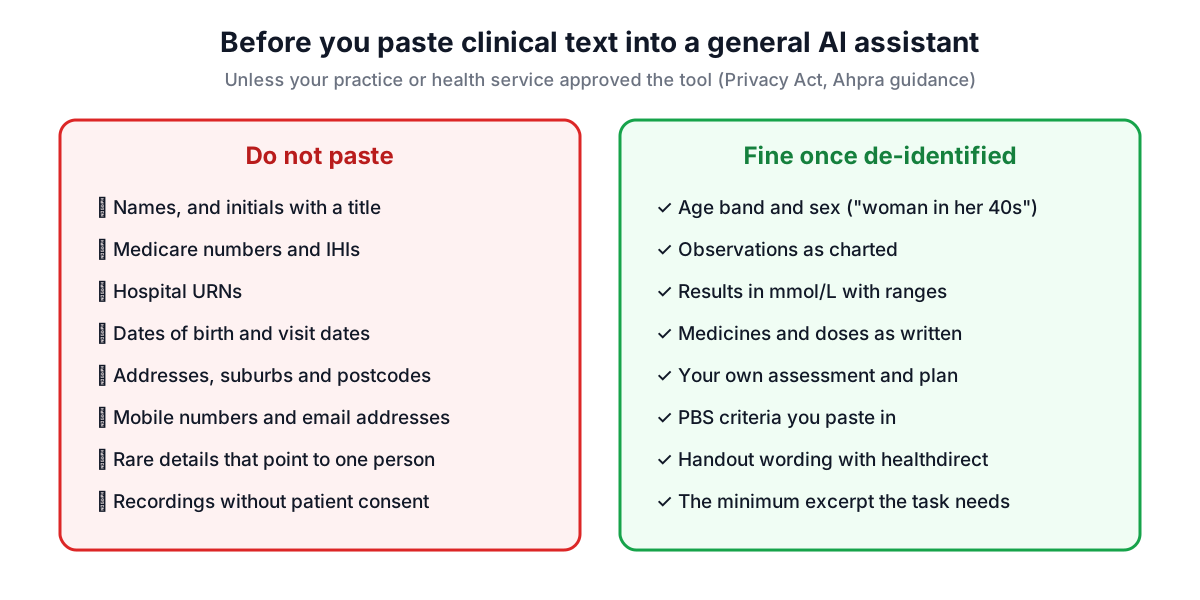
Masking an Australian note: what gets through
The kits' masking helper runs in your browser. A made-up note:
Patient: Sarah Nguyen, Medicare number 2123 45670 1, URN 0045821, DOB 14/03/1951, 22 Beach Road, Bondi 2026, mobile 0412 345 678.
returns:
Patient: [NAME-1], Medicare number [RECORD-ID-1], URN 0045821, DOB [DATE-1], [ADDRESS-1], Bondi 2026, mobile [PHONE-1].
The labelled Medicare number, the date of birth, the street address and the mobile are masked. Two identifiers are not:
- The URN. The helper has no pattern for hospital unit record numbers. Delete URNs by hand, or relabel them as "Patient ID" before masking.
- The suburb and postcode. A four-digit number is far too common in clinical text to mask on sight, so "Bondi 2026" stays. A suburb plus an age and an unusual diagnosis can identify someone in a country town.
The helper is a second pair of eyes. Read the text yourself before you paste it.
An Australian prompt and ISBAR
With the region set to Australia, the doctors' kit adds constraints such as:
- Write for Australian practice: Australian spelling, dates as 6 November 2026, glucose and cholesterol in mmol/L and HbA1c as written in the source.
- Name Therapeutic Guidelines, RACGP or state health guidance only if it appears in the material; otherwise write [CHECK AUSTRALIAN GUIDELINE: topic].
- Use Australian service names: GP, emergency department, healthdirect (1800 022 222) and 000. Show Medicare numbers and IHIs only as [MEDICARE NUMBER] or [IHI].
For nurses, the Australian setting turns the SBAR handover into ISBAR by adding an Identify line (the patient as [PATIENT ID], who is handing over and who is receiving) before Situation, and it asks the model to refer to the observation chart and MET criteria only as stated in your notes, otherwise writing [CHECK LOCAL ESCALATION CRITERIA]. The NMBA's codes of conduct for nurses and midwives, in effect since 1 March 2018, still govern how you keep records and protect privacy whichever tool drafted the words.
Review before it goes in the record
- Every fact against the source, looking for additions as well as omissions.
- Every number, especially doses and units: mmol/L, micrograms against milligrams.
- Guideline and PBS claims checked in the current Therapeutic Guidelines or the PBS schedule, never taken from the draft.
- Patient text read as the patient, with healthdirect and 000 where they belong.
- Consent recorded if the tool listened to the consultation.
Frequently asked questions
Do I need patient consent to use an AI scribe in Australia?
Ahpra's guidance says consent is generally required for AI scribes and is especially important when a consultation is recorded, warning that there may be criminal implications if consent is not obtained before recording. It suggests noting the patient's response in the health record.
Are AI scribes regulated by the TGA?
Usually not. Ahpra's guidance explains that the TGA regulates AI software with a therapeutic use that meets the medical device definition, while general-purpose generative AI tools such as AI scribes usually fall outside TGA regulation. You can check the Australian Register of Therapeutic Goods for a particular product.
Who is responsible for an error in an AI-drafted note?
You are. Ahpra's guidance says practitioners remain responsible for safe, quality care when using AI and must apply human judgement to its output, including checking the accuracy of records produced by an AI scribe.
Does the masking helper remove URNs and postcodes?
No. It masks dates, street addresses, phone numbers, Medicare numbers written after "Medicare", and IHIs written in groups (IHI 8003 6012 3456 7890) or straight after "IHI". In our test an IHI written as 16 unbroken digits after "IHI number" was left in clear, so check it. It has no pattern for hospital URNs, and it masks a four-digit postcode only when the word "postcode" comes before it, so a suburb and postcode such as Bondi 2026 stays. Remove those by hand.
Can nurses use AI for ISBAR handover?
For drafting the wording from your own notes, with identifiers removed and through a tool your health service approves. The handover content, the escalation decision and the record remain yours under the NMBA code of conduct.
Sources and further reading
- Meeting your professional obligations when using Artificial Intelligence in healthcare, Ahpra and the National Boards.
- Health information, Office of the Australian Information Commissioner.
- Australian Privacy Principles, Office of the Australian Information Commissioner.
- Professional standards, including the Code of conduct for nurses, Nursing and Midwifery Board of Australia.
- healthdirect, healthdirect Australia. 1800 022 222 and when to call 000.
- Ethics and governance of artificial intelligence for health: guidance on large multi-modal models, World Health Organization.
Open the AI Prompts for Doctors
More AI for Professions
Every tool in the AI for Professions section, free and in your browser.