
AI for NHS Doctors and Nurses: Safe Prompts and UK GDPR
Using AI to draft clinic letters, discharge summaries and NEWS2 handovers in the NHS: what UK data law and the NMC Code expect, NHS number masking and review.
By Redbison Dev · · 9 min read
United Kingdom edition. Written for NHS and UK independent practice, with UK data protection law, the NMC Code, NEWS2, NHS numbers and MHRA device rules in place of HIPAA. US edition
A GP registrar finishing a morning surgery has a dozen letters, a referral and a stack of results to file. A ward nurse coming off a long day has eight patients to hand over. Both are being told that a general AI assistant could do half the writing. It can: turning dictated notes into a clinic letter a GP can read in thirty seconds, or rewriting a discharge plan for a patient who left school at sixteen, is exactly the kind of rewriting language models do well. What it cannot do safely is hold patient identifiers in a tool your trust or practice has not approved, or supply facts that are not in front of it. This guide covers where AI drafting helps in UK practice, what UK data law and the professional codes expect, how the AI Prompts for Doctors (UK) and AI Prompts for Nurses (UK) kits handle NHS-specific details, and a review routine.
Where drafting helps in UK practice
| Task | What the model contributes | What stays with the clinician |
|---|---|---|
| Clinic letter to the GP from dictation | Structure: diagnosis, plan, actions for the GP, actions for the patient | The plan, and which actions you are asking the GP to take |
| Referral to secondary care | A short opening question and relevant history only | The urgency and the clinical question |
| Individual Funding Request | A letter framed around exceptional clinical circumstances | Whether the case is exceptional |
| Discharge summary and patient leaflet | Plain-English rewrite at a set reading level | Medicines list, red flags, NHS 111 and 999 advice |
| Nursing handover from shift notes | SBAR order, abnormal trends first | Escalation decisions and the NEWS2 score itself |
| Teaching material for students | Varied questions in the NMC test style, if asked | Checking every answer against current guidance |
The pattern is the same as anywhere else: you supply the facts, the model supplies the shape. It fails as soon as it has to supply knowledge, such as a dose, a NICE recommendation from memory or a decision about urgency.
What UK law and the codes expect
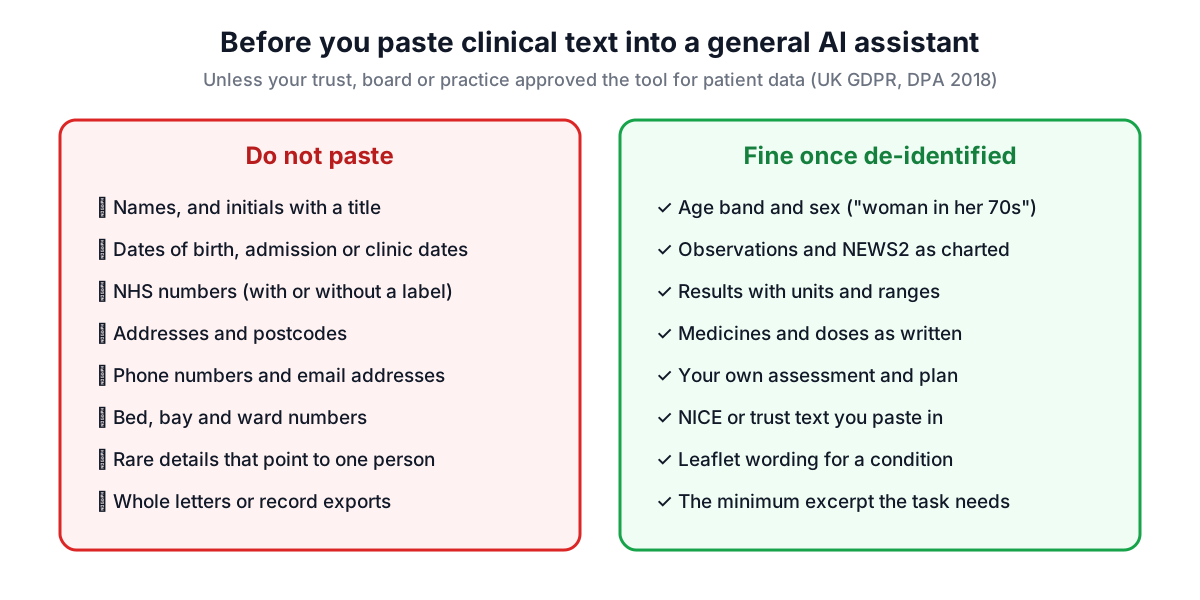
Data protection. The Data Protection Act 2018 sits alongside the UK GDPR, and health data is one of the special categories of personal data with extra conditions for processing (Part 2, sections 10 and 11 of the Act deal with them). Pasting a named patient's notes into a consumer chat service is a new disclosure to a third party your organisation has not assessed. Removing the name is not enough on its own if the date of birth, postcode or a rare detail still points to one person.
Confidentiality and records. The NMC Code applies to nurses, midwives and nursing associates. Section 5 asks you to respect people's right to privacy and confidentiality, and section 10 asks you to keep clear and accurate records: complete them at the time or as soon as possible after the event (10.1), complete them accurately and without falsification (10.3), and attribute entries to yourself without unnecessary abbreviations, jargon or speculation (10.4). An AI draft that you paste into a record becomes your entry under 10.4, so read it as if you had typed every word. Doctors should read the GMC's confidentiality guidance in the same way.
Medical devices. The MHRA explains that in the UK many software and AI products are regulated as medical devices. A general chat assistant used to tidy wording is not one, but a tool that suggests diagnoses or doses for individual patients may be, which is one reason trusts approve specific products rather than leaving staff to choose.
Your organisation's approval. Check whether your trust, board or practice has an AI or information governance policy naming the tools staff may use and for what data. If it does, it overrides anything in this guide.
Masking an NHS-style note: what the helper catches
The kits include a masking helper that runs in your browser and swaps common identifiers for tokens. Here is a made-up GP note, using the example NHS number that the NHS website prints and a made-up mobile number:
Patient: Margaret Ellis, NHS number 485 777 3456, seen 03/11/2026 at 12 Station Road surgery, Leeds LS6 2AB. Daughter on 07700 900123. Unlabelled copy of the number: 485 777 3456. Works as the only pharmacist in the village.
The helper returns:
Patient: [NAME-1], NHS number [RECORD-ID-1], seen [DATE-1] at [ADDRESS-1] surgery, Leeds [POSTCODE-1]. Daughter on [PHONE-1]. Unlabelled copy of the number: [PHONE-2]. Works as the only pharmacist in the village.
Three things are worth noticing. The labelled NHS number is masked as a record ID. The same digits without a label are masked only because they look like a phone number: the helper recognises an unlabelled NHS number by its modulus 11 check digit, and the example number on the NHS website does not pass that check, so a real number would be tagged as a record but this one is tagged as a phone. And "the only pharmacist in the village" goes straight through, because no pattern can recognise a detail that identifies someone by context. That sentence is the one you have to delete yourself.
A UK prompt, built by the kit
Set the region to United Kingdom and every prompt gains UK constraints. A referral built from the kit's template includes lines such as:
- Write for UK practice: British spelling, dates as 6 November 2026, glucose and cholesterol in mmol/L, HbA1c in mmol/mol, and drug names and doses as written in the source (the BNF is the UK reference for checking them).
- Name NICE guidance (or SIGN in Scotland) only if it appears in the material; otherwise write [CHECK NICE/SIGN GUIDANCE: topic]. Never quote a recommendation from memory.
- Use NHS service names: GP, A&E, NHS 111 for urgent advice and 999 for emergencies. Show any NHS number only as [NHS NUMBER].
The second line is the important one. Models are fluent at producing a plausible "NICE recommends..." sentence that does not match the current guideline. Forcing a placeholder turns that habit into a checklist item you resolve against the NICE website.
For nurses, the UK setting adds a NEWS2 rule: refer to the score and the trust's escalation thresholds only as stated in the notes, otherwise write [CHECK LOCAL NEWS2 ESCALATION POLICY]. NEWS2, the Royal College of Physicians' December 2017 update of the National Early Warning Score, scores six measurements (respiration rate, oxygen saturation, systolic blood pressure, pulse rate, level of consciousness or new confusion, and temperature) and adds 2 points for supplemental oxygen; NHS England has endorsed it for identifying acutely ill patients in hospitals in England. A model should never calculate or guess the score: it is a total you already have on the chart.
Reviewing before you sign or file
- Line up every fact with the source. Look for additions as well as omissions, especially allergies and medicines.
- Read every number twice. Units matter: mmol/L against mg/dL, mmol/mol against per cent for HbA1c, micrograms against milligrams.
- Check every guideline reference on the NICE or SIGN site, and every dose in the BNF.
- Read patient letters as the patient. Are NHS 111 and 999 used correctly, and does the letter match what you said in the room?
- File it as your own entry. Under the NMC Code and your employer's policy, it is.
Trying it for a month
| Week | What to do |
|---|---|
| 1 | Find your trust's or practice's AI policy and the information governance contact. List the tools approved and for what data. |
| 2 | Use two templates with no patient data at all: a patient leaflet on a common condition and a teaching quiz. |
| 3 | Add one template with de-identified text, such as a discharge leaflet, with the masking helper and your own read-through every time. Note what the helper missed. |
| 4 | Review with a colleague: keep the templates that saved time after checking, and export them for the team. |
Frequently asked questions
Can NHS staff use ChatGPT with patient information?
Only through a tool your trust, board or practice has approved for patient data. Health data is special category data under UK data protection law, and pasting identifiable notes into an unapproved service is a disclosure your organisation has not assessed. Without approval, remove identifiers first, including the NHS number, postcode and any detail that points to one person.
Is an anonymised NHS note safe to paste into AI?
It is far safer than an identifiable one, but check that it is genuinely anonymous. A date of birth, a postcode or a rare occupation can identify someone without a name, and a pattern-based masking helper will not catch context such as "the only pharmacist in the village".
Can AI calculate a NEWS2 score?
Do not ask it to. NEWS2 is a total of six scored observations plus 2 points for supplemental oxygen, and it belongs on the observation chart, worked out by the person taking the observations and acted on under the trust's escalation policy. A prompt should only repeat a score that is already in the notes.
What does the NMC Code say about records written with AI help?
The Code does not mention AI, but section 10 applies to any entry you make: complete records at the time or as soon as possible, accurately and without falsification, attributed to you and free of unnecessary jargon or speculation. An AI draft you file is your entry.
Is an AI tool a medical device in the UK?
It can be. The MHRA explains that many software and AI products are regulated as medical devices in the UK, depending on their intended purpose. A general assistant used to rewrite text is not designed as one; a tool that suggests diagnoses or treatment for individual patients may be.
Sources and further reading
- Data Protection Act 2018, legislation.gov.uk. Special categories of personal data, sections 10 and 11.
- The Code: read the Code online, Nursing and Midwifery Council. Section 5 (confidentiality) and section 10 (records).
- National Early Warning Score (NEWS) 2, Royal College of Physicians.
- Find your NHS number, NHS. The 10-digit format and an example number.
- Medical devices: software and artificial intelligence (AI), Medicines and Healthcare products Regulatory Agency.
- Ethics and governance of artificial intelligence for health: guidance on large multi-modal models, World Health Organization.
Open the AI Prompts for Doctors
More AI for Professions
Every tool in the AI for Professions section, free and in your browser.