
AI for Doctors and Nurses in Canada: Privacy and Prompts
AI for referral letters, charting and handover in Canada: PHIPA and provincial health privacy, CPSO advice on AI, masking health card numbers and review.
By Redbison Dev · · 9 min read
Canada edition. Written for Canadian practice, with provincial health privacy law such as Ontario's PHIPA, CPSO advice on AI, health card numbers, A1A 1A1 postal codes and Health Canada device rules in place of HIPAA. US edition
Referral letters, drug coverage forms and chart notes take a large share of a family physician's day, and nurses face the same at the end of a shift. A general AI assistant can take rough notes and return a tidy referral or a structured handover in seconds. The constraint in Canada is that health information is governed province by province, and the custodian of a patient's record, not the vendor of a chat app, carries the duty to protect it. This guide covers where AI drafting helps, what provincial health privacy law and the CPSO expect, how masking handles Canadian identifiers, and how to review a draft. The AI Prompts for Doctors (Canada) and AI Prompts for Nurses (Canada) kits hold ready-made, Canadian-tuned versions of the prompts.
Where drafting helps in Canadian practice
| Task | What the model contributes | What stays with you |
|---|---|---|
| Referral to a specialist | A focused letter that opens with your question | Urgency and the question |
| Drug coverage request (for example Ontario's Exceptional Access Program or a private plan's prior authorization) | Each program criterion matched to chart evidence | Whether the criteria are met |
| SOAP note from dictation | Sorting statements into sections | Assessment and plan wording |
| Patient instructions | Plain language at a set reading level, in English or French | Warning signs, 911 and health line advice |
| Nursing handover | SBAR order, abnormal trends first | Escalation and what is urgent |
| Charting from shift notes | Objective, factual phrasing | Anything you did not observe |
In Quebec, and anywhere you serve French-speaking patients, ask for the patient text in the language the patient reads best and have a fluent colleague check it.
Health privacy is provincial
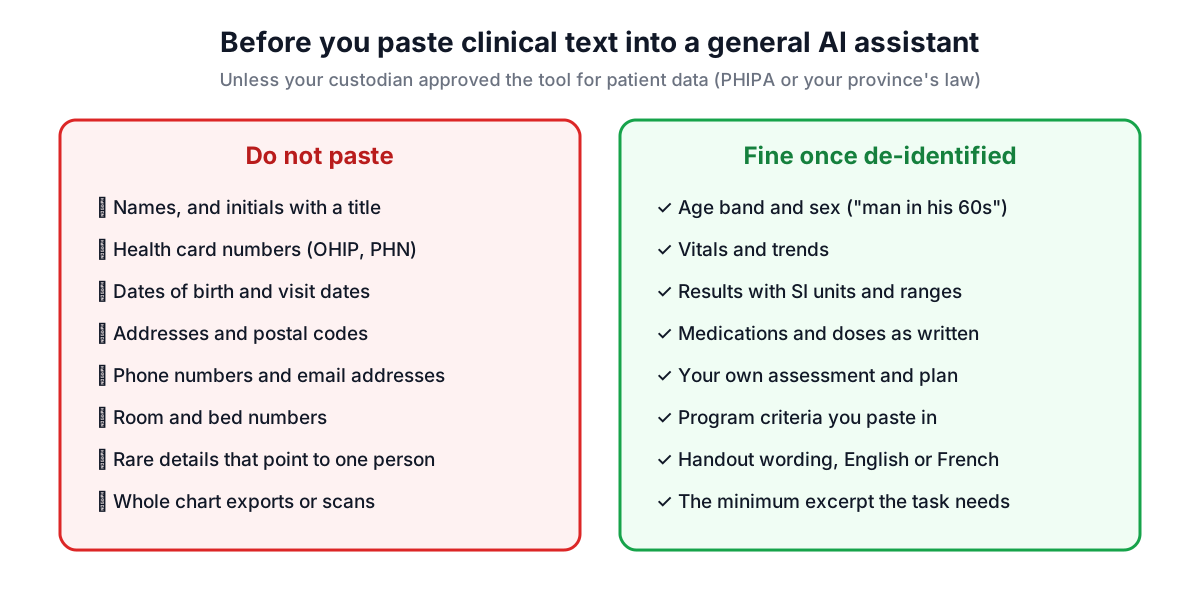
Custodians and agents. Ontario's Personal Health Information Protection Act, 2004 puts the duty on the health information custodian. Section 12(1) requires a custodian to take steps that are reasonable in the circumstances to protect personal health information against theft, loss and unauthorized use or disclosure. The Act defines an "agent" as a person who acts for the custodian with its authorization, for the custodian's purposes and not the agent's own. When you paste a patient's notes into an AI service, the question is whether your custodian (the clinic, hospital or you as a sole practitioner) has authorized that service and assessed it.
Federal law fills the gaps. The Office of the Privacy Commissioner explains that PIPEDA applies to private-sector organizations collecting personal information in commercial activities, and that Ontario, New Brunswick, Nova Scotia and Newfoundland and Labrador have adopted substantially similar legislation for personal health information. Other provinces have their own health information acts, so the law that applies depends on where you practise.
Your college. In October 2025 the CPSO announced new Advice to the Profession on artificial intelligence in clinical practice, replacing an earlier document that covered only AI scribes and extending it to tools for intake, triage and clinical decision support. The CPSO points physicians to the AI scribe programs run by OntarioMD and Canada Health Infoway, which identify approved vendors. Other colleges publish their own expectations; read yours.
Medical devices. Health Canada regulates machine learning-enabled medical devices, those that use machine learning to achieve a medical purpose, and has published pre-market guidance for manufacturers of Class II to IV devices. A general assistant used to tidy wording is not sold as a medical device, which is one reason it should never be asked to decide on a diagnosis or a dose.
Masking a Canadian note
The masking helper in the kits runs in your browser. A made-up note with an Ontario health card number:
Patient: Jean Tremblay, OHIP number 1234-567-890, DOB 1950-07-22, lives at 45 King Street, Toronto M5H 1A1, phone 416-555-0199.
comes back as:
Patient: [NAME-1], OHIP number [RECORD-ID-1], DOB [DATE-1], lives at [ADDRESS-1], Toronto [POSTCODE-1], phone [PHONE-1].
The labelled health card number, the ISO-style date, the street address, the postal code in A1A 1A1 form and the phone number are all caught. What the helper relies on is the label: a health card number pasted on its own, without "OHIP", "health card" or "PHN" in front of it, looks like any other ten-digit number and may only be caught as a phone number or not at all. Names written without a title or a label such as "Patient:" also get through, as do details like "retired lighthouse keeper from a small outport". Read the text after masking.
A Canadian prompt from the kit
With the region set to Canada the kit adds constraints including:
- Write for Canadian practice: Canadian spelling, dates as November 6, 2026 or YYYY-MM-DD, glucose in mmol/L and HbA1c as written in the source.
- Name Canadian guidance (for example Diabetes Canada, Hypertension Canada or a provincial program) only if it appears in the material; otherwise write [CHECK CANADIAN GUIDELINE: topic].
- Use Canadian service names: family doctor, emergency department, the provincial health line (811 in many provinces) and 911. Show a provincial health card number only as [HEALTH CARD].
For a drug coverage request the kit adds a note telling the model to quote the program's criteria only as given in your material and point to the chart evidence for each, rather than describing a US-style payer process. For billing, it swaps the US coding check for one telling you to verify any ICD-10-CA or provincial fee code in your billing system.
Nursing uses
For nurses, the Canada setting uses Canadian terms (the most responsible physician or nurse practitioner, charge nurse, emergency department) and asks the model to follow the documentation standard of the regulator named in your material, such as the College of Nurses of Ontario or BCCNM, or to write [CHECK COLLEGE STANDARD]. Handover still follows SBAR, the Situation, Background, Assessment, Recommendation frame the Institute for Healthcare Improvement publishes. As anywhere, do not ask a model for medication calculations or infusion rates.
Reviewing a draft
- Facts in the chart. Everything in the draft must be in your notes; look for added history as much as dropped allergies.
- Units and numbers. Check every value against the lab report, in the units it uses, and that nothing was converted or rounded.
- Program criteria and guidelines checked against the program's own form or the guideline's current version.
- Language. Patient text in the language the patient reads, checked by a fluent speaker if it is not yours.
- Your signature. The note is yours once it is in the chart.
Frequently asked questions
Is ChatGPT PHIPA compliant?
PHIPA puts the duty on the health information custodian, not on the software. A custodian must take reasonable steps to protect personal health information against unauthorized use or disclosure, so pasting identifiable notes into a service the custodian has not authorized and assessed is the problem. Use an approved tool, or remove identifiers first.
What does the CPSO say about AI in clinical practice?
In October 2025 the CPSO published new Advice to the Profession on artificial intelligence in clinical practice, replacing earlier advice that covered only AI scribes and extending it to intake, triage and decision support tools. It points physicians to the OntarioMD and Canada Health Infoway AI scribe programs that identify approved vendors.
Does the masking helper catch OHIP numbers?
Yes when the number follows a label such as "OHIP number", "health card" or "PHN". Without a label it looks like any other ten-digit number, so it may be masked only as a phone number or not at all. Label identifiers or remove them by hand.
Can nurses in Canada use AI for charting?
For drafting wording from your own observations, with identifiers removed and through a tool your employer approves, and following your college's documentation standard. Anything in the chart must be something you observed or did, written by you.
Which privacy law applies to a clinic outside Ontario?
It depends on the province. PIPEDA covers commercial activity where no substantially similar provincial law applies, and several provinces have their own health information acts. Ask your college or your provincial privacy commissioner which applies.
Sources and further reading
- Personal Health Information Protection Act, 2004, Government of Ontario. Section 12 (security) and the definition of agent.
- Summary of privacy laws in Canada, Office of the Privacy Commissioner of Canada.
- New advice document supports expanded use of AI in clinical practice, College of Physicians and Surgeons of Ontario, Dialogue.
- Pre-market guidance for machine learning-enabled medical devices, Health Canada.
- SBAR Tool: Situation-Background-Assessment-Recommendation, Institute for Healthcare Improvement.
- Ethics and governance of artificial intelligence for health: guidance on large multi-modal models, World Health Organization.
Open the AI Prompts for Doctors
More AI for Professions
Every tool in the AI for Professions section, free and in your browser.