
AI for Doctors and Nurses in the Philippines: Safe Prompts
How Filipino doctors and nurses can use AI for clinic notes, CF4 summaries, FDAR charting and patient teaching under the Data Privacy Act and Generics Act.
By Redbison Dev · · 9 min read
Philippines edition. Written for Philippine practice: health data as sensitive personal information under the Data Privacy Act of 2012, generic names under the Generics Act, PhilHealth Claim Form 4 summaries, FDAR charting, Filipino-language teaching and licensure exam review. US edition
A resident at a provincial hospital finishing a night of admissions, a clinic doctor writing referral letters between patients, and a staff nurse charting FDAR notes at the end of a 12-hour shift all have the same problem: too much writing and too little time. A general AI assistant can turn rough notes into a clean draft in seconds. It can also add a drug that was never ordered, change 0.5 mg into 5 mg, or invent a DOH memorandum. And in the Philippines, pasting a patient's name with their diagnosis into a chatbot is processing sensitive personal information under the Data Privacy Act. This edition covers the tasks where AI helps Filipino clinicians, the Philippine rules, worked examples with the AI Prompts for Doctors (Philippines) and AI Prompts for Nurses (Philippines) kits, and a review routine you can keep.
What to hand over, and what stays yours
| Task | Why AI helps | What stays with you |
|---|---|---|
| SOAP note from dictation | Sorting statements into sections | Assessment and plan wording |
| Clinical summary for a PhilHealth claim | Claim Form 4 follows a fixed structure | Every entry, every code and amount |
| Referral letter to a specialist or another hospital | Letters follow a pattern | What the receiving doctor needs to know |
| FDAR or SOAPIE nurse's notes from shift jottings | The format is fixed | The data and your actual response |
| Discharge teaching in English, Filipino or Taglish | Rewriting at a reading level | Medicine list and warning signs |
| Licensure or NCLEX practice questions | Generating varied items | Checking every answer and rationale |
Anything that asks the model to know something not in front of it fails: a dose, a diagnosis, the "current" PhilHealth case rate, the latest DOH clinical practice guideline. The kits tell the model to use only your material and to write [MISSING: ...] or [CHECK PHILIPPINE GUIDELINE: topic] instead of guessing.
The Data Privacy Act and clinical text
Under the Data Privacy Act of 2012 (Republic Act No. 10173), information about an individual's health is sensitive personal information (section 3(l)). Section 13 prohibits processing it unless an exception applies, such as consent specific to the purpose given before processing, or processing necessary for medical treatment carried out by a medical practitioner with adequate protection. Section 14 lets a hospital outsource processing but keeps it responsible, and the processor must comply with the Act as well.
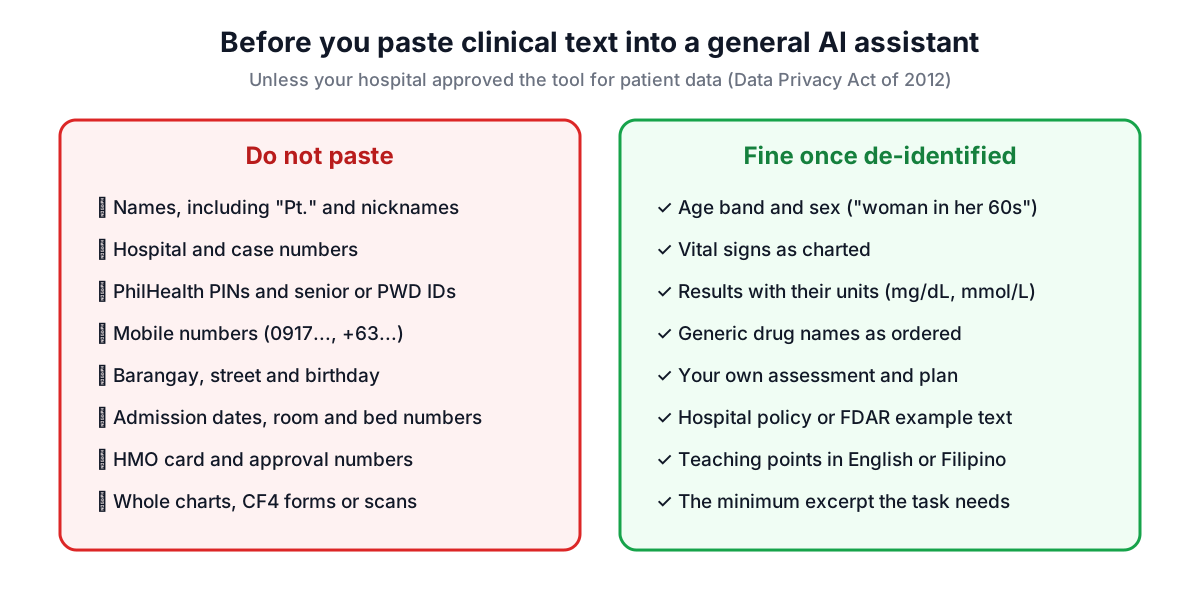
A consumer chatbot account is not a processor your hospital has engaged, and the patient did not consent to it. So the rules at the bedside are simple:
- Use only an AI tool your hospital or clinic has approved for patient data.
- Otherwise de-identify first, and paste only the excerpt the task needs.
- Nurses carry the same duty of confidentiality through the Code of Ethics the Board of Nursing adopts under the Philippine Nursing Act of 2002.
Masking a Philippine note
Both kits have a masking helper that runs in your browser. A made-up admission note:
Patient: Rosario Bautista, 64F, PhilHealth PIN 01-234567890-1, admitted 11/03/2026, Brgy. San Isidro, 0918 765 4321, FBS 186 mg/dL, HbA1c 8.4%.
becomes:
Patient: [NAME-1], 64F, PhilHealth PIN [RECORD-ID-1], admitted [DATE-1], Brgy. San Isidro, [PHONE-1], FBS 186 mg/dL, HbA1c 8.4%.
The name, PhilHealth PIN, date and mobile number go; the age, sex and results stay because the draft needs them. The barangay stays too, and in a small municipality a barangay plus age and diagnosis can point to one person, so delete it by hand.
Philippine charts have a habit that defeats pattern-based masking. The same patient written the way many notes are written:
Pt. Rosario Bautista, 64F, room 312, daughter Liza on 09187654321.
becomes:
Pt. Rosario Bautista, 64F, room 312, daughter Liza on [PHONE-1].
Only the mobile number is caught. "Pt." is not a title the helper knows, and a first name like "Liza" on its own is never caught. Read every masked text before you paste, and delete names, nicknames, room and bed numbers yourself.
Worked prompts in the Philippines kits
A clinical summary for a PhilHealth claim. The US prior authorization template becomes Philippine paperwork: with the region set to the Philippines, the doctors' kit frames the draft as the clinical summary for PhilHealth Claim Form 4, or as a request to the patient's HMO, whichever your notes name. It ties every statement to the chart and never states case rates or benefit amounts from memory. You enter codes and amounts from PhilHealth's current lists yourself.
Generic names. The Generics Act of 1988 (Republic Act No. 6675) requires prescriptions to use the generic name, with the brand name optional. The kits tell the model to write medicines by generic name as your source gives them and to keep doses, routes and units exactly as written. Lab values stay in the units your laboratory reports (many Philippine labs report glucose in mg/dL); the model is told never to convert them.
FDAR charting. If your ward charts in FDAR (focus, data, action, response), paste one de-identified example and ask the nurses' kit to keep that structure:
## Task
Turn these jottings into an FDAR entry in the format of the example. Keep times, vital signs and medicine names exactly as written.

## Constraints
- Never add an assessment, action or response that is not in the jottings. Write [MISSING] for a gap.
- Use the 24-hour time the ward uses.

Example entry: (paste a de-identified FDAR entry from your ward)
Jottings: (paste de-identified shift notes)
A made-up entry such as "FDAR 11/05/2026 22:00 Mr. Ramon Garcia, bed 7: F: risk for bleeding (dengue, day 5). D: platelet 48,000/uL, BP 100/70..." comes back from the helper as "FDAR [DATE-1] 22:00 Mr. [NAME-1], bed 7: ...", with the bed number still there for you to remove.
Teaching in Filipino. Discharge instructions for a dengue patient going home, or for a newly diagnosed diabetic, are often better understood in Filipino or Taglish. Ask for the teaching points in English first, check them, then ask for a Filipino version at a simple reading level and have a Filipino-speaking colleague read it once. Warning signs and where to go come from your hospital's own handout, not from the model.
Board review. The nurses' practice-question template matches the style you describe for the Philippine Nurse Licensure Examination or the NCLEX, points to official review materials from the Professional Regulation Commission or the foreign examining body, and never claims to reproduce real items. Check every answer and rationale against your review books.
Review before you sign
- Line up the facts in the draft against the chart. Look for additions as well as omissions.
- Check numbers character by character. Doses, units, platelet counts and times are where a plausible error does harm.
- Generic names and units match the order and the lab report.
- Anything cited (a DOH memorandum, a PhilHealth circular, a society guideline) is checked in the source or deleted.
- Patient-facing text is read as the patient or the family would read it, in the language they will use at home.
If the review takes longer than writing the note yourself, drop that template.
A four-week start
| Week | What to do |
|---|---|
| 1 | Ask your Data Protection Officer or medical records section which AI tools are approved and for what data. |
| 2 | Use templates with no patient data: a teaching handout, a PICO question, practice questions for review. |
| 3 | Add one de-identified task, such as a referral letter. Note what the masking helper missed. |
| 4 | Keep the templates that saved time after review and share them with your unit. |
Tools for this job
- AI Prompts for Doctors (Philippines): SOAP notes, referral letters, CF4 clinical summaries and handouts with generic names.
- AI Prompts for Nurses (Philippines): SBAR handoffs, FDAR-style charting, care plans, teaching and board review.
- Readability Checker: check that an English handout came back at the level you asked for.
The US edition of this guide covers HIPAA, which matters if you also chart for US clients as a remote nurse or medical scribe.
Frequently asked questions
Is it legal to paste patient information into ChatGPT in the Philippines?
Health information is sensitive personal information under the Data Privacy Act, and processing it is prohibited unless an exception applies, such as specific prior consent or medical treatment with adequate protection. Use a tool your hospital has approved, or remove every identifier first.
Will AI write medicine names the way the Generics Act requires?
The Philippines setting tells it to write medicines by generic name as your notes give them, with the brand name only if you included one, and never to change a dose or route. You still check every line.
Can AI fill in PhilHealth Claim Form 4 for me?
It can draft the clinical summary from your notes in the form's structure. Codes, case rates and amounts must come from PhilHealth's current issuances, and you are responsible for every entry.
Does the masking helper catch "Pt." names?
No. It catches names after "Patient:" or a title such as Mr., Mrs. or Dr., but not after "Pt." and never a first name alone. Delete those by hand.
Sources and further reading
- Republic Act No. 10173: Data Privacy Act of 2012, Lawphil (Arellano Law Foundation). Sections 3(l), 13 and 14.
- Republic Act No. 6675: Generics Act of 1988, Lawphil. Prescriptions written by generic name.
- Republic Act No. 9173: Philippine Nursing Act of 2002, Lawphil. The Code of Ethics for registered nurses.
- Downloads: claim forms, PhilHealth. Claim Form 3 and Claim Form 4.
- Professional Regulatory Boards, Professional Regulation Commission. Board of Medicine and Board of Nursing.
- Ethics and governance of artificial intelligence for health, World Health Organization. Principles for clinical use of AI.
Open the AI Prompts for Doctors
More AI for Professions
Every tool in the AI for Professions section, free and in your browser.